

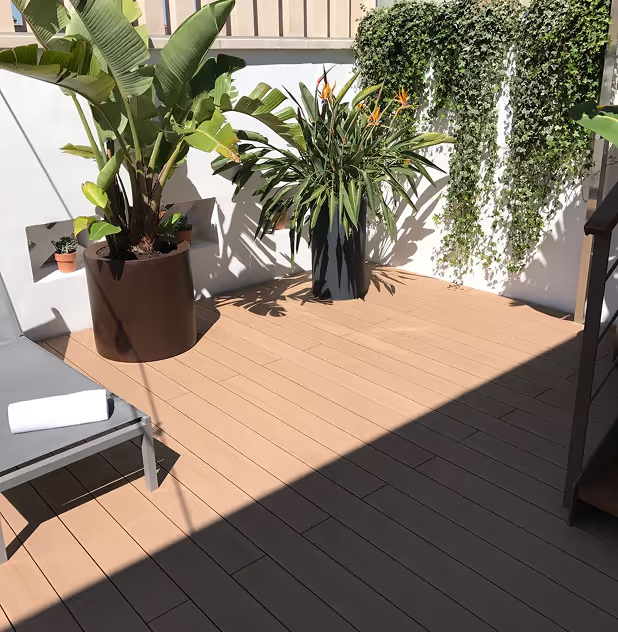
The lowest-maintenance decking in Canada needs no staining, sealing, or sanding — just an occasional wash with soap and water. A wood deck costs you a sand-stain-seal weekend every year or two; capped composite and stone composite ask for a bucket of soapy water twice a season, and they hold their colour through freeze-thaw.
Short answer: The lowest-maintenance decking in Canada needs no staining, sealing, or sanding — just an occasional wash with soap and water. A wood deck costs you a sand-stain-seal weekend every year or two; capped composite and stone composite ask for a bucket of soapy water twice a season, and they hold their colour through freeze-thaw.
You have probably noticed that "low-maintenance" gets stamped on almost every deck board sold in Canada — and the phrase hides a huge range of real-world effort. A pressure-treated pine deck and a mineral stone-composite board are both technically "decking," yet one demands a weekend of sanding and sealing every couple of years, and the other asks for a bucket of soapy water twice a season. We distribute Tarimatec stone composite across Canada, and the questions we field most aren't about colour — they're from homeowners worn out by the upkeep their last deck demanded. So this guide cuts through the marketing and shows you exactly what maintenance each material actually costs you in a Canadian climate, where the line really falls between "low" and "no," and how to keep a deck looking new through freeze-thaw winters and high-UV summers. (If it's the capped-composite-versus-PVC head-to-head you're after, we put those two in the ring in our composite decking vs PVC comparison — here, we're focused on the maintenance reality itself.)
Think about the last time you reached for a deck board's care instructions. If they ran longer than "rinse it," you were not looking at a low-maintenance deck. In practical terms, low-maintenance decking means you never have to stain, seal, paint, or sand the surface to keep it weatherproof. Where a wood deck relies on a sacrificial finish that breaks down and must be reapplied, a true low-maintenance board carries its colour and weather protection inside the material itself. Your entire care routine collapses down to periodic cleaning — usually warm water, a soft brush, and a mild soap.
We see the gap play out every spring. Picture the homeowner in suburban Ontario who blocks out the Victoria Day long weekend the way other people block out a dentist appointment: belt sander, palm sander for the rail spindles, a gallon of semi-transparent stain, and a forecast they're praying holds for 48 hours. That is the ritual a wood deck quietly signs you up for. The neighbour with capped boards spends that same Saturday morning with a hose and is at the lake by noon. Same square footage, completely different weekend — and that is the whole point of the category.
Here is the honest hierarchy, because "low-maintenance" and "no-maintenance" are not the same thing:
Notice that nothing is truly zero-maintenance. Anything outdoors in Canada collects pollen, dust, leaf tannins, and the grime that comes off boots and barbecues. The difference is whether maintenance means "rinse it occasionally" or "block out a weekend and buy a gallon of sealer."
If you have ever owned a wood deck, you already know where this section is going — you've lived the sander and the stain tray. The table below lines up the materials sold in Canada across the factors that actually drive long-term effort and cost, so you can see what each one asks of you over the years you'll own it. Stone composite is broken out as its own tier rather than lumped in with standard wood-plastic composite (WPC), because its mineral-rich makeup behaves differently — especially through freeze-thaw cycles.
| Factor | Pressure-treated / cedar wood | Capped WPC composite | PVC (cellular) | Stone composite (Tarimatec) |
|---|---|---|---|---|
| Cleaning effort | High — scrub, brighten, often pressure wash | Low — soap, water, soft brush 2–3×/yr | Low — soap and water 2–3×/yr | Lowest — soap and water; dense surface sheds dirt |
| Staining / sealing | Required every 1–3 years | Never | Never | Never |
| Sanding / splinters | Periodic sanding; splinter risk | None | None | None |
| UV fade resistance | Greys quickly without finish | Good (capstock-dependent) | Good to very good | Very good — engineered for high-UV summers |
| Mould / mildew tendency | High (organic, porous) | Low (cap resists; uncapped edges vulnerable) | Very low (no organic surface food) | Very low — dense, mineral-rich, low water uptake |
| Moisture & freeze-thaw behaviour | Absorbs water, swells, cracks, rots | Some movement; hollow cores can trap water | Low absorption; can expand/contract with heat | Mineral content resists swelling & freeze-thaw movement |
| Typical lifespan | 10–15 years (with upkeep) | 20–30 years | 25–30 years | 25+ years; 100% recyclable at end of life |
| Warranty | None on the wood itself | Often 25 years (limited) | Often 25–30 years (limited) | 25-year warranty |
| Upfront cost (CAD/sq ft, material) | ~$3–$8 | ~$9–$16 | ~$15–$25 | Premium tier (quote-direct) |
Pricing reflects typical 2026 Canadian material-only ranges and varies by region, board profile, and retailer; installed costs run substantially higher. To pressure-test the numbers for your own deck size, the CAD cost calculator gives an instant estimate. For a broader category ranking of brands and tiers, our guide to the best composite decking in Canada goes deeper.
Wood is the cheapest entry point and, for cedar especially, genuinely beautiful when new. But it is organic, porous, and hungry for water — exactly the wrong combination for a Canadian climate that cycles between soaking spring melt, baking summer UV, and repeated winter freeze-thaw. Here is the labour nobody quotes you on day one: left unfinished, pressure-treated pine greys within a season and starts checking and cracking; cedar silvers and can cup. To hold its appearance and resist rot, wood needs cleaning plus a fresh coat of stain or sealer every one to three years, and periodic sanding to manage the splinters that turn a barefoot summer deck into a hazard. Over a 25-year horizon, that is potentially a dozen re-finishing cycles — a closet full of half-used stain cans and a dozen long weekends you never get back. That is the bill "cheap" wood quietly defers onto your future self.
Modern capped composite wraps a wood-fibre-and-plastic core in a hard polymer shell (the "cap" or capstock). That shell is what eliminated the staining, sealing, and splinter problems of older uncapped composites. It is a legitimately low-maintenance product: wash it a few times a year and it stays looking good for decades — no sander, no stain tray, no lost weekend. Two honest caveats. First, many WPC boards still contain wood fibre, so any exposed cut ends or uncapped underside can absorb moisture and host mould in damp, shaded spots — the kind of corner that never quite dries out behind a Vancouver Island fern. Second, some composite boards are hollow or ribbed underneath; those internal channels can trap water and debris if drainage is poor. Capping solved the surface; it did not change what is inside the board.
Cellular PVC takes wood out of the equation entirely — it is all plastic, so there is no organic material for mould or rot to feed on, and water absorption is very low. For maintenance, that is a real strength in wet, shaded zones. Its trade-offs are a more uniform, sometimes "plastic" look that not everyone loves, higher thermal movement, and a price that sits at the top end of the market. We keep it brief here on purpose: if you want the full capped-composite-versus-PVC breakdown — heat, expansion, feel underfoot, cost — we run that comparison properly in our composite decking vs PVC guide.
Stone composite is a distinct category from standard WPC, and it is where Tarimatec's Ecofiber technology sits. Instead of wood fibre, the board is built from rice husk — an agricultural by-product — at 50 parts for every 100 parts of PVC, roughly a quarter of the blend by weight per the EPD, blended with ground limestone. That mineral loading does two things that matter intensely for maintenance in Canada. It gives the board real dimensional stability, so it resists the swelling and freeze-thaw movement that splits wood and stresses some composites. And it produces a dense body with no hollow-core channels to trap melt-water or grit, which is a major reason mould and staining struggle to take hold. Engineered in Spain by Plásticos Viters S.A. (a manufacturer with 70+ years of experience) and selected for Canadian weather — not made in Canada, and we won't pretend otherwise — Tarimatec is the composite decking range Zinodeck distributes exclusively here. It pairs that performance with an EPD verified by Tecnalia, ISO 14001 manufacturing, a 25-year warranty, and 100% recyclability, across 31 colours and finishes in the Chromatic, Wood, and Ethnic collections — including the anti-slip Surco groove built for wet and poolside decks.
If your deck spends January under snow, this is the maintenance factor that should worry you most — and it is the one nobody mentions in the showroom. It explains why two boards marketed identically as "composite" can age completely differently on your property. Water that pools inside a hollow or ribbed board does not simply drain and disappear in our climate — it freezes. When water freezes it expands by about 9%, and that expansion exerts force on whatever contains it. Repeat that cycle dozens of times each winter, season after season, and trapped moisture becomes a slow mechanical wedge that can stress board walls, worsen movement, and create persistently damp pockets where mould thrives out of sight — the kind you only discover when you finally lift a board.
Picture a cottage deck in Muskoka, closed up and left untended from Thanksgiving to the May long weekend. Nobody is there to sweep the snow or clear the gaps; meltwater seeps in, refreezes overnight, thaws by afternoon, and does it again for five months straight. A dense, solid-bodied board sidesteps the whole problem because there is nowhere for water to collect and freeze internally. Tarimatec's mineral-rich stone composite is engineered for exactly this: low water uptake, no internal channels, and the dimensional stability to ride out the expansion-and-contraction punishment that defines a Canadian deck's life from October through April. Less trapped water means less mould, less movement, and less for you to fix in spring — which is the whole point of buying low-maintenance in the first place.
So what does the upkeep actually look like across your year? Here is a realistic, climate-appropriate routine for any composite or stone-composite deck in Canada. Follow it and you will spend a few hours a year, not a few weekends — and you will never touch a sander or a can of stain.
This is where a Halifax deck earns its keep — salt off the harbour all summer, then a winter of wet snow and freeze-thaw that would have a wood deck checking by March. Capped and stone-composite boards take it in stride, as long as you clear snow the right way:
That is the entire program. No sanding, no staining, no sealing — just seasonal cleaning and sensible snow habits. It is the routine that low-maintenance decking was supposed to deliver all along.
Before you assume low-maintenance means no compromises, here are the real trade-offs to weigh — because pretending otherwise would do you no favours, and you deserve to go in clear-eyed.
Stone composite addresses the durability and moisture concerns better than most of the category, but the heat-in-dark-colours and higher-upfront-cost realities apply to it too. Going in clear-eyed is how you end up happy with the deck a decade later, instead of surprised by it.
So where does your own deck land? Match the material to how you actually live and where you build — and be honest with yourself about how much weekend labour you are truly willing to give a deck:
Whichever way you lean, the smartest first step is to feel the material in your own hands and your own light. You can order samples of Tarimatec online before committing to full boards, which go through a quick quote-direct process. And if you are weighing the big North American brands, our best Trex alternatives in Canada comparison puts stone composite head-to-head with the names you already know.
Yes. A mild dish soap like Dawn mixed with warm water is one of the safest, most effective ways to clean composite and stone-composite decking. Apply it with a soft-bristle brush, scrub along the length of the boards, and rinse thoroughly with a garden hose so no soapy film is left to dry on the surface. For most Canadian decks, this two-to-three-times-a-year soap-and-water wash is the entire cleaning routine.
Avoid abrasive tools and harsh chemicals: steel wool, wire brushes, metal scrapers, and metal snow shovels can scratch the surface, while bleach, acetone, and strong solvents can discolour or dull some boards. Skip oil-based wood soaps such as Murphy Oil Soap, which are formulated for sealed timber and can leave a residue on composite. If you pressure wash, use a wide fan tip, keep the pressure low (well under 1,500 psi), and stay back from the surface to avoid etching it. When in doubt, mild soap and water is always safe.
Diluted white vinegar is generally safe and is a common home remedy for light mildew and water spots on composite — mix it with water, apply, let it sit briefly, then rinse well. That said, vinegar is acidic, so do not use it full-strength or leave it to dry on the boards, and avoid it on surfaces where the manufacturer specifies a particular cleaner. For routine cleaning, plain soap and water remains the gentlest and most reliable choice.
Start with soap, water, and a soft brush. For established mould or mildew, a diluted vinegar solution or a dedicated composite-deck cleaner labelled for mould works well — apply, give it a few minutes, scrub gently, and rinse thoroughly. Improve drainage and airflow in the affected spot and clear any trapped leaf debris, since standing moisture is what feeds mould in the first place. Dense stone-composite boards resist mould better than wood or hollow-core composites because they hold far less water and have no internal channels for it to collect in.
Use a plastic or poly snow shovel — never metal — and push the snow parallel to the boards rather than scraping across them. Leaving a thin layer instead of scraping hard to the surface protects the board and reduces scratching. If you need traction, use calcium chloride or a deck-safe ice melt sparingly rather than harsh rock salt, and rinse any residue off in spring. For steps and wet areas, an anti-slip finish like Surco reduces your reliance on de-icers altogether.
Quality capped composite and PVC decking typically lasts 25–30 years in Canadian conditions, far outlasting an untreated wood deck's roughly 10–15 years. Stone composite is built for 25-plus years and is backed by a 25-year warranty, with the added benefit of being 100% recyclable at the end of its life. Lifespan depends heavily on the climate factors that punish a deck here — freeze-thaw cycles, UV, and trapped moisture — which is exactly where a dense, mineral-rich, freeze-thaw-stable board outperforms wood and hollow-core composites.
Or go straight to the range: Tarimatec composite decking in Canada · technical data for architects and specifiers · order decking samples.
{"@context":"https://schema.org","@type":"FAQPage","mainEntity":[{"@type":"Question","name":"Can I use Dawn dish soap to clean composite decking?","acceptedAnswer":{"@type":"Answer","text":"Yes. A mild dish soap like Dawn mixed with warm water is one of the safest, most effective ways to clean composite and stone-composite decking. Apply it with a soft-bristle brush, scrub along the length of the boards, and rinse thoroughly with a garden hose so no soapy film is left to dry on the surface. For most Canadian decks, this two-to-three-times-a-year soap-and-water wash is the entire cleaning routine."}},{"@type":"Question","name":"What should you not use on composite decking?","acceptedAnswer":{"@type":"Answer","text":"Avoid abrasive tools and harsh chemicals: steel wool, wire brushes, metal scrapers, and metal snow shovels can scratch the surface, while bleach, acetone, and strong solvents can discolour or dull some boards. Skip oil-based wood soaps such as Murphy Oil Soap, which are formulated for sealed timber and can leave a residue on composite. If you pressure wash, use a wide fan tip, keep the pressure low (well under 1,500 psi), and stay back from the surface to avoid etching it. When in doubt, mild soap and water is always safe."}},{"@type":"Question","name":"Does white vinegar damage composite decking?","acceptedAnswer":{"@type":"Answer","text":"Diluted white vinegar is generally safe and is a common home remedy for light mildew and water spots on composite. Mix it with water, apply, let it sit briefly, then rinse well. That said, vinegar is acidic, so do not use it full-strength or leave it to dry on the boards, and avoid it on surfaces where the manufacturer specifies a particular cleaner. For routine cleaning, plain soap and water remains the gentlest and most reliable choice."}},{"@type":"Question","name":"How do you remove mould from composite decking?","acceptedAnswer":{"@type":"Answer","text":"Start with soap, water, and a soft brush. For established mould or mildew, a diluted vinegar solution or a dedicated composite-deck cleaner labelled for mould works well: apply, give it a few minutes, scrub gently, and rinse thoroughly. Improve drainage and airflow in the affected spot and clear any trapped leaf debris, since standing moisture is what feeds mould in the first place. Dense stone-composite boards resist mould better than wood or hollow-core composites because they hold far less water and have no internal channels for it to collect in."}},{"@type":"Question","name":"How do you remove snow from a composite deck in winter?","acceptedAnswer":{"@type":"Answer","text":"Use a plastic or poly snow shovel, never metal, and push the snow parallel to the boards rather than scraping across them. Leaving a thin layer instead of scraping hard to the surface protects the board and reduces scratching. If you need traction, use calcium chloride or a deck-safe ice melt sparingly rather than harsh rock salt, and rinse any residue off in spring. For steps and wet areas, an anti-slip finish like Surco reduces your reliance on de-icers altogether."}},{"@type":"Question","name":"How long does composite decking last in Canada?","acceptedAnswer":{"@type":"Answer","text":"Quality capped composite and PVC decking typically lasts 25 to 30 years in Canadian conditions, far outlasting an untreated wood deck's roughly 10 to 15 years. Stone composite is built for 25-plus years and is backed by a 25-year warranty, with the added benefit of being 100% recyclable at the end of its life. Lifespan depends heavily on the climate factors that punish a deck here, namely freeze-thaw cycles, UV, and trapped moisture, which is exactly where a dense, mineral-rich, freeze-thaw-stable board outperforms wood and hollow-core composites."}}]}