

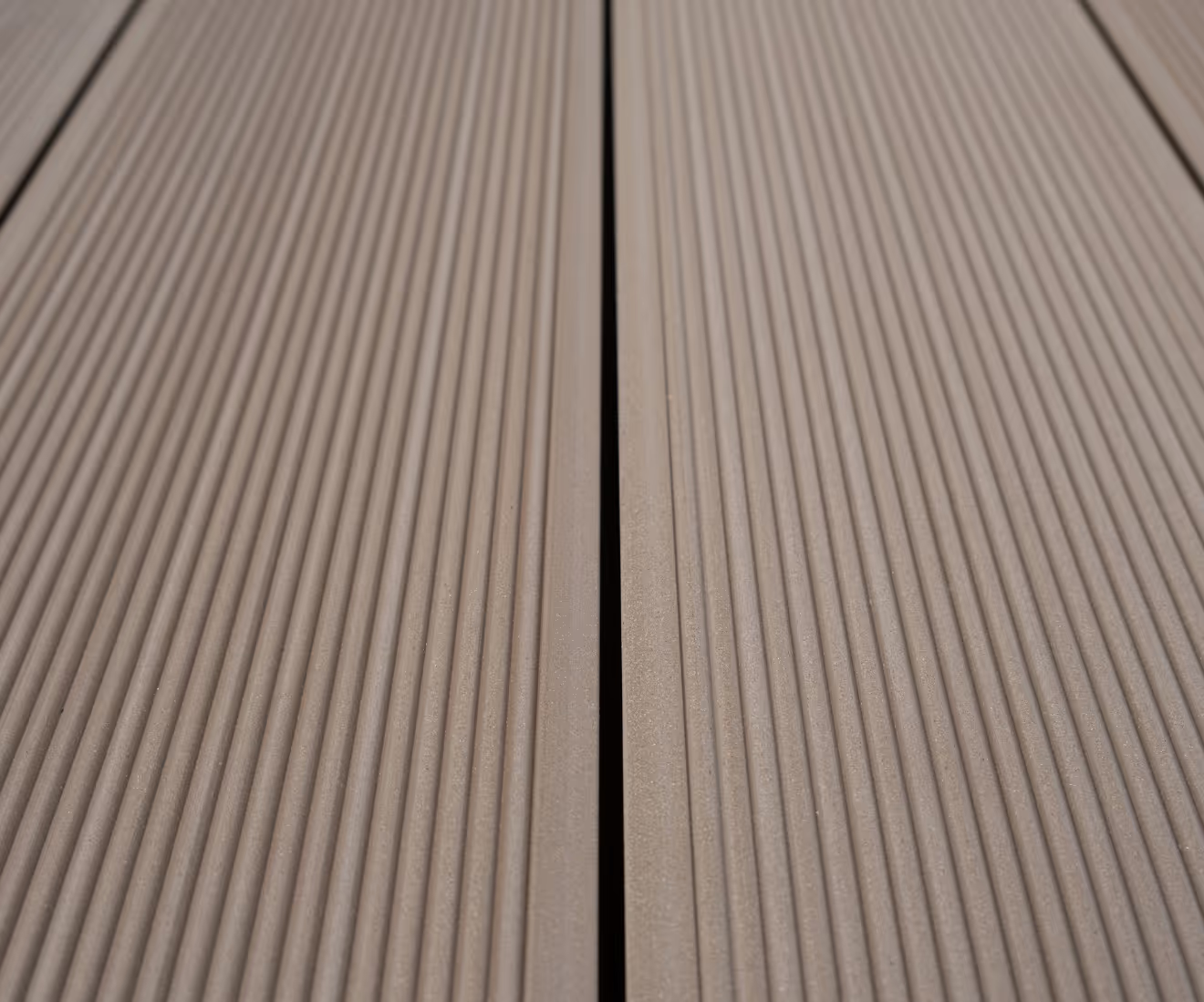
For most Canadian decks, capped composite gives you a solid, natural feel while cellular PVC runs cooler but moves more and can sound hollow underfoot. Tarimatec stone composite splits the difference — a dense mineral board that resists moisture and freeze-thaw movement, with a verified EPD.
Short answer: For most Canadian decks, capped composite gives you a solid, natural feel while cellular PVC runs cooler but moves more and can sound hollow underfoot. Tarimatec stone composite splits the difference — a dense mineral board that resists moisture and freeze-thaw movement, backed by a verified EPD.
We supply decking across Canada — from Halifax waterfronts to Winnipeg backyards — and we work alongside the builders who install it, so we end up quoting both composite and PVC on the same project all the time. The honest truth is that this isn't a one-winner contest. The board that's right for a shaded Vancouver Island patio isn't the one we'd put on a south-facing rooftop in downtown Toronto. So here's the comparison the way we'd talk you through it on a site visit: what each material is, how each behaves in heat and cold, how it feels underfoot, what it costs, and where the documentation stops at a brochure. And because most buyer's guides only show you two-thirds of the menu, we'll be straight about a third category — stone composite — that sits between them.
You've probably seen "composite or PVC" framed as the whole decision, and if that's all anyone's shown you, you've been shown two-thirds of the menu. There are really three families on the table, and the difference between them is what's inside the board.
Capped wood-plastic composite (WPC) wraps a core of wood fibre and recycled plastic in a hard polymer shell — the "cap" or capstock. That shell is what eliminated the staining, sealing, and splintering of older uncapped boards, and it's why a quality capped board feels solid and reads natural underfoot. The catch lives in the core: there's still wood fibre in there, and wood fibre drinks moisture wherever the cap is breached — a cut end, a screw hole, an uncapped underside.
Cellular PVC takes wood out of the recipe entirely. It's all polymer, so there's no organic material for mould or rot to feed on and water absorption is very low — a genuinely strong moisture performer. The trade-offs are a lighter board that moves more with temperature, a surface some people find reads "plastic," and a price that usually sits at the top of the market.
Stone composite is the third path, and it's the category Tarimatec's Ecofiber formula sits in. Instead of leaning mainly on wood flour and plastic, it binds rice husk at 50 parts for every 100 parts of PVC — about a quarter of the blend by weight — with ground limestone in a dense, mineral-rich matrix. It isn't WPC and it isn't PVC — it's a different recipe that changes how the board behaves in exactly the ways a Canadian climate cares about. We'll come back to it under each test.
Walk a south-facing Toronto deck off a west-end alley on a cloudless July afternoon and you'll feel the thing every spec sheet is trying to describe. A dark board in full sun can climb past 60°C — hot enough that bare feet do that little hop to the nearest shade and the dog refuses it outright. Heat underfoot is the single most physical difference between these materials, and it's where the marketing gets loudest.
This is the column PVC likes to lead with, and fairly: cellular PVC generally runs a few degrees cooler than a comparable dark composite, because the foamed polymer doesn't hold heat the same way a denser, wood-filled board does. If barefoot comfort on a blazing rooftop is your top priority, that's a real point in PVC's favour and we won't pretend otherwise. Capped WPC, with wood fibre in the core and often a darker capstock, tends to sit at the warmer end of the three.
Stone composite lands in between, and the mineral content does the work — it resists heat build-up better than many wood-fibre composites we've handled, while staying a denser, more substantial board than foamed PVC. The honest caveat we give everyone: colour beats chemistry on a heatwave. A light or mid-tone board of any of the three materials will be far kinder to bare feet than a deep charcoal, and no decking on earth stays cool when it's 33°C and cloudless. If you're set on a dark tone for a full-sun deck, plan for it — that's true of composite and PVC alike.
Picture a Calgary deck in February. A chinook rolls in and the temperature jumps 20°C in a single afternoon — the surface goes from frozen to thawed and back before dinner. That daily expand-and-contract is exactly what wears a deck down over a decade, and here the heat-versus-movement story flips on its head: the same low density that helps PVC stay cool is also what makes it move the most.
Cellular PVC has the highest thermal expansion and contraction of the three. It's a lighter, all-polymer board, and polymer grows and shrinks with temperature — which is why PVC installations live or die on gapping. Get the spacing right and it's fine; get it tight and a hot afternoon has nowhere to send that expansion. Capped WPC moves less than PVC but still carries the wood fibre that, once it takes on water, expands a little more with every freeze-thaw cycle — which over enough winters is how you get the cupping and the gaps builders get called back to look at.
Stone composite is engineered to move the least of the three. The mineral matrix gives it real dimensional stability, so it rides out the chinook swing — and the wider Canadian expand-and-contract punishment from October through April — with less movement than either wood-fibre composite or PVC. One caveat we'll always give, because it's true of every board on the table: the material can only do its half. Whatever you choose, follow Canadian board-spacing and hidden-fastener guidance so the deck has room to breathe. We've seen a great board telegraph a bad install far more often than the other way around — leave too little gap and even the most stable stone composite has nowhere to go.
Cottage country tells this story plainly. A Muskoka or Kawarthas deck sits empty through the worst of winter, then spring melt arrives and the water has nowhere to go but down — pooling under the boards, soaking into anything that wicks, then refreezing on the next cold night. Here's what actually goes wrong: the moisture got in months ago, and the April thaw is just when you finally see it. This is the test that quietly decides how a deck looks in year three, and it's where the inside of the board matters most.
On pure water resistance, PVC and stone composite both pull ahead of standard capped WPC, for the same underlying reason — neither leans on wood fibre, so neither has a hungry core waiting at every cut end. Capped WPC is well protected on its surface, but the cap can be breached, and once water reaches the wood fibre through a scratch or an uncapped edge, freeze-thaw turns that trapped moisture into a slow mechanical wedge. Water expands about 9% when it freezes; repeat that cycle dozens of times a winter and it stresses board walls and feeds mould in damp pockets out of sight.
There's a second moisture trap worth naming, because two boards sold as the same thing can age completely differently: many composite and some PVC boards are hollow or ribbed underneath, and those channels collect meltwater and grit when drainage is poor. Tarimatec's stone composite is a dense, solid-bodied board — no hollow core for water to pool and freeze in, and very low water uptake to begin with. Less water in, less movement, fewer surprises in year three. Picture a Halifax waterfront deck taking salt spray off the harbour all summer and freeze-thaw all winter — about the most punishing combination Canada serves up. A board that simply doesn't drink that water is the difference between opening the season to a deck and opening it to a project. (If your deck sits over living space, none of these boards is a waterproofing system on its own — water still drains between the planks, so you'll want a membrane underneath regardless of material.)
You won't read a spec sheet every morning — you'll feel the deck. And the three materials feel genuinely different underfoot, which is the part photos can't tell you and the reason we push samples so hard.
Capped WPC feels solid and substantial, closest to the heft of real wood, with a surface that reads natural in daylight — that density is its calling card. Cellular PVC is noticeably lighter, and on some board-and-substructure combinations it can sound a little hollow or feel slightly less planted; plenty of people don't mind it, but it's the most common thing we hear when someone stands on PVC after composite. Stone composite is the densest of the three — the mineral loading gives it real weight and a planted, quiet feel, with the moisture and stability behaviour to match.
Think about a downtown Toronto condo balcony over a membrane, where every board lands on a pedestal or sleeper rather than solid joists. That's exactly the setup where a hollow-sounding board announces itself with every step, and where a dense board feels reassuringly solid. It's also where format matters: stone composite comes in both plank and tile, and the tiles drop straight onto a pedestal system over the membrane — a tidy answer to a balcony that a standard backyard board doesn't solve as cleanly.
Here's the whole field on one screen. If you read nothing else, read across the row for the climate factor that worries you most — because for a Canadian build, that's the variable that should pick the board.
| Factor | Capped composite (WPC) | Cellular PVC | Tarimatec stone composite |
|---|---|---|---|
| Heat retention | Warmest of the three; wood-filled core holds heat, darker caps add to it | Coolest; foamed polymer sheds heat best | In between; mineral content resists heat build-up |
| Thermal movement | Moderate; less than PVC, more than stone | Highest; gapping is critical on install | Lowest; mineral matrix is dimensionally stable |
| Moisture / freeze-thaw | Good surface, but wood fibre wicks at breached edges | Very low absorption; no organic core | Very low uptake; dense, solid body, no hollow trap |
| Feel underfoot | Solid, natural, wood-like heft | Lighter; can sound hollow on some assemblies | Densest; planted and quiet |
| Relative cost | Mid-range of the three | Top of the market | Premium tier (quote-direct) |
| Verified sustainability | Self-reported recycled content | Self-reported; all-plastic body | EPD verified by Tecnalia; ISO 14001; PVC : rice husk : limestone at 100:50:40 parts, 33% recovered composite, 100% recyclable |
One word on the cost row, because it's the one buyers read fastest. On materials, capped composite generally sits mid-range, cellular PVC at the top end, and stone composite in the premium tier — but the cheque you write on install day isn't the whole story. Substructure and labour do a lot of quiet work, and a deck over a tricky grade or a rooftop membrane costs more to build right no matter whose board sits on top. Where these synthetics earn their keep is total cost of ownership: none of the three ever needs staining, sealing, or sanding, so the wood-deck weekend-and-a-gallon-of-sealer routine simply disappears. You can pressure-test the numbers for your own square footage with our CAD cost calculator before you commit to anything.
Almost every board prints a recycled-content percentage. Far fewer can hand you an independently verified Environmental Product Declaration (EPD) to back it — and on a project where someone is going to ask for documentation, that gap is the whole conversation. A number you can't verify is a marketing claim wearing a lab coat.
This is where composite and PVC tend to land in the same place: both usually publish a self-reported figure, and cellular PVC's all-plastic body means its story leans on recycled polymer rather than diverted by-product. Tarimatec is the outlier on the table, and the credentials are named and verifiable, not decorative: an EPD verified by Tecnalia, ISO 14001 certification, a body built from rice husk at 50 parts for every 100 parts of PVC, roughly a quarter of the blend by weight per the EPD — an agricultural by-product that would otherwise be burned or dumped — plus 33% recovered composite re-used in production, per the EPD, 100% recyclable at end of life, and a 25-year warranty. For a LEED or BREEAM submission, a registered document outweighs the highest self-reported percentage on the shelf. The part nobody mentions until the project review: "up to 95% recycled" with no third party behind it can't always survive a real audit; a registered EPD can. And if your deck is just a backyard project with no specifier in sight, this column may not move your decision an inch — that's fine. We flag it so you know which factor matters for your build and which doesn't.
Strip it back to your priority, because that's what actually decides this. If maximum barefoot coolness on a blazing south-facing rooftop is the thing you can't compromise, cellular PVC has the honest edge on heat — just respect the gapping, because it's also the board that moves the most. If you want a solid, natural, wood-like feel at a friendlier price than PVC, capped composite is the value sweet spot; choose fully capped boards and mind the drainage on the underside. And if your priorities are freeze-thaw stability, low moisture uptake, a dense planted feel, and verified sustainability you can put in front of an architect, Tarimatec stone composite is the one we reach for — it splits the difference between the other two and documents the parts that matter. Yes, we're biased, and the EPD and the cold-climate behaviour are the documented reasons we're biased.
Whatever you're leaning toward, don't choose a deck off a screen. Boards read completely differently in your own backyard light, and they feel completely different under your own feet, than they do in any photo. The smartest next step is to put samples on your actual deck, in your actual sun: order decking samples, explore the decking range, or estimate your project in CAD before you commit to a single board. If you're also weighing the big North American brands, our guide to the best composite decking in Canada puts stone composite head-to-head with the names you already know.
One last point of integrity, because we'd rather you hear it from us: Tarimatec is not made in Canada. It's European-engineered, made in Spain by Plásticos Viters S.A., and selected specifically for Canadian weather — and Zinodeck is its exclusive Canadian distributor, administering its 25-year manufacturer warranty and servicing it from Vaughan, Ontario. Not made here, but supported here, which is the part that decides your week when a board ever needs replacing.
Or go straight to the range: Tarimatec composite decking in Canada · technical data for architects and specifiers · order decking samples.
{"@context":"https://schema.org","@type":"FAQPage","mainEntity":[{"@type":"Question","name":"Is composite or PVC decking better for Canada?","acceptedAnswer":{"@type":"Answer","text":"It depends on your priority. Cellular PVC runs the coolest in full sun but has the highest thermal expansion, so gapping on install is critical, and some find it lighter and a little hollow underfoot. Capped wood-plastic composite feels more solid and natural and costs less, but its wood-fibre core can wick moisture at breached edges, which freeze-thaw cycles then aggravate. Tarimatec stone composite splits the difference: a dense, mineral-rich board that runs between the two on heat, moves the least, resists moisture and freeze-thaw, and carries a Tecnalia-verified EPD. For a cold, freeze-thaw Canadian climate, the dimensional stability and low water uptake of stone composite are why we reach for it most often."}},{"@type":"Question","name":"Does PVC decking get hotter or cooler than composite?","acceptedAnswer":{"@type":"Answer","text":"Cellular PVC generally runs a few degrees cooler than a comparable dark wood-plastic composite, because the foamed all-polymer board holds less heat than a denser, wood-filled one. That said, colour matters far more than material on a hot day: a deep charcoal board of any type can climb past 60 C in full Canadian summer sun, while a light or mid-tone board of the same material stays far kinder to bare feet. If barefoot comfort on a blazing south-facing or rooftop deck is your top priority, choose PVC and a lighter tone, but expect any decking to warm up in direct sun."}},{"@type":"Question","name":"Which moves more, PVC or composite decking?","acceptedAnswer":{"@type":"Answer","text":"Cellular PVC moves the most. As a lighter, all-polymer board it has the highest thermal expansion and contraction of the common decking materials, which is why correct gapping is critical on a PVC install, especially through a temperature swing like a Calgary chinook. Capped composite moves less than PVC but more than stone composite. Tarimatec stone composite moves the least, because its mineral-rich matrix gives it real dimensional stability. Whatever you choose, follow Canadian board-spacing and hidden-fastener guidance so the deck has room to expand and contract through the seasons."}},{"@type":"Question","name":"Is PVC or composite decking more waterproof?","acceptedAnswer":{"@type":"Answer","text":"Both cellular PVC and stone composite resist water better than standard capped wood-plastic composite, because neither relies on wood fibre that can wick moisture at cut ends or scratches. Capped WPC is well protected on the surface, but once water reaches the wood-fibre core through a breach, freeze-thaw cycles can drive swelling and mould. That said, no individual deck board is a waterproofing system on its own. Boards are installed with expansion gaps, so water always drains between them by design. If there is living space below your deck, you still need a vinyl or PVC membrane underneath, regardless of which board you choose on top."}},{"@type":"Question","name":"What is the difference between stone composite and PVC decking?","acceptedAnswer":{"@type":"Answer","text":"Cellular PVC is a 100% plastic board with no organic filler, which keeps it cool and non-absorbent but also light, prone to more thermal movement, and sometimes hollow-feeling underfoot. Stone composite, such as Tarimatec Ecofiber, is a different category: it binds rice husk at 50 parts for every 100 parts of PVC — about a quarter of the blend by weight — with ground limestone in a dense matrix. That mineral loading makes it the densest and most dimensionally stable of the two, with very low water uptake, a planted feel underfoot, and a third-party-verified EPD. PVC tends to win narrowly on surface temperature; stone composite wins on stability, freeze-thaw resistance, and documented sustainability."}},{"@type":"Question","name":"Is composite or PVC decking more expensive in Canada?","acceptedAnswer":{"@type":"Answer","text":"On material cost, cellular PVC usually sits at the top end of the market, capped wood-plastic composite lands mid-range, and stone composite is a premium, quote-direct tier. But the install-day price is not the whole story: substructure and labour vary widely, and a deck over a tricky grade or a rooftop membrane costs more to build right no matter the board. The stronger case for any of these synthetics is total cost of ownership. None of them ever needs staining, sealing, or sanding, so they avoid the repeated refinishing cost that makes cheaper wood expensive over 25 years."}}]}