
.svg)


What a finish actually is
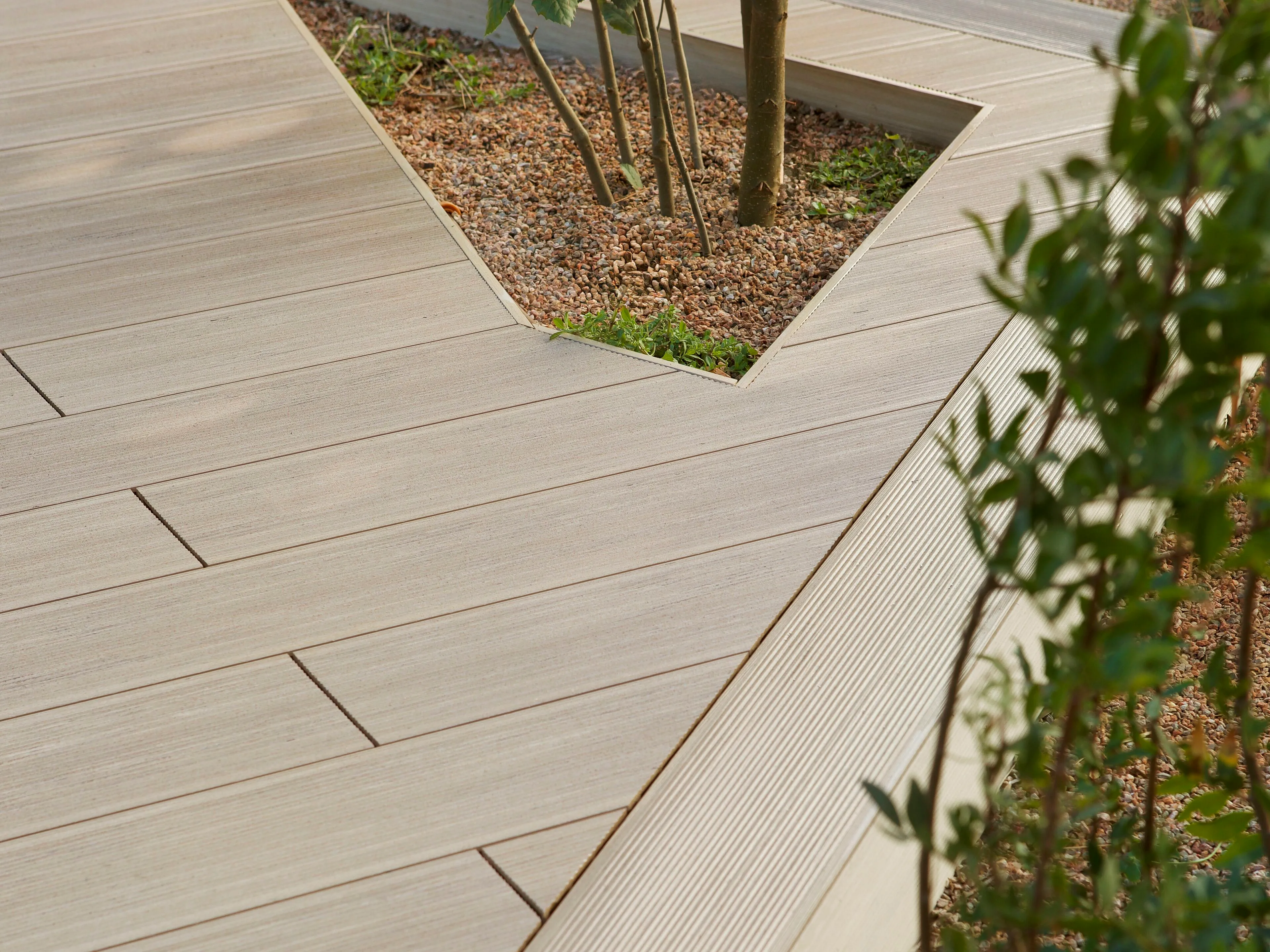
Tarimatec boards are extruded from one PVC-mineral composite: PVC, rice husk and limestone. The colour runs through the board. The finish is the mechanical texture worked into the top face after extrusion, so it cannot peel, flake or wear off the way a surface coating can.
Three finishes are made for the Canadian decking range. A fourth, Sanding, exists in Tarimatec's wider catalogue for vertical products and is not part of the Canadian decking assortment, so it is not shown here.
Tecno, Nature and Surco
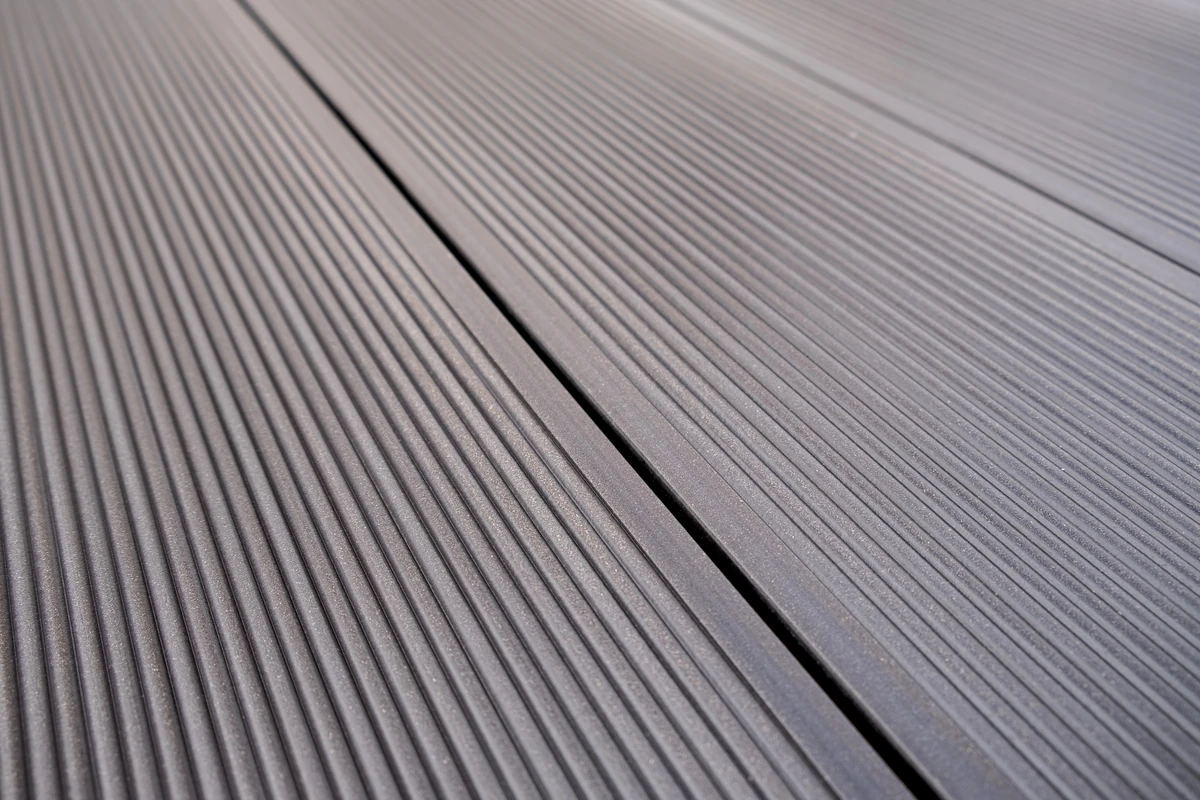
Tecno — grooved
A regular, machine-cut groove running the length of the board. It reads as a crisp, technical, contemporary surface: the most architectural of the three, and the one that suits a modern terrace with straight lines and hard landscaping.
- Underfoot: the ribbing is felt, and it gives the foot something to grip when wet.
- Slip: Class 3, R11 (UNE-ENV 12633).
- Collections: Chromatic.
- Profile: hollow 150 x 27 mm.
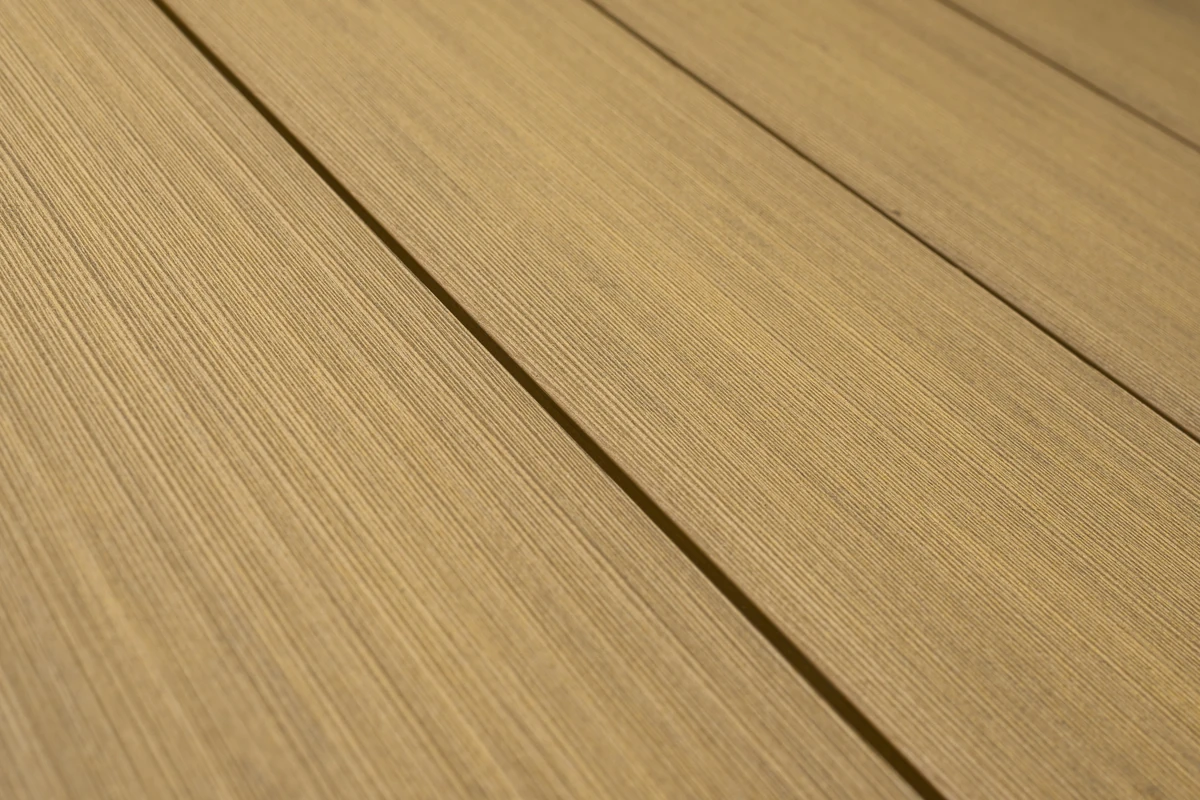
Nature — brushed
A flat face with a fine brushed grain worked into it. Softer and quieter than Tecno, closer to a sanded timber board, and the finish most people expect when they picture a deck. It is also the only finish on the solid profile.
- Underfoot: smooth with a faint grain; the most comfortable barefoot.
- Slip: Class 3 (UNE-ENV 12633).
- Collections: Chromatic and Wood.
- Profile: hollow 150 x 27 mm and solid 149.2 x 20 mm.
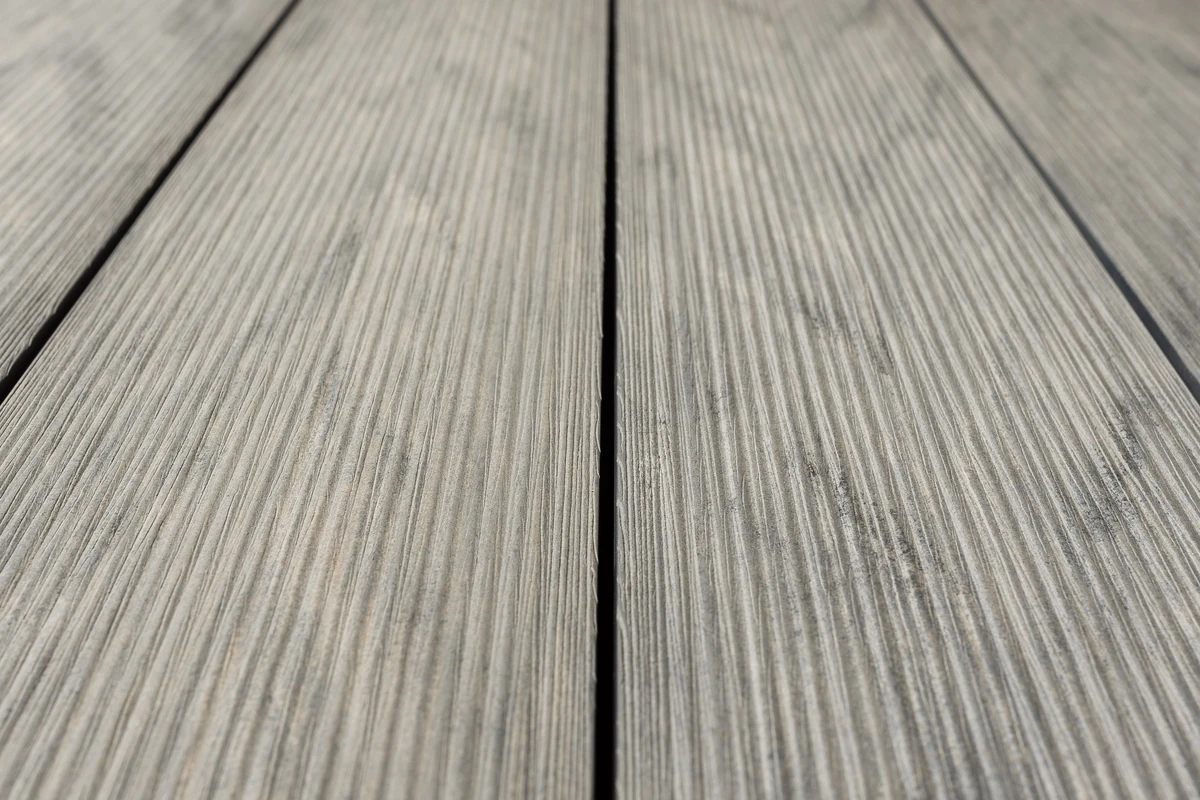
Surco — grooved and brushed
Irregular grooves of varying width, brushed after cutting. The most tactile and the most character-heavy of the three, with real movement across the board face. It carries the Ethnic palette, which is the range designed to be looked at rather than to disappear.
- Underfoot: the most textured; grip you can feel.
- Slip: Class 3 (UNE-ENV 12633).
- Collections: Ethnic.
- Profile: hollow 150 x 27 mm.
The photographs above are macro shots of the three surfaces on real boards — Tecno on Wengue 2204, Nature on Roble 2349, Surco on Antique 2397. All three finishes are Class 3 slip rated to UNE-ENV 12633; the texture changes how grip feels, not the classification.
Which finish for which project
| If the project is | Start with | Because |
|---|---|---|
| A modern terrace with hard landscaping and straight lines | Tecno | The regular groove reads as a designed surface rather than an imitation of timber |
| A family deck used barefoot, or a pool surround | Nature | Smoothest underfoot of the three, and available on the solid profile for heavier traffic |
| A rooftop or courtyard that needs visual warmth and movement | Surco | Irregular grooves and the Ethnic palette give the surface depth at close range |
| A hospitality terrace taking trolleys and daily service | Nature on the solid profile | 46.4 MPa flexural strength and above 20 J impact resistance (UNE-EN ISO 178 / 477) |
| A deck that has to match an existing timber or stone element | Order chips of two finishes | The same colour in two finishes reads as two different materials in daylight |
Browse colours by finish
Each collection carries its own finish. Pick the finish here, then look at the colours that come in it.
Chromatic — Tecno and Nature
Five disciplined flat tones. Moka, Marron, Miel, Wengue and Gris, in either the grooved or the brushed surface.
Wood — Nature
Fourteen timber-referencing tones from Polar to Castano, brushed, and the only collection offered on the solid profile.
Ethnic — Surco
Twelve characterful tones from Blanco Ivory to Preto, in the grooved-and-brushed surface with the most movement.
Finish FAQ
Can a finish wear off?
No. The finish is a texture cut into the body of the board, not a film applied to the top of it, and the colour runs through the material. There is nothing to peel or flake. Do not paint, stain or seal the board: coatings do peel, and they can affect the manufacturer warranty.
Is one finish less slippery than another?
All three are Class 3 to UNE-ENV 12633, with the Tecno grooved surface tested at R11. Texture changes how grip feels underfoot, particularly when wet, but it does not move the classification. If slip is the deciding factor for a pool or a rooftop, ask for the test report with the technical pack.
Which finish is easiest to keep clean?
The flat brushed Nature face has the least texture to hold grit, so it is the quickest to sweep and rinse. Deep-grooved surfaces trap a little more, and are worth brushing along the groove rather than across it. None of them need sealing or oiling.
Can I use two finishes on one deck?
Yes, and it is a good way to separate a dining zone from a walkway. They share the same substructure and the same clip. Order chips of both before committing: the same colour in two finishes can read as two different colours in Canadian light.
What happened to the Sanding finish?
Sanding is part of Tarimatec's wider catalogue for vertical and cladding products, which are not available in Canada. Listing it here would be selling something we cannot supply, so the Canadian decking range is Tecno, Nature and Surco.
A finish has to be held to be chosen
Order chips in two finishes and look at them where the deck will be. Samples are paid, ship from Vaughan in 5 to 10 business days, and the cost is credited against your order.