

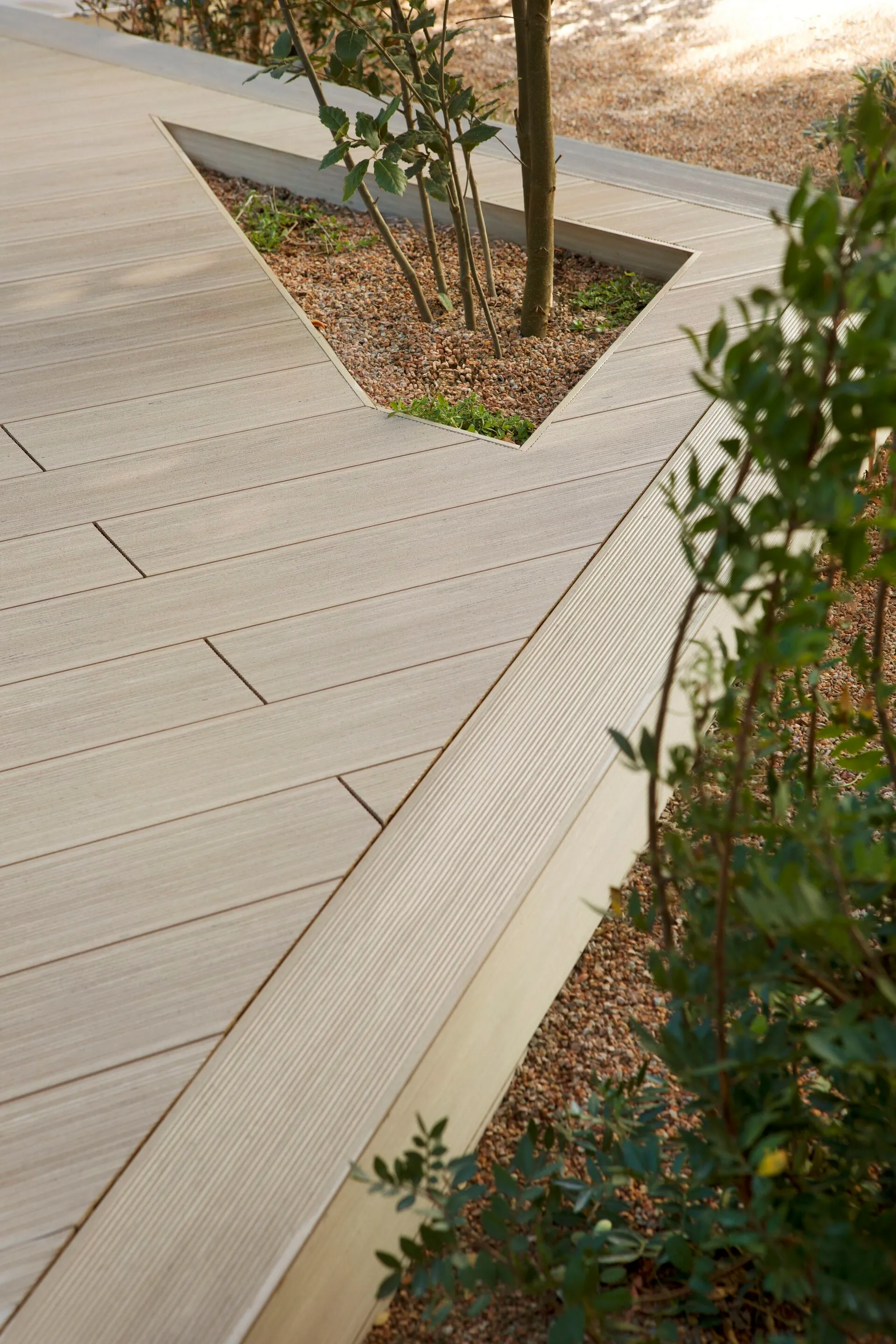
For most Canadian decks, wood wins on day-one price and composite wins over the decade once you add staining, rot, and freeze-thaw replacement. Pressure-treated costs least upfront but most over time; cedar looks better and rots; capped and Tarimatec stone composite cost more now and far less to keep.
Short answer: Across Canada, wood decking is cheaper on day one and composite is usually cheaper over the deck's life. Pressure-treated wood has the lowest upfront cost but the highest maintenance and the shortest lifespan in freeze-thaw climates; cedar buys you looks and still rots; capped composite and Tarimatec stone composite cost more upfront and far less to own.
We've spent a long time around Canadian decks — the builders we work with came up swinging hammers on pressure-treated builds in eastern Ontario, and today we're on the supply side at Zinodeck, the exclusive Canadian distributor of Tarimatec Ecofiber stone composite, working alongside the crews who install it from Halifax to Winnipeg. So we've seen both sides of this question: the homeowner in the lumber aisle doing the math on a wood deck, and that same homeowner three winters later asking why the boards are cupping. This guide is the comparison we'd give you across a kitchen table — wood versus composite for a real Canadian backyard, costed honestly, with the climate factored in instead of ignored.
You're looking at a stack of pressure-treated 5/4 boards, the per-piece price is a fraction of what the composite samples cost, and the math feels settled. We get it — that's the same math the builders we work with ran for years. The part the lumber aisle never prices for you is the second invoice: the one that arrives in instalments every spring for the next decade.
Here's how it actually plays out on a Toronto or Ottawa backyard build. Pressure-treated wood is the cheapest board you can put down, but it's also the thirstiest. It drinks moisture, swells, dries, checks, and cups — and to keep it from rotting outright you're cleaning and re-staining it every two to three years. Over a fifteen-year horizon that's stain, sealer, a day or two of your spring each round, and eventually replacing the boards that lost the fight. The deck that was half the price on install day quietly becomes the more expensive one to own.
Cedar is the prettier wood answer, and it earns part of its premium — it's naturally more rot- and insect-resistant than pressure-treated, and it looks genuinely beautiful the day it's built. But cedar is soft, it greys fast under Canadian UV if you don't oil it, and "more rot-resistant" is not "rot-proof." The part nobody mentions until year three: cedar still needs near-annual oiling to hold its colour, and on a deck that sits in standing snowmelt it will still go soft at the joints. You're paying more upfront for wood that's lower-maintenance than pressure-treated but nowhere near maintenance-free.
This is why "cheaper" is the wrong word for wood. Cheaper to buy, yes — cheaper to own, almost never, not in a climate that spends five months a year trying to pry water into every board.
Picture a cottage deck in the Kawarthas in late March. Nobody's been up since November. The snow load finally lets go, the days warm just enough to melt, and the meltwater runs down between the boards and pools on the frame underneath — then refreezes hard the next cold night. Melt, freeze, melt, freeze, dozens of times before you ever open the place in May. That cycle is the single most destructive thing that happens to a Canadian deck, and wood is the material with the least defence against it.
The mechanism is simple and merciless. Wood is porous, so it wicks that meltwater in; water expands about nine percent when it freezes, so every cycle pushes the fibres apart a little more from the inside. A full winter of that is how you get the splits, the raised grain, the cupping, and the soft rot at the joints. Here's the part that catches people: the damage happens in February when nobody's watching, and you only see it in April — by the time the board looks wrong, the water got in months ago.
Capped composite handles this far better because its wood-plastic core is wrapped in a hard polymer shell that sheds water instead of drinking it — the cap is what keeps a freeze-thaw winter from reaching the absorbent core. Tarimatec's stone composite goes a step further by changing the recipe underneath. Instead of leaning mainly on wood flour and plastic, its Ecofiber formula binds rice husk and recycled content in a mineral-rich matrix engineered to move less and resist moisture wicking in the first place. Less water in, less movement, fewer surprises when you open the cottage. That's the honest reason it sits at the top of the freeze-thaw column below — it's built for exactly the cycle that destroys wood.
One caveat about every board on that table, composite included: the material can only do its half. A composite deck installed with too little gap, or fastened so it can't move with the seasons, will still telegraph trouble. Whatever you choose, follow Canadian board-spacing and hidden-fastener guidance so the deck can breathe — we've seen a great board fail on a tight install more often than the other way around.
If you read nothing else, read this. We've kept every row honest — wood's real strengths included, and composite's real costs included — because a comparison that only flatters the product we distribute isn't worth the screen it's on. Prices are Canadian materials-only ranges for the board itself; installed cost runs higher once substructure and labour are in, no matter what sits on top.
| Material | Upfront $/sq ft (materials) | Lifetime cost | Maintenance | Freeze-thaw behaviour | Lifespan | Verified sustainability |
|---|---|---|---|---|---|---|
| Pressure-treated wood | ~$3-6 | High (stain + repairs + replacement) | Clean & re-stain every 2-3 yrs | Poor — wicks water, cups, splits, rots | ~10-15 yrs in freeze-thaw | None; treated with chemical preservatives |
| Cedar | ~$6-12 | Medium-high (annual oiling + eventual rot) | Oil yearly to hold colour | Below average — softens, greys, rots at joints | ~15-20 yrs with diligent care | Renewable wood; no product-level EPD typical |
| Capped composite | ~$7-14 | Low (wash only) | Soap-and-water wash; no stain | Good — polymer cap sheds water | ~25-30 yrs | Self-reported recycled content (varies by brand) |
| Tarimatec stone composite | ~$10-18 | Lowest over 25 yrs | Soap-and-water wash; no stain | Best — mineral matrix resists wicking & movement | 25-yr warranty; built to outlast it | EPD verified by Tecnalia (EPD-IES-0007588:002); ISO 14001; PVC : rice husk : limestone at 100:50:40 parts, 33% recovered composite, 100% recyclable |
A word on the lifespan column, because it's the one people read too fast. Those wood numbers assume diligent upkeep — skip the staining for a few summers in a freeze-thaw climate and pressure-treated can be soft and unsafe well before the low end of that range. The composite numbers assume a correct install. Neither is magic, but composite's idea of being treated right is a hose and a bottle of soap; wood's is a recurring weekend with a sander and a can of stain. For the full brand-by-brand view of the composite side, our companion guide to the best composite decking in Canada compares the capped composites among themselves.
Be honest with yourself about the weekend math, because this is where most people's real preference lives. A wood deck is a standing appointment with your spring: sweep it, wash it, let it dry, sand the rough spots, brush or roll the stain, wait for it to cure, keep the dog and furniture off it while it does. On a 400-square-foot deck that's a genuine two-day job — every two to three years for pressure-treated, every year or so for cedar if you want it to hold colour.
Now picture the same square footage on a south-facing deck off a west-end Toronto alley in July — full afternoon sun, the kind of heat where the surface decides whether you can stand on it barefoot. A composite deck's maintenance that season is a hose-down and, if something gets spilled, soap and water. No stain, no sealer, no curing time, no lost weekend — the upfront price is really buying you a backyard you use instead of service.
We'll give composite its one fair knock, because the honest version of this section has to. Dark composite boards do get hot in direct summer sun — that barefoot test is real, and no board stays cool in a heatwave. Tarimatec's mineral matrix resists heat build-up better than many wood-fibre composites we've handled, and lighter colours in its 31-colour range run cooler than the deep tones, but physics is physics. The fair way to put it: wood can be cooler underfoot at noon, and composite gives you back every other day of the year. Where you land depends on whether your deck bakes at midday or lives in shade — and on a hot, exposed deck, cooler-running is the spec we'd steer you toward in the Tarimatec decking range.
If sustainability is part of your decision — and on a lot of the builds we see now, a designer or a green-building checklist has made it part of the decision — the wood-versus-composite story is more tangled than either side admits. Wood is renewable and, untreated, biodegradable, which sounds like the clean answer. But pressure-treated lumber is pressure-treated for a reason: it carries chemical preservatives, which is precisely what lets it survive ground contact and moisture, and that complicates both the "natural" claim and its end-of-life. Cedar is cleaner on that front but comes with the harvest-and-replant footprint of any solid-wood product.
Composite's honest position is different: it's a manufactured product, but the credible ones keep waste out of the ground and can prove it — and here the gap between brands matters more than the gap between materials. Almost every composite prints a recycled-content percentage; far fewer hand you an independently verified Environmental Product Declaration to back it. A brochure number is a marketing claim; a registered EPD is an audited document a specifier can file. Picture a Halifax waterfront deck taking salt spray off the harbour all summer and freeze-thaw all winter — about the most punishing brief Canada serves up, and exactly where an owner or architect wants documentation, not adjectives. Tarimatec's Ecofiber carries an EPD verified by Tecnalia (registered EPD-IES-0007588:002), plus ISO 14001 certification. It's built from rice husk at 50 parts for every 100 parts of PVC, roughly a quarter of the blend by weight per the EPD — an agricultural by-product that would otherwise be burned or dumped — and 33% recovered composite re-used in production, per the EPD, and it's 100% recyclable at end of life. We lean on that stack with architects, because for a LEED or BREEAM submission a verifiable document outweighs the highest self-reported percentage on the shelf. Be straight about one thing, though: Tarimatec is not made in Canada. It's European-engineered, manufactured in Spain by Plásticos Viters S.A., and selected specifically for Canadian weather; Zinodeck is its exclusive Canadian distributor, shipping samples and quoting projects from Vaughan, Ontario. The sustainability is real and verified — the country of origin just isn't the part we'd ever fudge.
The real comparison isn't the deck on install day — both look great that afternoon. It's the deck a decade in, and that's where the two materials part ways for good. Run a Winnipeg backyard through it: a deck that rides −35°C every January and bakes through a prairie summer gets the full Canadian range, and ten years of it is a brutal honesty test for any board.
A well-kept wood deck can absolutely reach ten years and beyond — we've stood on plenty that did. But "well-kept" carries the whole sentence: it means a decade of diligent staining and the boards that didn't make it swapped out along the way, so the deck you have at year ten is partly newer than the one you built. A composite deck at the same age, capped or stone, is mostly the deck you installed — same boards, faded a touch, washed not sanded. A buyer reads that instantly: a wood deck is a maintenance item they're inheriting, a composite deck is one they don't have to think about. The part that surprises people is how the cost curves cross. Wood starts cheaper and climbs every few years on stain, repairs, and replacement boards; composite starts higher and flattens to almost nothing. Somewhere in the back half of the first decade those lines cross, and from there composite is simply the cheaper deck to own — which is why "cheaper upfront" and "cheaper overall" are two different questions. To see those curves drawn against your own square footage instead of taking our word for it, estimate your project in CAD and watch the crossover land for your build.
Strip it back to your honest priority, because that's what decides this. If your budget is capped at the lowest number today, you don't mind the recurring weekends, and you accept a shorter lifespan in our climate, pressure-treated wood is the rational choice and we won't talk you out of it. If you want real wood looks and you'll commit to the annual oiling, cedar is beautiful for as long as you keep up with it. But if you're weighing the next fifteen years and not the next fifteen minutes — lowest lifetime cost, the best freeze-thaw behaviour, a hose instead of a sander, and sustainability you can document — composite wins, and Tarimatec stone composite is the strongest version of that answer for a Canadian deck. Yes, we're biased; the EPD, the warranty, and the freeze-thaw behaviour are the documented reasons why.
Whatever you're leaning toward, don't decide it off a screen. Boards read completely differently in your own backyard light than in any photo — a composite that looks grey online can read warm brown in afternoon sun. Put samples on your actual deck, in your actual sun, and let the material make its own case: order samples, explore the decking range, or estimate your project in CAD before you commit to a single board.
Or go straight to the range: Tarimatec composite decking in Canada · technical data for architects and specifiers · order decking samples.
{"@context":"https://schema.org","@type":"FAQPage","mainEntity":[{"@type":"Question","name":"Is wood or composite cheaper for decking in Canada?","acceptedAnswer":{"@type":"Answer","text":"Wood is cheaper to buy and composite is usually cheaper to own. Pressure-treated lumber has the lowest upfront cost (roughly $3-6/sq ft for materials) but adds staining every 2-3 years plus repairs and earlier replacement. Capped and stone composite cost more upfront (roughly $7-18/sq ft) but need only washing, so over a 10-15 year horizon in a freeze-thaw climate composite typically costs less overall."}},{"@type":"Question","name":"How long does composite decking last compared to wood in Canada?","acceptedAnswer":{"@type":"Answer","text":"In Canadian freeze-thaw conditions, pressure-treated wood typically lasts about 10-15 years and cedar about 15-20 years with diligent care, while capped composite lasts roughly 25-30 years. Tarimatec stone composite carries a 25-year warranty and is engineered to outlast it because its mineral-rich matrix resists the moisture wicking and freeze-thaw movement that wears wood out."}},{"@type":"Question","name":"Does composite decking handle freeze-thaw better than wood?","acceptedAnswer":{"@type":"Answer","text":"Yes. Wood is porous, so it wicks meltwater that expands when it refreezes, causing splits, cupping and rot over repeated cycles. Capped composite is wrapped in a polymer shell that sheds water, and Tarimatec stone composite binds rice husk and recycled content in a mineral matrix that resists wicking and moves less, so both handle Canadian freeze-thaw far better than pressure-treated or cedar wood."}},{"@type":"Question","name":"What is the downside of composite decking versus wood?","acceptedAnswer":{"@type":"Answer","text":"The two honest downsides are upfront cost and summer heat. Composite costs more to buy than wood, though it usually wins on lifetime cost. And dark composite boards get hot in direct afternoon sun; wood can feel cooler underfoot at midday. Tarimatec's mineral matrix and lighter colours run cooler than deep-toned wood-fibre composites, but no board stays cool in a heatwave."}},{"@type":"Question","name":"Is composite decking more eco-friendly than wood?","acceptedAnswer":{"@type":"Answer","text":"It depends on the wood and the proof behind the composite. Untreated wood is renewable and biodegradable, but pressure-treated lumber carries chemical preservatives, and only some composites can document their sustainability. Tarimatec stone composite has an EPD verified by Tecnalia (EPD-IES-0007588:002), ISO 14001 certification, rice husk at 50 parts for every 100 parts of PVC — roughly a quarter of the blend by weight — and 33% recovered composite re-used in production, per the EPD, and is 100% recyclable, making it the verifiable choice for LEED or BREEAM projects."}},{"@type":"Question","name":"Is Tarimatec composite decking made in Canada?","acceptedAnswer":{"@type":"Answer","text":"No. Tarimatec is European-engineered and manufactured in Spain by Plasticos Viters S.A., then selected specifically for Canadian weather. Zinodeck is its exclusive Canadian distributor and administers its 25-year manufacturer warranty and ships samples from Vaughan, Ontario, working alongside the builders who install it. The truly made-in-Canada composite option is TruNorth, manufactured in Brantford, Ontario."}}]}