

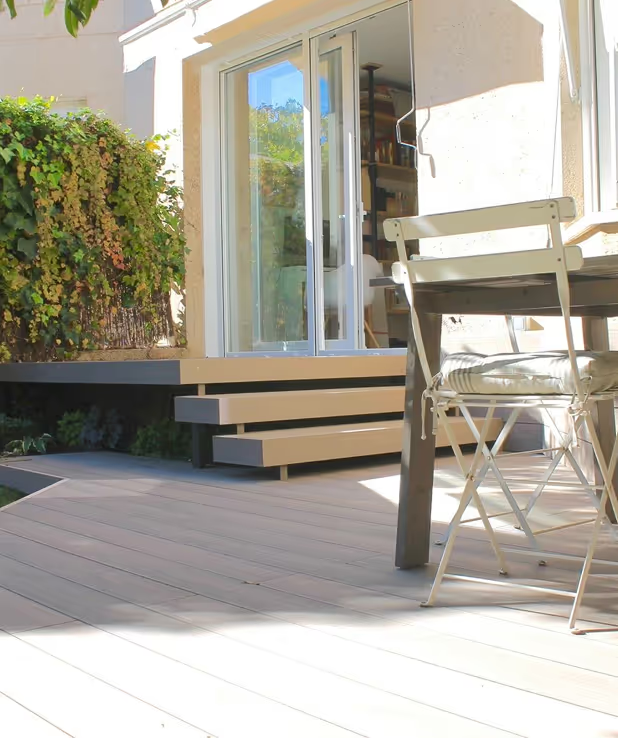
A composite deck in Canada typically runs about $40 to $75 per square foot installed in 2026, or roughly $8,000 to $15,000 for a standard 200-square-foot deck. Board choice matters less than most people expect; labour, frost-depth footings, and the substructure drive the final number.
Short answer: Budget for roughly $40–$75 per square foot installed for a composite deck in Canada in 2026 — about $8,000–$15,000 for a typical 200 sq ft deck. Materials are only part of it; the real drivers are labour rates, frost-depth footings, the substructure underneath, and which board you choose.
If what you want is the raw number rather than the reasoning, the verified brand-by-brand price ladder in Canadian dollars per linear foot lives on our composite decking cost in Canada page. This guide is about what sits behind those numbers on your own quote.
We supply Tarimatec stone composite to builders across Canada, which means we read quotes for a living — and we see where homeowners get blindsided every week. The number that lands in your inbox is almost never about the deck boards. It's about everything you can't see once the deck is finished: the posts going below the frost line, the framing, the labour to build it right in a climate that tries to tear it apart. So let's break a real Canadian composite deck cost down honestly — what the boards cost, what the build costs, where the money goes — so the quote you get back doesn't surprise you.
You've probably typed "how much does a composite deck cost" into Google and gotten a US figure in US dollars for a climate that never sees -30°C. That number is useless to you in Canada. Here's the honest range we'd give you over the phone: a finished composite deck in this country generally lands between $40 and $75 per square foot installed in 2026 — and the spread is that wide for real reasons.
Picture two decks the same size. One's a simple ground-level rectangle off the back door in a Hamilton subdivision, flat lot, easy access. The other's a raised deck on a sloped Okanagan property where every footing has to be dug deeper and the crew is working on an incline. Same square footage, same boards on top — and the second deck can cost half again as much to build. The boards didn't change. The build did. That's the most important thing to understand before you read another price online: in Canada, the deck you walk on is the cheap part.
As a rough split on a composite build, expect materials to make up something like 40–50% of the total and labour plus substructure the rest. On a wood deck that ratio tilts more toward labour, because the cheap boards make the skilled hands the biggest line item. Move to composite and the board cost climbs and the ratio evens out — but the labour to frame, footing, and fasten a deck properly through a Canadian frost cycle never gets cheaper.
You want to know what you're paying for, line by line — fair. Most quotes bundle it into one intimidating number, so here's how we'd pull it apart, because once you see the pieces the total stops feeling arbitrary.
The decking boards themselves. Entry-level capped composite runs roughly $7–$10 per square foot for materials alone; premium lines — where a stone composite like Tarimatec sits — climb to around $14–$20. That's the number everybody fixates on, and the part you have the most control over. But on a finished 200 sq ft deck, the gap between an entry board and a premium one might be $1,500–$2,000 spread across a deck you'll stand on for 25 years. Against the rest of the build, the board upgrade is rarely where the budget breaks.
The substructure — the quote nobody warns you about. This is the line that catches people. Underneath every composite deck is a pressure-treated frame, joists, beams, and posts, and in Canada those posts have to reach below the frost line on proper footings. Picture a Winnipeg backyard where the deck rides −35°C every January: skip the depth and frost heave will lift and rack that frame until the boards on top telegraph every bit of movement. Doing it right means digging, concrete, and engineered hardware — and it's invisible the day the deck is done, which is exactly why homeowners are shocked to see it on the bill. We'll tell any builder's customer the same thing: the substructure is where a deck is won or lost, and it's the cost you should question least.
Labour. Skilled deck-building labour in Canada isn't cheap and shouldn't be — you're paying for a crew that knows how to gap boards for thermal movement, set hidden fasteners, and frame to your local code. Labour scales with complexity fast: stairs, multiple levels, railings, angled boards, and tricky access all add hours. A picture-frame border and a herringbone inlay look stunning and cost real labour to cut and fit. None of that is the boards. All of it is the build.
You're really deciding between three material paths, and the right way to compare them isn't the price on install day — it's the price over the life of the deck. Here's the field laid out the way we'd walk you through it, with typical Canadian market ranges. Treat these as planning numbers; for a figure tied to your actual square footage, province, and board, run it through the deck cost calculator (estimate your project in CAD) rather than trusting a round number off a blog.
| Material | Typical material $/sq ft | Typical installed $/sq ft | Est. total — 200 sq ft | Est. total — 400 sq ft | Lifetime & maintenance |
|---|---|---|---|---|---|
| Pressure-treated wood | $3–$6 | $25–$45 | $5,000–$9,000 | $10,000–$18,000 | 10–15 yrs; annual clean, stain/seal every 2–3 yrs; replace boards as they rot or warp |
| Capped composite (wood-flour based) | $7–$12 | $40–$65 | $8,000–$13,000 | $16,000–$26,000 | 25–30 yrs; wash seasonally, no staining or sealing; wood-fibre core can wick moisture |
| Tarimatec stone composite | $14–$20 | $50–$75 | $10,000–$15,000 | $20,000–$30,000 | 25-yr warranty; wash seasonally, no staining or sealing; mineral matrix resists moisture and freeze-thaw |
Read that last column before the first ones, because it's where the real math lives. A pressure-treated deck is cheapest to build and most expensive to own — picture a Muskoka cottage deck that gets stained every couple of springs, then sees a few boards swap out after a decade of meltwater pooling and refreezing underneath. Add up the stain, the labour, and the replacement boards across fifteen years and the "cheap" deck quietly closes much of the gap. Composite costs more up front and then asks for little more than a wash each season. That's the trade you're weighing — not $5,000 versus $10,000 today, but what the deck costs you between now and 2041.
If you're comparing your quote to a number you found online, here's the variable that breaks the comparison: footings. Most US pricing assumes shallow footings or none. In Canada, building codes require deck posts to sit below the local frost line — and that depth changes everything about what the substructure costs.
That frost line isn't a formality. Picture a Calgary deck the morning after a chinook — the temperature has jumped 20°C in an afternoon, the ground is heaving and settling, and a post that didn't go deep enough is now levering the whole frame a few millimetres at a time. In much of Ontario that means footings dug well past a metre down, with concrete and engineered post bases at the bottom of every hole; on the Prairies the frost reaches deeper still. Each footing is labour, material, and sometimes an inspection — and no composite board on earth fixes a frame that wasn't put down right. This is the single biggest reason a Canadian deck quote runs ahead of the American figure you saw, and it's money well spent. A deck that heaves is a deck you rebuild.
It's also why we steer every homeowner toward a builder who quotes the substructure in detail instead of waving at it. When you compare two quotes and one is suspiciously low, the footings are usually where the corner got cut — and that corner doesn't show up until the third winter, when the boards start gapping unevenly and you finally understand what you didn't pay for.
You're not really thinking in square feet — you're thinking "what does my deck cost." So let's put the per-square-foot ranges into the sizes people actually search for, using the installed composite range as a planning guide. These are ballpark figures to set expectations, not a quote.
Why such a spread inside each size? Because two 14x20 decks are never the same deck. One sits a foot off flat ground in a Halifax suburb; the other is a second-storey walkout over a sloped lot taking salt air off the harbour, with a staircase, a railing run, and footings that fight bedrock. Same footprint, very different build. The square footage tells you the boards; everything else — height, levels, stairs, railings, site access, footing depth — tells you the real price. That's the gap a generic online estimate can't close, and why we'd rather you estimate your project in CAD with the calculator than anchor on a single number.
You've heard composite is "way more expensive," and on day one that's true — but you're going to own this deck for a long time, so day one is the wrong frame. On install day, a pressure-treated deck is clearly cheaper: cheaper boards, sometimes lighter framing requirements, a smaller total. If your honest plan is to sell the house in three years, wood can be the rational financial call, and we won't pretend otherwise.
But run the clock forward. A wood deck in the Canadian climate wants staining or sealing every two to three years — that's product and a weekend, or product and a contractor, every couple of springs. It splinters, it greys, and after a decade of freeze-thaw and the odd pooling-meltwater winter, boards start cupping and need swapping. Picture a south-facing Toronto deck that bakes past 60°C in a July heatwave and then rides a hard frost all winter: wood feels that whole swing, season after season. Composite costs more once, then mostly just asks for a wash. Somewhere between years eight and fifteen, depending on how diligently the wood gets maintained, the lines cross — and from there composite is the cheaper deck to own. So the honest answer is: cheaper to build, wood; cheaper to live with, composite. Your timeline decides which number matters.
You want the deck to land closer to the bottom of that range, and there are smart ways to get there — and one tempting way that always backfires. Start with the levers that are genuinely yours: keep the shape simple (a clean rectangle costs far less to frame and board than a multi-level deck with angled inlays), keep it close to grade where your lot allows, and be honest about how much railing and stairs you actually need, since those are labour-heavy. A south-facing Vancouver deck built as a simple low rectangle can come in dramatically under a raised, railed, multi-level version of the same square footage.
What we'll never tell you to trim is the substructure or the footings. That's the one place "saving money" just defers a bigger bill to your third winter. If the budget's tight, it's far better to start with a smaller, well-built deck than a large one on undersized footings — you can extend a deck that was framed right; you can't un-heave one that wasn't. And before you commit to any board, see it in your own yard: order a few composite decking samples and set them on your existing deck in real sun before you spend five figures on a colour you only ever saw on a screen.
You're weighing whether a premium board is worth it, so let us be straight about where Tarimatec sits and what you're paying for. It's a stone composite — Ecofiber — that we distribute across Canada, and to be honest about its origin: it isn't made here. It's European-engineered, made in Spain by Plásticos Viters S.A., and Zinodeck is its exclusive Canadian distributor out of Vaughan, Ontario. We supply it across the country and work alongside the builders who install it — so the boards, the colours, and the people who stand behind the warranty are already on this side of the border.
On price, it sits at the premium end of the material range — roughly $14–$20 per square foot for the boards, landing a finished deck around $50–$75 per square foot installed. What that buys, beyond the look across 31 colours, is documented: a 25-year warranty, an EPD verified by Tecnalia, ISO 14001 certification, a build that's rice husk at 50 parts for every 100 parts of PVC — roughly a quarter of the blend by weight — and 33% recovered composite re-used in production, per the EPD, and a mineral-rich matrix engineered to move less and resist moisture wicking through freeze-thaw. That last part is where the premium earns back on a Canadian deck specifically — less water in the board means less of the cupping-and-gapping that turns a wood-fibre deck into a year-eight repair. If you want to see how it stacks up against the rest of the field on more than price, we laid the whole category out in our guide to the best composite decking in Canada, and you can explore the range when you're ready to narrow it down.
Here's the bottom line we'd leave you with. A composite deck in Canada is a real investment — plan for somewhere around $40–$75 per square foot installed, more for premium boards, raised builds, and deep-footing sites. But the number on the quote is mostly about the build, not the boards, and the cheapest quote is rarely the one that survives the winters. Get the substructure right, choose a board you'll be glad you chose in 2041, and run your real square footage and province through the CAD deck cost calculator before you sign anything. That's the difference between a deck that's done and a deck that's a project.
Or go straight to the range: Tarimatec composite decking in Canada · technical data for architects and specifiers · order decking samples.
{"@context":"https://schema.org","@type":"FAQPage","mainEntity":[{"@type":"Question","name":"How much does a composite deck cost in Canada?","acceptedAnswer":{"@type":"Answer","text":"In 2026, a composite deck in Canada typically costs about $40 to $75 per square foot installed, or roughly $8,000 to $15,000 for a standard 200-square-foot deck. The board itself is only part of the cost; labour, frost-depth footings, and the pressure-treated substructure underneath usually drive the final price more than the choice of decking board."}},{"@type":"Question","name":"How much does a 20x20 composite deck cost in Canada?","acceptedAnswer":{"@type":"Answer","text":"A 20x20 composite deck is 400 square feet and generally runs about $16,000 to $30,000 installed in Canada, depending on height, access, railings, stairs, and footing depth. A simple ground-level 20x20 sits near the bottom of that range; a raised, multi-level, or fully railed deck on a difficult lot lands near the top. Use a CAD deck cost calculator with your province and board choice for a closer figure."}},{"@type":"Question","name":"Is it cheaper to build a wood deck or a composite deck in Canada?","acceptedAnswer":{"@type":"Answer","text":"A pressure-treated wood deck is cheaper to build on day one, but a composite deck is usually cheaper to own over time. Wood needs staining or sealing every two to three years and board replacement after about a decade of freeze-thaw, while composite mostly just needs a seasonal wash. The lifetime cost lines typically cross somewhere between years eight and fifteen."}},{"@type":"Question","name":"Why is a composite deck more expensive in Canada than in the US?","acceptedAnswer":{"@type":"Answer","text":"The biggest reason is frost-depth footings. Canadian building codes require deck posts to sit below the local frost line, which in much of Ontario and the Prairies means digging well past a metre down with concrete and engineered post bases at every footing. That extra excavation, material, and labour is invisible once the deck is finished but adds real cost that most US pricing never accounts for."}},{"@type":"Question","name":"What part of a composite deck quote costs the most?","acceptedAnswer":{"@type":"Answer","text":"Usually the substructure and labour, not the decking boards. Underneath every composite deck is a pressure-treated frame on frost-depth footings, and building that correctly for a Canadian winter takes excavation, concrete, hardware, and skilled labour. On a composite build, materials are often only 40 to 50 percent of the total, and the board upgrade from entry to premium is rarely where the budget breaks."}},{"@type":"Question","name":"Where does Tarimatec stone composite sit on price in Canada?","acceptedAnswer":{"@type":"Answer","text":"Tarimatec quotes typically land in the premium-PVC band, alongside advanced-PVC lines rather than entry-tier capped composite. Zinodeck does not publish a board price, because the number depends on colour, profile, accessories and freight; boards are brought in per project and quoted in CAD with a stated lead time. The premium covers a 25-year Tarimatec manufacturer warranty administered in Canada by Zinodeck, a Tecnalia-verified EPD (S-P-07588), ISO 14001 certification, 31 colours, and a mineral-rich matrix with 0.59 percent water absorption at 24 hours on the hollow board (EN 317)."}}]}