

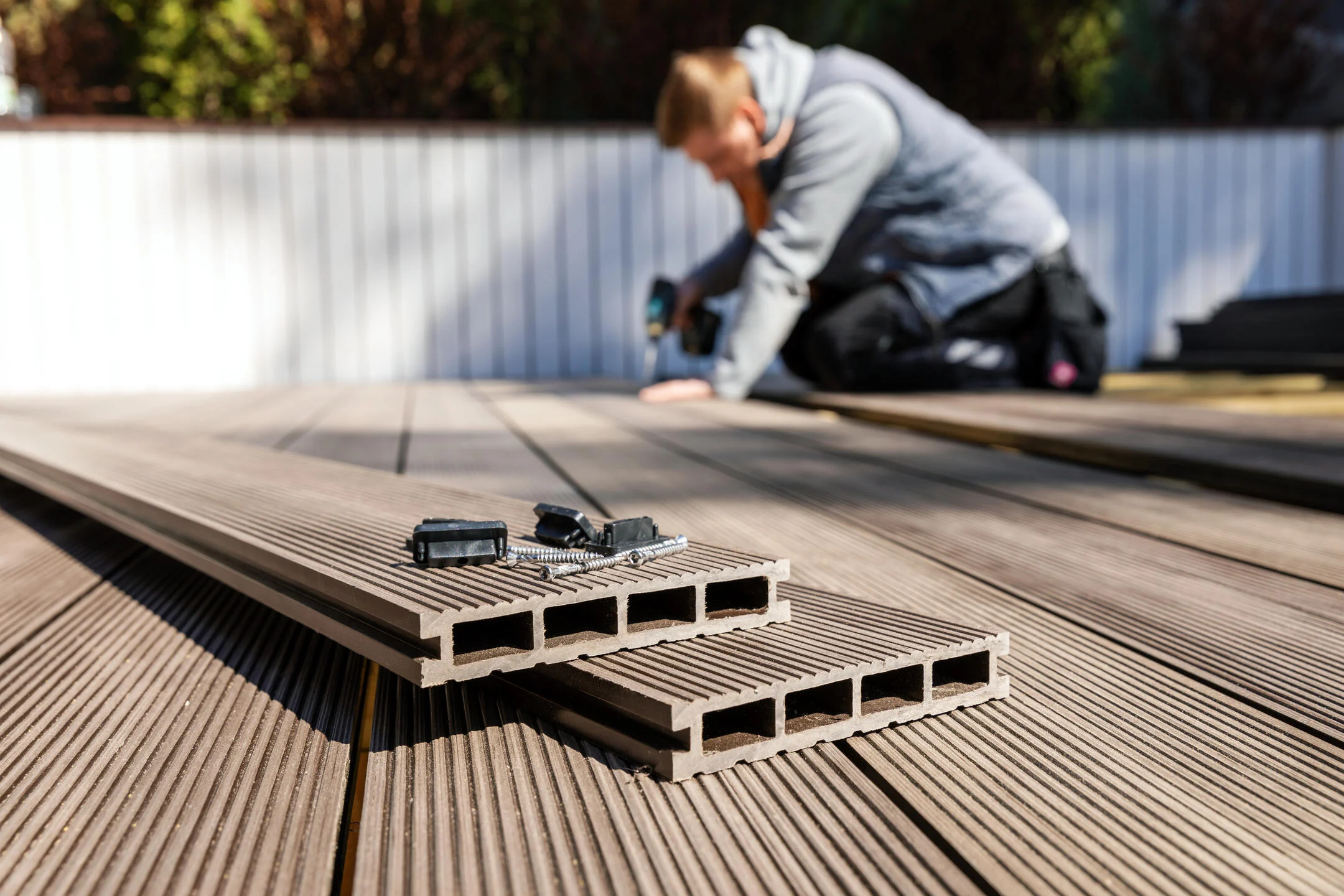
To install composite decking in Canada, you build a pressure-treated frame on frost-depth footings, set joists 12 to 16 inches on centre, then fasten boards with hidden clips and leave manufacturer-specified end and side gaps so the deck can expand and contract through a 60-degree seasonal swing.
Short answer: To install composite decking in Canada, you frame a pressure-treated substructure on frost-depth footings, set joists 12–16" on centre (tighter for stairs and 45° boards), then fasten the boards with hidden clips and leave the manufacturer's specified end and side gaps so the deck can move through a 60°C seasonal swing without buckling.
We supply Tarimatec stone composite to builders across Canada, so we're on the phone with the crews who install it every week — and we see which installs come back to bite and which never do. It isn't a board our own crews put down; it's a board we distribute and stand behind. So think of this as what to know before your installer starts: how the certified builders we work with do it in this climate, the steps in the order they happen, and the Canadian-specific details — frost, joist spacing, hidden fasteners, expansion gaps — a generic US guide quietly skips. Wherever a number matters, one rule overrides everything below: follow your board's published installation spec.
You're tempted to start at the fun part — the boards. Don't. The deck you'll be happy with in 2034 is decided here, in the planning, long before a board gets cut. Picture a homeowner in a Mississauga subdivision who orders boards and books a crew, then learns the municipality wants a permit and a footing inspection — weeks of delay one afternoon of planning would have caught. Three things get sorted before the build, the same three on every good crew's checklist:
Get those three down and the rest is execution. Skip them and you're rebuilding in year three — usually starting with the part nobody could see.
Here's the part most US guides wave at, and it decides whether your deck is still flat in a decade. You're not really building a surface — you're building a frame that has to hold its line through frost heave, and the boards just ride on top. Picture a Winnipeg backyard where the deck sees −35°C every January: a post that didn't reach below the frost line gets levered upward by heaving ground until the whole frame racks and the boards telegraph every millimetre of movement. The spring call-back we hear about most isn't a board problem at all — it's a footing that wasn't deep enough. So the substructure comes first, built to your local code, not to a number off the internet:
One contractor truth, plainly: a perfect board on a bad frame still fails. We've watched a great deck surface cup and gap because the substructure under it moved — and you can't fix a heaved frame by swapping boards.
You've got a flat, square, code-built frame — now the part you'll actually see begins. The first question everyone asks is the right one: how does composite decking attach? For nearly every modern composite, including the boards we distribute, the answer is hidden fasteners — clips that seat into a groove milled along each board's edge and screw down into the joist, so the surface stays clean with no screw heads showing.
Picture squaring the first board along a ledger on a Kawarthas cottage deck, the lake just past the railing line. That first row sets the line for everything after it, so get it dead straight:
Get the first board right and the field flies. Get it crooked and every board after inherits the error.
This is the rhythm of the whole deck — board, clip, board, clip — and where the most expensive Canadian mistake hides: gapping. The temptation on a cool day is to butt boards up nice and tight because it looks clean. In this climate, that's the call-back we see most: boards butted tight in October that buckle in July.
Composite expands and contracts with temperature, and a Canadian deck lives through an enormous swing — a Muskoka surface can run from −30°C in deep winter to 60°C-plus in full summer sun, a 90-degree journey every year. Leave it nowhere to go and it pushes against its neighbours until something lifts. The gaps aren't trim detail; they're structural:
If you take one thing from this guide, take this: in Canada the gap is not where you save effort. A deck a few millimetres too tight in spring is a deck that fights itself by midsummer.
You're almost there — the field is down, and now the details separate a deck that looks built-in from one that looks bolted-on. Picture a Calgary deck the first afternoon a chinook rolls through: 20°C of swing in a few hours, the fascia warming and moving while the framing behind it sits cooler. Detail the edges to allow that, or the trim is the first thing to oil-can and pop.
You've got the steps — but if you only remember what's different about installing in Canada specifically, remember these three. They're the ones the US-written guides leave out and the ones our builders never skip.
That's the difference between a Canadian install and a generic one: the frost, the gaps, and the water — honest the whole way through.
Here's the field on one screen — general best-practice ranges to plan around, not a substitute for your board's published numbers. Read the last column first: every value here gets overridden by the manufacturer's installation guide for the board you actually buy.
| Detail | Flat field boards | Stairs / 45° diagonal | Why it matters in Canada | The rule that overrides this |
|---|---|---|---|---|
| Joist spacing (on centre) | 12–16" (16" common straight-laid) | Tighter — typically ~12" for 45°; stair stringers closer still | Diagonal boards span more between joists; closer spacing resists deflection | Confirm against your board's spec |
| Fastener type | Hidden clips into the board's side groove, into every joist | Often face-screwed with plugged composite screws where spec permits | Clean surface, no exposed heads; warranty assumes the clip system | Use the manufacturer's clip + screw |
| Side (board-to-board) gap | Set automatically by the hidden clip | Same — clip self-spaces | Allows side-to-side thermal movement without buckling | Don't force tighter than the clip |
| End (butt) gap | Per temperature table — larger when installed cold | Per temperature table; longer boards need more | Sized for a −30°C to +60°C annual swing; cold installs need bigger gaps | Follow the published end-gap table |
| Footing depth | Below the local frost line (often 1m+ in Ontario; deeper on the Prairies) | Stops frost heave from racking the frame and gapping the boards | Set by your provincial code + permit | |
Whether you're a confident DIYer or hiring out, the value of knowing all this is that you can tell a good install from a shortcut. We distribute Tarimatec and work alongside the certified builders who install it — we don't swing the hammer ourselves, and we'd rather be honest about that than oversell it. Picture two quotes for the same Hamilton backyard. One details the footing depth, joist spacing, clip system, and gapping method; the other just says "build deck." The detailed one costs a little more and is the one still flat in 2036, because every number above is written into it. If you're hiring, ask your installer how they gap for our climate, what joist spacing they're using for your board, and how deep the footings go — crisp answers mark a builder who's worked through a few Canadian winters.
Whatever you build, start where every good install starts: the right board confirmed in your own yard, and a clear-eyed budget for the substructure that does the quiet work. Put real samples in your real sun — order composite decking samples and explore the decking range to lock in your board — then run your square footage, province, and board choice through the CAD deck cost calculator so the substructure and labour don't surprise you. If cost is what you're weighing, we broke the whole number down in how much a composite deck costs in Canada; if you're still choosing a board, our comparison of the best composite decking in Canada lays out the field. Get the board right, get the frame right, gap it for the swing — that's the difference between a deck that's done and a deck that becomes a project.
Or go straight to the range: Tarimatec composite decking in Canada · technical data for architects and specifiers · order decking samples.
{"@context":"https://schema.org","@type":"FAQPage","mainEntity":[{"@type":"Question","name":"How do you install composite decking in cold climates?","acceptedAnswer":{"@type":"Answer","text":"In a cold climate like Canada's, you build a pressure-treated frame on footings below the local frost line, set joists 12 to 16 inches on centre, and fasten the boards with hidden clips. The critical step is gapping: because composite expands and contracts through a swing that can exceed 60 degrees Celsius from winter to summer, you leave the manufacturer's specified end and side gaps, and you increase the end gap when installing on a cold day so the deck has room to expand in summer. Keep the underside ventilated and well drained so meltwater cannot pool and refreeze against the frame."}},{"@type":"Question","name":"What is the best way to attach composite decking?","acceptedAnswer":{"@type":"Answer","text":"For nearly every modern composite board, the best way is a hidden-fastener clip system. The clips seat into a groove milled along each board's edge and screw down into the joist, leaving a clean surface with no exposed screw heads and self-spacing the side gap. Face-screwing through the top of the board is generally only done where the manufacturer's spec permits it, such as at stairs or a final board, using a proper composite screw in a pre-drilled, plugged hole."}},{"@type":"Question","name":"How far apart should joists be for composite decking in Canada?","acceptedAnswer":{"@type":"Answer","text":"As a general best-practice range, composite field boards run on joists spaced 12 to 16 inches on centre, with 16 inches common for standard residential decks laid straight. Boards run on a 45-degree diagonal need tighter spacing, typically down toward 12 inches, because the unsupported span grows when the board crosses at an angle, and stair stringers are closer still. Always confirm the exact figure against your specific board's published installation spec, as some composites require closer spacing than dimensional lumber."}},{"@type":"Question","name":"How big should the expansion gap be on a composite deck?","acceptedAnswer":{"@type":"Answer","text":"The side (board-to-board) gap is set automatically by the hidden clip, so you do not size it yourself. The end (butt) gap depends on the board's temperature on installation day and its length: you leave a larger end gap when installing on a cold day because the boards are contracted and will expand in summer heat, and a smaller gap when installing in hot weather. Manufacturers publish an end-gap table by install temperature and board length; in Canada you follow it closely because the annual swing is wider than many default spec assumptions."}},{"@type":"Question","name":"Do deck posts have to go below the frost line in Canada?","acceptedAnswer":{"@type":"Answer","text":"Yes. Canadian building codes require deck posts to sit on footings below the local frost depth, which is often more than a metre down in much of Ontario and deeper across the Prairies. This stops frost heave from levering the posts upward, which would rack the frame and make the boards on top gap and cup. The footing depth for your site is set by your provincial code and is typically checked during the permit inspection, so it should never be guessed."}},{"@type":"Question","name":"Can I install composite decking myself, or do I need a contractor?","acceptedAnswer":{"@type":"Answer","text":"A confident DIYer can install composite decking if the substructure is built correctly and the manufacturer's spec is followed exactly, but the footings, framing, and code compliance are where most projects need professional judgement. Zinodeck distributes Tarimatec and works alongside the certified builders who install it rather than installing it directly. If you hire out, ask the installer what joist spacing they will use for your board, how they gap for the Canadian climate, and how deep the footings go; clear answers signal a builder who has worked through a few Canadian winters."}}]}