

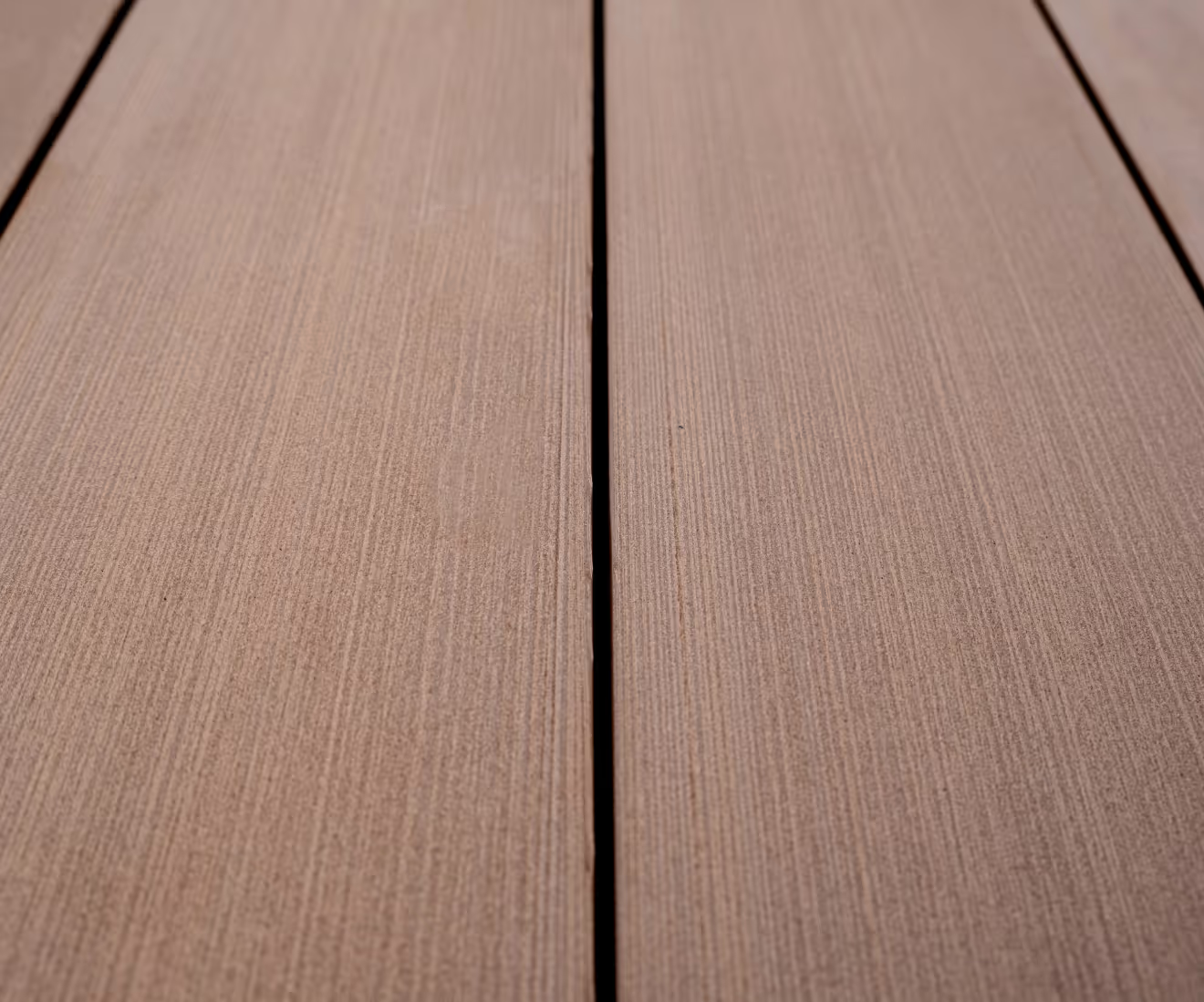
Trex wins on retail availability, brand familiarity and entry price. Tarimatec wins on a Tecnalia-verified EPD, a 31-colour range, European stone-composite freeze-thaw stability and lower heat build-up. For a design-led Canadian deck that values proof, we'd point you to Tarimatec; for a fast big-box buy, Trex.
Short answer: Trex wins on retail availability, brand familiarity and entry price. Tarimatec wins on a Tecnalia-verified EPD, a 31-colour range, European stone-composite freeze-thaw stability and lower heat build-up. For a design-led Canadian deck that values proof, we'd point you to Tarimatec; for a fast big-box buy, Trex.
You've typed "Tarimatec vs Trex" into a search bar because you're standing between two boards and you want the honest difference, not a sales pitch. Fair. Trex is the name almost every Canadian homeowner reaches for first, and for good reason — it effectively created the modern composite-decking category in North America, and you can touch a sample at a big-box store this afternoon. We distribute Tarimatec, so we'll show our cards up front: we're biased. But the reasons we're biased are documented, not decorative, and Trex genuinely wins a couple of these rounds — we'll tell you which ones. Tarimatec is a different animal: a European-engineered, mineral-rich stone composite made in Spain and selected specifically for the freeze-thaw, UV and snow-load reality of a Canadian deck.
One thing we'll never fudge: Tarimatec is not made in Canada. It is European-engineered (made in Spain by Plásticos Viters S.A. near Valencia) and brought here by Zinodeck, the exclusive Canadian distributor of the Tarimatec composite decking range. Trex is made in the United States. Neither is a "Canadian-made" board, and any guide that tells you otherwise is selling you something. If you want the broader field rather than this one-on-one, our roundup of the best Trex alternatives in Canada is the broader shortlist — this page stays a straight Tarimatec-vs-Trex fight.
You want the whole thing on one screen before you read a word of analysis — so here it is. We've put Tarimatec's published, verified credentials next to Trex's own publicly stated, self-reported figures so you're comparing like with like. Where a number is a manufacturer's own claim rather than independently verified, we say so out loud.
| Criterion | Tarimatec (by Zinodeck) | Trex |
|---|---|---|
| Material category | Ecofiber Stone Composite — rice husk at 50 parts per 100 parts PVC — an agricultural by-product, about a quarter of the blend by weight — plus ground limestone; a distinct mineral-rich category, not wood-fibre WPC | Capped wood-plastic composite (WPC) — reclaimed wood fibre and recycled polyethylene with a protective polymer shell |
| Country of manufacture | Spain (Paterna, Valencia) — 70+ years of manufacturing | United States |
| Third-party environmental verification | EPD verified by Tecnalia (registration EPD-IES-0007588:002, EPD International, valid to 2027-12-02); ISO 14001 | No product-specific EPD published; recycled content is self-reported by the manufacturer |
| Recycled / bio-based content | 50 parts rice husk per 100 parts PVC, plus 33% recovered composite re-used in production, per the EPD; 100% recyclable at end of life | Marketed as made largely from recycled and reclaimed material (manufacturer's own figure) |
| Colour range | 31 colours across 3 collections — Chromatic (bold/modern), Wood (natural wood-tones), Ethnic (textured/stone-look) | A smaller curated palette, organised by product line (entry lines offer fewer colours; premium lines offer more) |
| Finishes / textures | 3 finishes — Nature, Tecno, and Surco (anti-slip linear-groove for wet/poolside/rooftop) | Wood-grain and brushed textures depending on line; no dedicated linear anti-slip groove finish |
| Freeze-thaw behaviour | Mineral-rich, low-moisture-uptake core resists freeze-thaw movement; engineered for European and Canadian temperature swings | Capped shell resists surface moisture well; wood-fibre core can be more sensitive to moisture-driven movement over time |
| Heat build-up | Designed to resist heat build-up better than wood-fibre composites, helped by mineral content | Like most composites, darker boards warm up in direct sun; lighter colours run cooler |
| Warranty | 25-year warranty | 25-year limited warranty on entry lines; longer limited warranties on premium lines |
| Format options | Plank and tile; pedestal/rooftop compatible | Plank (boards); rooftop use typically via separate substructure systems |
| Price tier (CAD, material only) | Premium tier, roughly $15–$22 / sq ft depending on collection and finish | Spans entry (~$6–$9) through premium (~$14–$18) / sq ft by product line |
| Canadian availability | Exclusively through Zinodeck; samples online, full boards quote-direct | Wide retail availability through big-box and lumber retailers nationwide |
Read that table and the trade-off jumps out. Trex is the convenient, broadly stocked, brand-name board with a genuine entry-level price advantage. Tarimatec is the verified-credential, wider-design-range, stone-composite board engineered for stability. The rest of this guide unpacks the four or five comparisons that actually change a buying decision — not the ones that just fill a spec sheet.
If you're choosing between these two boards, this is the one distinction worth slowing down for — it's the difference that sits underneath every other row in that table, and it's the one most decking guides skip entirely.
Trex is a capped wood-plastic composite (WPC). The core blends reclaimed wood fibre with recycled plastic, and a co-extruded polymer "cap" (a protective shell) wraps the board to shield it from moisture, stains and fading. Capping was a genuine leap forward over the uncapped composites of the early 2000s, and it's why modern Trex resists the staining and surface fade that plagued first-generation boards. Credit where it's due: this is good engineering, and it's why Trex earned its reputation.
Tarimatec is an Ecofiber Stone Composite. Instead of wood fibre, the recipe is built on rice husk at 50 parts for every 100 parts of PVC, roughly a quarter of the blend by weight — a by-product of rice milling that would otherwise be burned or dumped — combined with recycled mineral content (ground calcite) in a PVC matrix. That mineral loading is the whole point. Wood fibre, even capped, is an organic material that can absorb moisture if the cap is ever breached at a cut end or a screw hole. A mineral-and-rice-husk matrix simply has far less organic wood fibre to swell, which is why stone composite tends to behave more predictably through repeated freeze-thaw cycles and holds up around water.
Picture the underside of a board you cut to length on a Saturday: that fresh end is exposed core, cap or no cap. On a shaded Vancouver Island patio that rarely freezes, the difference is academic. On a deck that freezes and thaws dozens of times a winter and wears snow that sits and melts on the surface, the lower-moisture-uptake approach has a real, physical advantage. Both philosophies are valid — capped WPC protects an organic core with a shell; stone composite reduces how much vulnerable organic material is in the core to begin with. For Canadian weather, we think the second approach is the safer bet, and we'll show you why in the next section. You can also read the full category breakdown in our guide to the best composite decking in Canada.
If you're an architect, a LEED-conscious builder, or just a homeowner who's tired of greenwashing, this is the round you came for — and it's the one where the gap is widest. Both brands have a legitimate sustainability story; they just prove it in completely different ways, and the difference matters enormously the moment someone asks you to document it.
Trex's pitch rests on recycled and reclaimed content — the company has long marketed its boards as being made largely from recycled materials, diverting plastic film and wood scrap from landfill. That's a real, commendable environmental benefit, and we won't wave it away. The nuance you need to hold onto: that recycled percentage is self-reported by the manufacturer. It's a claim about inputs, not an independently audited, cradle-to-grave accounting of the product's environmental impact.
Tarimatec proves its credentials with a verified Environmental Product Declaration (EPD) — verified by Tecnalia, registered with EPD International (EPD-IES-0007588:002) and valid until 2 December 2027. An EPD is the gold standard in building-product sustainability: a third-party-verified document, built on a full life-cycle assessment (LCA), that reports a product's environmental footprint across its whole life. It's the difference between "we use a lot of recycled material" (a claim) and "here is an independently verified, audited accounting of this product's impact" (a document a specifier can actually submit). Tarimatec is also manufactured under ISO 14001 (environmental management) and is 100% recyclable at end of life.
Here's where it stops being abstract. Picture a LEED-targeted rooftop terrace on a Vancouver office building, the design team assembling its materials documentation, and the spec writer emailing you at 4 p.m. on a Friday asking for an EPD on the decking before the submission goes out. With Tarimatec, you forward a registered document and move on. With a self-reported percentage — however genuine — you're explaining why you don't have the paperwork the credit asks for. We've watched that exact email decide a board, and it's the moment a verified EPD stops being a nice-to-have and becomes the whole conversation.
For green-building and commercial projects, a registered EPD is frequently the document that earns the credit. A self-reported recycled percentage, however genuine, does not carry the same weight in a LEED or BREEAM submission.
The honest verdict: Trex has a real recycled-content story and decades of landfill diversion behind it, and that counts. But on verified, documented, specifier-grade sustainability, Tarimatec is clearly ahead, because it carries a third-party EPD that Trex does not publish for its boards. If proof matters to you as much as practice, Tarimatec wins this round. You can review the full documentation on the Tarimatec EPD and sustainability page.
If your deck has to get through a real Canadian winter — not a mild Pacific-Northwest one, but freeze-thaw and snow load and hard summer UV — this is the section that should weigh most heavily on your choice. It's also the part of the decision that is uniquely Canadian, and the part the US-written spec sheets quietly skip.
Picture a Calgary deck in February. A chinook rolls in and the temperature jumps 20°C in a single afternoon — the surface goes from frozen to thawed and back before dinner. Each cycle, any moisture that's worked into a board freezes, expands and stresses the material. Capped WPC like Trex resists this well at the surface because the cap blocks moisture — but the wood-fibre core stays the more moisture-sensitive element if a cut end or fastener hole is ever exposed. Tarimatec's mineral-rich, low-uptake stone-composite core gives that freeze-thaw movement far less organic fibre to act on, which is why we position it as a freeze-thaw-stable board for exactly this kind of Canadian punishment.
If your deck faces open sky in, say, the Okanagan or southern Ontario, it takes intense summer UV, and prolonged exposure fades pigments in any decking material over time. Modern capped Trex resists fade well thanks to its protective shell. Tarimatec is engineered to resist UV fade as part of its stone-composite formulation. In practice, both are dramatically more fade-stable than wood — this is a round where premium composites of either brand outperform a stained cedar or pressure-treated deck by a wide margin, and we'd happily put either ahead of timber here.
Walk a south-facing Toronto deck off a west-end alley in July and you'll feel what the spec sheet is trying to describe: a dark wood-fibre board can hit 60°C+ in full afternoon sun — hot enough that bare feet do the little hop to the nearest shade and the dog refuses it entirely. Colour matters more than brand here, so a charcoal board of any make runs hotter than a light grey one. That said, Tarimatec's mineral content is designed to help it resist heat build-up better than wood-fibre composites — a real advantage on a sun-trapped deck or rooftop. Whichever brand you pick, choose a lighter colour anywhere barefoot comfort matters.
Snow that sits and melts on a deck off a Halifax waterfront — salt spray all summer, freeze-thaw all winter — is a moisture-and-slip problem rolled into one. Here Tarimatec has a specific edge: its Surco finish is an anti-slip linear-groove texture purpose-built for wet, poolside and rooftop applications — exactly the surfaces that get treacherous under Canadian ice and snowmelt. Trex offers textured surfaces but no dedicated linear anti-slip groove finish of this kind. Explore the full range of 31 colours and the Nature, Tecno and Surco finishes to see how the Surco groove differs.
If price is the thing keeping you up at night, here's the straight answer before the nuance: no, Tarimatec is not cheaper, and we're not going to pretend otherwise. Trex has a genuine price advantage at the entry level, and that's one of its real strengths — not a weakness we're spinning.
Trex spans a wide price ladder. Its entry-level line sits at roughly $6–$9 per square foot (material only, CAD), its mid-range around $9–$14, and its premium boards roughly $14–$18. That entry tier is meaningfully cheaper than Tarimatec, and for a budget-first backyard project, it's hard to beat.
Tarimatec is a premium-tier board, roughly $15–$22 per square foot (material only, CAD) depending on collection and finish. It competes with the top of Trex's range, not the bottom. You're paying for European stone-composite engineering, the Tecnalia-verified EPD, the 31-colour design range and the Surco anti-slip finish — not for a budget board, and we'd never position it as one.
Where it gets more interesting is total cost of ownership. Composite of either brand crushes wood over 25 years, because there's no annual staining, sealing or board replacement. Between the two composites, the upfront gap narrows when you weigh Tarimatec's stability and verified durability over a 25-year warranty period. Picture a Muskoka cottage deck that nobody watches all winter: when spring melt sits and refreezes under the boards and a few of them cup, the cheap board stops being cheap the day you pay someone to pull and replace them. The boards you don't replace after a bad winter are the cheapest boards you'll ever own. But on day-one sticker price, Trex's entry line is cheaper, full stop. To model your own numbers for either material, run the Zinodeck CAD cost calculator before you commit.
| Budget question | Better answer |
|---|---|
| Lowest possible upfront material cost | Trex (entry line) |
| Best premium-tier value with verified credentials | Tarimatec |
| Lowest 25-year maintenance cost | Tie — both far beat wood |
| Best design range per dollar at the premium tier | Tarimatec (31 colours, 3 finishes) |
If your deck is an architectural statement and not just a surface to stand on, this round matters to you as much as price — maybe more. So picture yourself on a grey Ottawa afternoon, laying samples across the table, trying to match a board to your siding, your railing and the flat northern light your yard actually gets in October — not the warm showroom glow that made every swatch look good.
Tarimatec gives you 31 colours across three named collections. Chromatic delivers bold, modern, contemporary tones; Wood reproduces natural wood-tones for a warmer look; and Ethnic offers textured, stone-look boards for a more architectural, European aesthetic. Layer on the three finishes — Nature (subtle grain), Tecno (smooth and contemporary) and Surco (anti-slip groove) — and you've got a genuinely large design matrix from a single product family. The Ethnic and stone-look options in particular are a look the North American WPC brands simply don't offer.
Trex's palette is curated and well-designed, but it's organised by product line: the entry lines carry fewer colours, and you step up to the premium lines to reach the richer, multi-tonal boards. It's a strong range — just a narrower one — and it leans into the North American wood-look aesthetic rather than a European stone-look design language. If that wood-look is exactly what you want, that's a point in Trex's favour, not against it.
So if you want maximum colour choice, a true stone-look option and a dedicated anti-slip finish from one cohesive range, Tarimatec gives you more to work with. If you want a familiar, proven wood-look board in a handful of safe, popular colours, Trex's curated palette is more than enough — and there's no shame in picking the simpler menu.
So where does that leave you, standing on a half-built deck in a Vaughan backyard with a Trex sample in one hand and a Tarimatec offcut in the other? There's no universal winner here — only the right winner for your project. Here's the straight call, the way we'd give it to you on a site visit.
Choose Trex if you want the most familiar brand name, you need to buy off the shelf at a big-box retailer this week, you're building to a tight upfront budget, or you specifically want a North American wood-look board with a long retail track record. Trex's availability, brand recognition and entry-level pricing are real, legitimate advantages — and for plenty of homeowners they're the deciding factors. We'd never talk you out of a board that genuinely fits your project.
Choose Tarimatec if you want a Tecnalia-verified EPD rather than a self-reported figure, the widest colour and finish range including stone-look and a dedicated anti-slip groove, European stone-composite stability through freeze-thaw, lower heat build-up than wood-fibre composites, and a design-led board engineered for Canadian weather — and you're comfortable ordering through an exclusive distributor rather than off a store shelf. For premium residential projects, rooftops, poolside decks, and any build where verified credentials have to be submitted, Tarimatec is the stronger choice, and yes, we're biased — the EPD and the freeze-thaw behaviour are the documented reasons why.
If you're still weighing the wider field rather than just these two, it's worth seeing how both stack up against everything else — our roundup of the best Trex alternatives in Canada is the broader shortlist, putting Tarimatec alongside TimberTech, Fiberon and the other contenders so you can compare in context.
The lowest-risk way to decide is to feel the difference yourself. Order a Tarimatec sample, set it next to a Trex board from the store, and compare the weight, the surface, the colour depth and the finish in your own light — a board reads completely differently in your backyard than under showroom lights. You can order Tarimatec composite decking samples online in minutes; full boards are quoted directly so your order is matched to your exact project. Builders and contractors can also explore trade pricing through the Zinodeck dealer and trade program.
"Better" depends on your priorities. Trex is excellent for retail availability, brand familiarity and entry-level price. If you want a third-party-verified EPD, a wider 31-colour range, a dedicated anti-slip finish and European stone-composite stability for freeze-thaw climates, Tarimatec is a strong alternative for Canadian projects. Other capped-composite brands like TimberTech and Fiberon are also credible alternatives depending on what you value most — our best Trex alternatives guide compares the full field.
No. Trex has a genuine entry-level price advantage, with its lowest line around $6–$9 per square foot (material only, CAD). Tarimatec is a premium-tier product at roughly $15–$22 per square foot, competing with the top of Trex's range rather than the bottom. You pay more for the Tecnalia-verified EPD, the European stone-composite engineering, the 31-colour design range and the Surco anti-slip finish.
Both have real sustainability stories. Trex markets a high recycled and reclaimed content, but that figure is self-reported by the manufacturer. Tarimatec carries a third-party EPD verified by Tecnalia (registration EPD-IES-0007588:002, valid to December 2027) plus ISO 14001, and is 100% recyclable. On verified, specifier-grade sustainability, Tarimatec is ahead because it publishes an audited EPD that Trex does not.
Wood-plastic composite (WPC) like Trex blends wood fibre with recycled plastic under a protective polymer cap. Tarimatec's stone composite replaces wood fibre with PVC, rice husk and limestone at roughly 100:50:40 parts, so the rice husk is about a quarter of the blend by weight. With far less organic wood fibre in the core, stone composite tends to resist moisture uptake and freeze-thaw movement more predictably, which matters in Canadian climates.
No. Tarimatec is European-engineered and made in Spain by Plásticos Viters S.A. in Paterna, Valencia. It is selected for Canadian weather and distributed exclusively in Canada by Zinodeck (West Nova Group Ltd., Vaughan, Ontario). Trex is made in the United States. Neither brand is manufactured in Canada.
Yes. Tarimatec is available exclusively through Zinodeck, the exclusive Canadian distributor. You can order samples online to compare boards in person, and full boards are quoted directly so the order is matched to your project size and specification. Trade and contractor pricing is available through the Zinodeck dealer program.
Or go straight to the range: Tarimatec composite decking in Canada · technical data for architects and specifiers · order decking samples.
{"@context": "https://schema.org", "@type": "FAQPage", "mainEntity": [{"@type": "Question", "name": "Is there a better alternative to Trex?", "acceptedAnswer": {"@type": "Answer", "text": "\"Better\" depends on your priorities. Trex is excellent for retail availability, brand familiarity and entry-level price. If you want a third-party-verified EPD, a wider 31-colour range, a dedicated anti-slip finish and European stone-composite stability for freeze-thaw climates, Tarimatec is a strong alternative for Canadian projects. Other capped-composite brands like TimberTech and Fiberon are also credible alternatives depending on what you value most."}}, {"@type": "Question", "name": "Is Tarimatec cheaper than Trex?", "acceptedAnswer": {"@type": "Answer", "text": "No. Trex has a genuine entry-level price advantage, with its lowest line around $6-$9 per square foot (material only, CAD). Tarimatec is a premium-tier product at roughly $15-$22 per square foot, competing with the top of Trex's range rather than the bottom. You pay more for the Tecnalia-verified EPD, the European stone-composite engineering, the 31-colour design range and the Surco anti-slip finish."}}, {"@type": "Question", "name": "Which is more sustainable, Tarimatec or Trex?", "acceptedAnswer": {"@type": "Answer", "text": "Both have real sustainability stories. Trex markets a high recycled and reclaimed content, but that figure is self-reported by the manufacturer. Tarimatec carries a third-party EPD verified by Tecnalia (registration EPD-IES-0007588:002, valid to December 2027) plus ISO 14001, and is 100% recyclable. On verified, specifier-grade sustainability, Tarimatec is ahead because it publishes an audited EPD that Trex does not."}}, {"@type": "Question", "name": "What is the difference between stone composite and wood-plastic composite?", "acceptedAnswer": {"@type": "Answer", "text": "Wood-plastic composite (WPC) like Trex blends wood fibre with recycled plastic under a protective polymer cap. Tarimatec's stone composite replaces wood fibre with PVC, rice husk and limestone at roughly 100:50:40 parts, so the rice husk is about a quarter of the blend by weight. With far less organic wood fibre in the core, stone composite tends to resist moisture uptake and freeze-thaw movement more predictably, which matters in Canadian climates."}}, {"@type": "Question", "name": "Is Tarimatec made in Canada?", "acceptedAnswer": {"@type": "Answer", "text": "No. Tarimatec is European-engineered and made in Spain by Plasticos Viters S.A. in Paterna, Valencia. It is selected for Canadian weather and distributed exclusively in Canada by Zinodeck (West Nova Group Ltd., Vaughan, Ontario). Trex is made in the United States. Neither brand is manufactured in Canada."}}, {"@type": "Question", "name": "Can I buy Tarimatec decking in Canada?", "acceptedAnswer": {"@type": "Answer", "text": "Yes. Tarimatec is available exclusively through Zinodeck, the exclusive Canadian distributor. You can order samples online to compare boards in person, and full boards are quoted directly so the order is matched to your project size and specification. Trade and contractor pricing is available through the Zinodeck dealer program."}}]}