

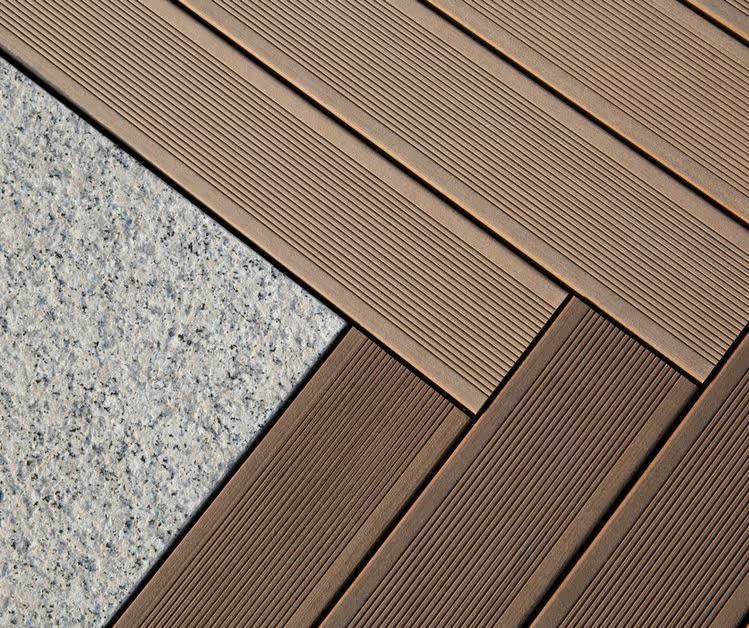
Stone composite decking binds rice husk and recycled mineral content in a polymer matrix instead of wood flour, making it denser and more stable than wood-plastic composite. Tarimatec's Ecofiber is the leading example: a Spanish-made, EPD-verified board we distribute across Canada for freeze-thaw stability and lower heat build-up.
Short answer: Stone composite decking is a board that binds rice husk and recycled mineral content in a polymer matrix instead of the wood flour found in ordinary composite — which makes it denser, more moisture-resistant, and more dimensionally stable. Tarimatec's Ecofiber is the leading example, and we distribute it across Canada from Vaughan, Ontario.
If you've been researching premium decking and keep hitting the phrase "stone composite" — sometimes called mineral composite, sometimes shown as a brand name like Ecofiber — this is the plain-English explainer. We supply Tarimatec across Canada and work alongside the builders who install it, from Halifax waterfronts to Winnipeg backyards, so we'll tell you what the material actually is, where it came from, why its recipe behaves differently in our climate, and where the honest trade-offs sit. Tarimatec is the example we know best because it's the one we distribute — European-engineered, made in Spain by Plásticos Viters S.A., and distributed in Canada by Zinodeck. We're the distributor, not the manufacturer, and we'll keep that straight throughout.
You walked into a showroom, asked about composite decking, and got pointed at two bins — wood-plastic composite and cellular PVC. That's the menu most Canadian buyers are handed, and it's missing a column. Stone composite is its own category, and the difference is in the recipe, not the marketing.
Ordinary composite leans on wood flour or sawdust as its filler. Stone composite throws that out and builds the board around two things instead: rice husk — the hard, silica-rich outer shell of the rice grain, an agricultural by-product that would otherwise be burned or dumped — and a recycled mineral load, typically ground calcite, that adds density and a genuinely stone-like feel underfoot. A polymer matrix locks the two together into a solid, weather-sealed profile. In Tarimatec's Ecofiber, that works out to rice husk at 50 parts for every 100 parts of PVC — roughly a quarter of the blend by weight — with 33% recovered composite re-used in production, per the EPD.
Pick up a board and you'll feel the category change before anyone explains it. Stand a length of stone composite next to a hollow-cell PVC plank on a Vaughan loading dock and the stone board has heft — the mineral content is doing the talking. That weight is the first clue to how it behaves through a Canadian year: more mass, less movement, less water finding its way in.
Here's the question that actually decides your deck in year three, and it's the one the US-written buyer's guides skip: what happens when water gets into the board? Because in Canada, it will try.
Conventional wood-plastic composite (WPC) blends recycled plastic with wood flour, and that wood content is the weak point — it's hygroscopic, meaning it draws in moisture like a sponge. Picture a Muskoka deck through the off-season: it sits empty under snow all winter, then spring melt arrives and the water has nowhere to go but down, pooling under the boards, soaking into anything that wicks, then refreezing on the next cold night. That absorbed water expands as it freezes, and over enough winters that internal pressure is exactly what drives the swelling, surface flaking and cupping that gets a contractor called back out. Here's the part that catches owners off guard: the moisture got in months ago, and the April thaw is just when you finally see it.
Stone composite sidesteps that failure mode at the recipe level, in three ways:
None of this makes WPC a bad product — quality capped WPC from established brands performs well and stays a sensible choice for plenty of decks. The honest framing is that stone composite attacks the single biggest long-term vulnerability of wood-fibre composite, its wood content, by removing wood fibre entirely. For a brand-by-brand view of where each material lands, see our guide to the best composite decking in Canada.
If you're trying to slot this into what you already know, you're probably asking whether "stone composite" is just WPC with a fancier name, or PVC in disguise. It's neither — and here's the comparison on one screen, with Tarimatec's Ecofiber standing in as the stone-composite column because it's the example we can speak to with real numbers.
| Property | Wood-Plastic Composite (WPC) | Cellular PVC | Stone Composite (Tarimatec Ecofiber) |
|---|---|---|---|
| Core organic filler | Wood flour / sawdust | None (fully synthetic) | Rice husk, at 50 parts per 100 parts PVC (no wood flour) |
| Mineral content | Low or none | None | Recycled ground calcite |
| Binder | Recycled polyethylene/polypropylene | PVC | Polymer matrix |
| Moisture absorption | Moderate (wood content) | Very low | Very low |
| Density / feel | Medium | Light, hollow-cell common | High, solid, stone-like |
| Freeze-thaw resilience | Grade-dependent | Strong | Strong |
| Surface heat in sun | Can run hot (dark tones) | Can run hot | Lower build-up (thermal mass) |
| Verified EPD | Varies by brand | Varies by brand | Yes — EPD-IES-0007588:002 |
| Recyclability | Often limited (mixed materials) | Recyclable | 100% recyclable |
The short version: stone composite is not WPC, and it isn't cellular PVC either. It borrows the moisture-resistance of PVC and the recycled-content story of an eco-minded board, then swaps in rice husk for the wood fibre that defines WPC. If you take one row away from that table, make it the moisture line — on a south-facing Toronto deck or a Halifax dock, that's the row you'll be living with.
You've read "95% recycled" on enough brochures to stop trusting the number, and you're right to. Almost every board prints a recycled-content percentage; far fewer can hand you an independently verified document to back it. A number you can't verify is a marketing claim wearing a lab coat — and on a project where a spec writer is going to ask for paperwork, that gap is the whole story.
This is where stone composite, in Tarimatec's case, has something concrete to show. The board carries a verified Environmental Product Declaration registered with EPD International as EPD-IES-0007588:002, valid until 2 December 2027. An EPD is essentially a verified "nutrition label" for a building product: it reports environmental impact across the product's life cycle, measured against an international standard (ISO 14025 / EN 15804) and checked by an independent third party before it's published in a public registry. It is audited data, not a self-declared green claim. Behind it sit ISO 14001 (environmental management) certification, 33% recovered composite re-used in production per the EPD, a feedstock built on a rice-husk by-product, and a board that's 100% recyclable at end of life.
Picture a Halifax waterfront deck taking salt spray off the harbour all summer and freeze-thaw all winter — about the most punishing combination Canada serves up. The owner investing in a board to survive that wants more than a brochure figure; they want a credential that holds up the way they need the deck to. For LEED or BREEAM submissions, a registered EPD outweighs the highest self-reported percentage on the shelf — "up to 95% recycled" with no third party behind it can't always survive a real audit, and a registered EPD can. If your deck is just a backyard project with no specifier in sight, this may not move your decision an inch, and that's fine; we're flagging which column matters for your build and which doesn't. You can review the documentation on the Zinodeck decking and sustainability pages.
This is ultimately why a Spanish-engineered board ends up on Canadian decks. Our climate throws a brutal combination at decking: deep winter cold, repeated freeze-thaw cycling in spring and fall, hard summer UV, road and de-icing salt near entries, and on the West Coast, months of sustained rain. Each of those targets a different weakness in the wrong material.
Stand on a Winnipeg deck in January when it's riding −35°C, then come back in July — that annual swing is the real test, and it's where low moisture absorption and low thermal movement earn their keep. Snow-melt and ponding water don't get drawn into a stone-composite board to drive freeze-thaw damage. High density keeps boards, gaps and fasteners stable as the temperature swings across the year. UV stabilisation protects colour through long, bright summers. And for the wet, icy realities of shoulder season, Tarimatec offers an anti-slip linear-groove finish (it calls it Surco) purpose-built for poolsides, rooftops and rainy-coast decks — where slip resistance is a safety requirement, not a nicety.
The heat question has a slow-burn cousin most people don't think about at purchase. Walk a south-facing Toronto deck off a west-end alley in July and a dark wood-fibre composite can hit 60°C+ in full afternoon sun — hot enough that bare feet do the little hop to the nearest shade and the dog refuses it entirely. The mineral matrix in stone composite resists that heat build-up better than many wood-fibre boards we've worked with. It isn't magic, and no board stays cool in a heatwave, but on the hot-deck question it's the formulation that buys you the most margin.
One caveat we'll always give, because it's true of every board: the material can only do its half. Whatever you choose, follow Canadian board-spacing and hidden-fastener guidance so the deck has room to breathe — we've seen a great board fail on a tight install more often than the other way around. For the pedestal-mounted rooftop and balcony work that's increasingly common on Canadian condos, the stability and drainage compatibility are exactly what an engineer wants to see.
You're not looking for a sales sheet, so here's the trade-off side, because a guide that pretends a material is perfect isn't worth trusting. Stone composite sits at the premium end of the market — above entry-level WPC and well above pressure-treated wood — so the upfront cost is real. The mineral content that makes it stable also makes it heavier to handle: it's not the board you sling around solo on a tight job, and the weight can inform substructure planning. And like all composites in dark colours, it still warms up in direct peak-summer sun — engineered to build up less heat than wood-fibre boards, but not cold to the touch.
The counter-argument is total cost of ownership. Picture the Muskoka cottage owner again, opening up every spring: with composite there's no staining, no sealing, no annual board replacement, so over a 25-year life the premium typically narrows or reverses against wood. You can model that for your own deck with the Zinodeck CAD cost calculator before you commit to anything.
If you're a North American buyer, you're benchmarking everything against Trex, and that's a fair instinct — Trex is an excellent, deservedly popular capped WPC with enormous distribution and a strong track record. The difference here is categorical, not just brand-to-brand. Trex and most of its peers are wood-fibre composites; stone composite like Tarimatec has no wood flour and carries a verified EPD. Each has genuine strengths: Trex wins on ubiquity, colour familiarity and an established North American support network; stone composite wins on dimensional stability from its mineral body, its published environmental documentation, and — in Tarimatec's case — a European design language spanning 31 colours with a dedicated anti-slip finish. For an even-handed, brand-by-brand breakdown, read our comparison of the best composite decking in Canada.
If you're sold on the category and wondering where to start, the buying path for Tarimatec is refreshingly direct, because Zinodeck is its exclusive Canadian distributor. Whether you're a homeowner replacing a tired wood deck, an architect writing an EPD-backed board into a spec, or a contractor sourcing something your clients won't find at the local lumberyard, here's the order of operations we'd give you:
That last point is the unglamorous reason a distributor matters. When a single board gets gouged or a warranty claim comes up in year eight, the question that decides your week is whether someone here can identify the colour and administer the warranty. Working from Vaughan means the colour records, the warranty administration and the people who stand behind them are on this side of the border — and that's the honest case for stone composite as a category and Tarimatec as the example of it we'd put on your deck.
Stone composite decking is a board that binds rice husk and recycled mineral content (typically ground calcite) in a polymer matrix, instead of the wood flour used in ordinary wood-plastic composite. The mineral load makes it denser and more dimensionally stable, so it resists moisture absorption, freeze-thaw movement, UV fade and surface heat build-up more effectively. Tarimatec's Ecofiber, distributed in Canada by Zinodeck, is a leading example.
No. Standard WPC uses wood flour or sawdust as its organic filler, which can absorb water and is the part most prone to swelling, mould and freeze-thaw cracking. Stone composite replaces wood fibre with rice husk plus recycled mineral content, so there's no wood flour to soak up moisture. It's a separate category, often called mineral composite, and it behaves more like PVC on moisture while keeping a strong recycled-content story.
For freeze-thaw stability, yes, by design. Because stone composite absorbs very little moisture, snow-melt and ponding water don't get drawn into the board to drive the expand-and-contract damage that punishes wood-fibre composite over repeated winters. Its high density also keeps boards, gaps and fasteners stable across wide annual temperature swings — from a Winnipeg −35°C January to a Calgary chinook to a 60°C+ July deck surface. Correct board-spacing and fastening still matter on any install.
Tarimatec's Ecofiber does. It carries a verified Environmental Product Declaration registered with EPD International as EPD-IES-0007588:002, valid until 2 December 2027 — an independently verified, standardized report of the product's life-cycle environmental impact. Its manufacturer, Plásticos Viters S.A., is also certified to ISO 14001 (environmental management), and the boards are made with 33% recovered composite re-used in production, per the EPD, and are 100% recyclable at end of life.
Three honest trade-offs: it sits at the premium end of the market on upfront cost; the mineral content that makes it stable also makes it heavier to handle and can inform substructure planning; and like all composites in dark colours, it still warms up in direct peak-summer sun, though it builds up less heat than wood-fibre boards. Over a 25-year life, the maintenance it eliminates — no staining, sealing or board replacement — usually narrows or reverses the cost gap versus wood.
Tarimatec's Ecofiber stone composite is available across Canada exclusively through Zinodeck, the official Canadian distributor based in Vaughan, Ontario. You can order colour and finish samples online, use the CAD cost calculator to estimate a project, and request a direct quote for full boards. Contractors and retailers can apply through the Zinodeck dealer and trade program.
If you've been researching stone composite decking in Canada, you've probably run into two other names: Deckorators Surestone and Tanzite StoneDeck. They belong to the same broad family as Tarimatec Ecofiber — mineral-reinforced composites engineered to move less and absorb less water than standard wood-plastic composite (WPC) — and they're worth understanding before you choose.
Here's how we'd frame it honestly, as the people who supply Tarimatec in Canada:
The honest summary: all three are real stone composites and a clear step up from wood-fibre composites for a cold, wet climate. If third-party-verified sustainability is part of your decision — for a LEED or BREEAM project, a spec, or simply your own peace of mind — Tarimatec Ecofiber is the one in this group that can hand you the documentation to back the claim.
Building the environmental case for your deck? Start with our composite decking sustainability and EPD overview, then compare these guides:
Or go straight to the range: Tarimatec composite decking in Canada · technical data for architects and specifiers · order decking samples.
{"@context":"https://schema.org","@type":"FAQPage","mainEntity":[{"@type":"Question","name":"What is stone composite decking?","acceptedAnswer":{"@type":"Answer","text":"Stone composite decking is a board that binds rice husk and recycled mineral content (typically ground calcite) in a polymer matrix, instead of the wood flour used in ordinary wood-plastic composite. The mineral load makes it denser and more dimensionally stable, so it resists moisture absorption, freeze-thaw movement, UV fade and surface heat build-up more effectively. Tarimatec's Ecofiber, distributed in Canada by Zinodeck, is a leading example."}},{"@type":"Question","name":"Is stone composite the same as WPC (wood-plastic composite)?","acceptedAnswer":{"@type":"Answer","text":"No. Standard WPC uses wood flour or sawdust as its organic filler, which can absorb water and is the part most prone to swelling, mould and freeze-thaw cracking. Stone composite replaces wood fibre with rice husk plus recycled mineral content, so there is no wood flour to soak up moisture. It is a separate category, often called mineral composite, and it behaves more like PVC on moisture while keeping a strong recycled-content story."}},{"@type":"Question","name":"Is stone composite decking better for cold Canadian climates?","acceptedAnswer":{"@type":"Answer","text":"For freeze-thaw stability, yes, by design. Because stone composite absorbs very little moisture, snow-melt and ponding water do not get drawn into the board to drive the expand-and-contract damage that punishes wood-fibre composite over repeated winters. Its high density also keeps boards, gaps and fasteners stable across wide annual temperature swings. Correct board-spacing and fastening still matter on any install."}},{"@type":"Question","name":"Does stone composite decking have a verified EPD?","acceptedAnswer":{"@type":"Answer","text":"Tarimatec's Ecofiber does. It carries a verified Environmental Product Declaration registered with EPD International as EPD-IES-0007588:002, valid until 2 December 2027 — an independently verified, standardized report of the product's life-cycle environmental impact. Its manufacturer, Plásticos Viters S.A., is also certified to ISO 14001 (environmental management), and the boards are made with 33% recovered composite re-used in production, per the EPD, and are 100% recyclable at end of life."}},{"@type":"Question","name":"What is the downside of stone composite decking?","acceptedAnswer":{"@type":"Answer","text":"Three honest trade-offs: it sits at the premium end of the market on upfront cost; the mineral content that makes it stable also makes it heavier to handle and can inform substructure planning; and like all composites in dark colours, it still warms up in direct peak-summer sun, though it builds up less heat than wood-fibre boards. Over a 25-year life, the maintenance it eliminates usually narrows or reverses the cost gap versus wood."}},{"@type":"Question","name":"Where can I buy stone composite decking in Canada?","acceptedAnswer":{"@type":"Answer","text":"Tarimatec's Ecofiber stone composite is available across Canada exclusively through Zinodeck, the official Canadian distributor based in Vaughan, Ontario. You can order colour and finish samples online, use the CAD cost calculator to estimate a project, and request a direct quote for full boards. Contractors and retailers can apply through the Zinodeck dealer and trade program."}}]}