

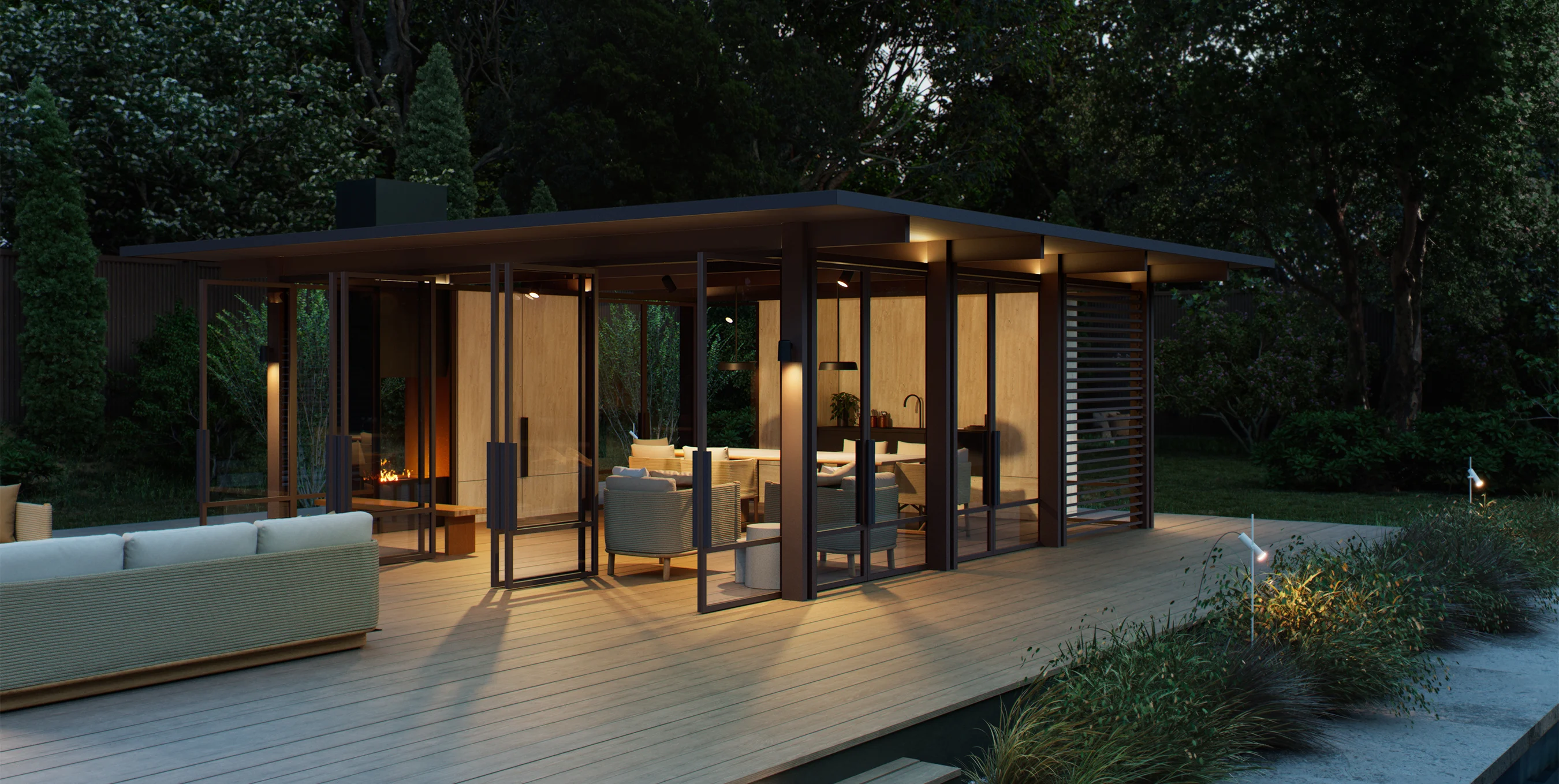
To specify composite decking you need a documentation set, not adjectives: a third-party-verified EPD, ISO 14001, current fire and slip data, a clear warranty, and CAD details. On a real submission a registered EPD beats a self-reported recycled percentage every time, because verification is what a reviewer can file.
Short answer: To specify composite decking on a Canadian project, you need a documentation set rather than a sales sheet — a third-party-verified Environmental Product Declaration (EPD), an ISO 14001 certificate, current fire and slip-resistance data, a clear warranty, and CAD details for your drawings. On a real submission, a registered EPD beats a self-reported recycled percentage every time, because verification is what a reviewer can actually file.
We supply Tarimatec to the architects and builders we work with across Canada, from Toronto spec reviews to Vancouver LEED submissions, so we spend a lot of time on the documentation side of decking rather than the showroom side. The honest truth is that most decking marketing is written for the homeowner picking a colour, not for you writing a section into a project manual. This guide is the other thing — the spec-writer's view of what a board has to prove before it earns a place in your drawings, why a verified document outweighs a glossy percentage, and exactly what to request from the distributor so the line in your spec holds up when someone asks for the paperwork.
When you specify composite decking, you're not really choosing a board — you're choosing a stack of documents that has to survive other people reading it. The board is the easy part. The hard part lands three weeks later when a building envelope consultant, a sustainability reviewer, or a client's QS asks you to substantiate the line you wrote, and the answer can't be "the rep said it was great."
Picture a Toronto architect's spec review on a Thursday afternoon. The drawings are up on the monitor, the team is working down the materials schedule, and someone gets to the deck and asks the only question that matters at that stage: "do we have the EPD for this?" That's the moment a decking choice stops being aesthetic and becomes a documentation problem. A board with a brochure and a confident sales story earns a polite nod and a follow-up email that never gets answered. A board with a registered EPD, ISO certificates, and current test data gets ticked off the list and the meeting moves on.
So before you specify anything, assemble the set a reviewer will eventually ask for — roughly in the order it gets challenged on a Canadian project:
Get the first two wrong and the rest stops mattering: a board you can't document is a board you can't defend, and on a specified project, undefendable is the same as unusable.
You've read "up to 95% recycled" on enough product sheets to have stopped reading it, and on a submission you're right to. Here's the specifier truth most decking brochures bank on you not knowing: a self-reported percentage doesn't survive a LEED documentation review — a registered EPD does. Anyone can print a number about their own product; far fewer can hand you an independently audited document that stands behind it.
An Environmental Product Declaration is, in plain terms, a verified "nutrition label" for a building product. It reports measured environmental impact across the full life cycle — carbon footprint, resource use, end-of-life and more — built to an international standard (ISO 14025 / EN 15804) and checked by an independent verifier before it's published in a public registry. A recycled-content percentage answers one narrow question — how much of this board used to be something else — on the manufacturer's word alone. An EPD answers a much bigger one, with a third party's signature on it. One is a claim; the other is a receipt, and you can file a receipt.
Picture a Vancouver office assembling a LEED v4 submission for a coastal mixed-use building. The materials binder doesn't win the credit with adjectives — it wins with registration numbers a reviewer can verify line by line. This is where a documented board separates from the field: Tarimatec's Ecofiber stone composite carries an EPD registered with EPD International as EPD-IES-0007588:002, verified by Tecnalia, built to EN 15804+A2, and valid until 2 December 2027. We cite the number on purpose, because that's the difference between a claim and a credential — you can look it up. Most brands ranking for "sustainable decking" publish a percentage and a recycling narrative; very few publish a product-specific, registered EPD. On a submission, that gap is the entire decision.
You're not specifying a deck because it's green — you're specifying it because it has to earn its place in a certified building, and "eco-friendly" is a word a reviewer can't award points for. Green-building frameworks don't reward adjectives; they reward documentation, and the documentation is exactly where most decking falls down.
Under LEED v4, the relevant lever sits in the Materials & Resources category — the Building Product Disclosure and Optimization credits, where a product-specific, third-party-verified EPD is precisely the evidence the credit is written around. A self-reported recycled percentage, however high, generally doesn't carry the same weight, because the framework — like an auditor — trusts verification over assertion. Under BREEAM, the Mat 01 (Materials) assessment likewise leans on life-cycle data and verified environmental declarations rather than marketing figures. In both systems, the registered document is the currency; the brochure number is not.
Picture the specifier on a Calgary commercial podium project, building the materials package that has to clear certification before the deck above the parkade gets signed off. They're not choosing the board they like the look of — they're choosing the one they can defend in a binder a reviewer will pick through. The part nobody mentions until that review: "up to 95% recycled" with no third party behind it can't always survive the scrutiny, and a registered EPD can. That's why an EPD-verified board ends up specified on commercial, hospitality and institutional projects where a self-reported one quietly doesn't. If your submission needs an EPD, the verification isn't a nice-to-have — it's the requirement wearing a different hat. We go deeper on verified-versus-claimed in our companion guide to the most sustainable composite decking in Canada.
You're vetting a supplier, not only a product, because you've learned that a good board from a sloppy operation is still a risk you have to carry on your stamp. This is where ISO certification earns its line in the spec — and where most decking marketing goes quiet, because it's unglamorous and hard to fake.
One certification matters most here. ISO 14001 certifies the environmental-management system — how the plant manages its impact, not just what the finished board is made of. Tarimatec's manufacturer, Plásticos Viters S.A., holds it, which tells a reviewer the sustainability is built into how the product is made, audited at the level of the operation itself.
Think of a Halifax coastal project where the deck takes salt spray off the harbour all summer and freeze-thaw all winter, and the envelope consultant is stress-testing every assembly on the drawings. That binder doesn't win an argument with "high quality" — it wins with certificate numbers and ISO scopes a reviewer can verify. When the deck has to be defensible on paper, the management-system certifications do quiet, load-bearing work long before anyone walks on the boards. So when you request documentation, ask for the certificate numbers and issuing body, not a logo on a slide.
You're writing a deck into a drawing that a building envelope consultant and a code reviewer have to sign off on, which means the performance data has to be current and traceable — not a figure you half-remember from a 2022 catalogue. This is the part of the spec where "request the current test data" is genuinely the right instruction, because ratings get re-tested, standards get revised, and the responsible thing to specify against is the live document.
Picture a spec sheet that has to clear a building envelope consultant on a multi-unit project in Ottawa. They'll want the fire performance data appropriate to the assembly and occupancy, the slip-resistance figures for an exterior surface that sees rain, snowmelt and ice, and the structural numbers — span ratings, load behaviour, fastening — that show the board performs as drawn under Canadian conditions. The honest move, and the one we'd give any specifier, is to request the current fire and slip test data plus the structural and span details from the distributor for your specific assembly, and write the spec against those documents rather than a marketing claim. A board worth specifying will have that data ready to send; if the request turns into a runaround, that's information too.
The same logic covers Canadian-climate behaviour. Standard wood-plastic composite carries wood fibre, and wood fibre drinks moisture — every freeze-thaw cycle works it a little harder, which is how a board that looked fine in a showroom shows up cupped in year three. Tarimatec's stone composite binds rice husk and recycled content in a mineral-rich matrix engineered to move less and resist moisture wicking. But on the drawing, it's the test documentation, not the material story, that the consultant signs against — so that's what you request and cite.
You read warranties for a living, so you already know the headline number is the least informative thing on the page. "25-year" or "25–50 yr" reads generous until you open the document and find that most composite warranties split into a fade-and-stain promise and a separate structural promise — and the longest number usually applies to only one of them, often pro-rated, often residential-only. On a commercial spec, residential-only isn't a footnote; it's a disqualifier. So specify against the document, not the marketing: Tarimatec carries a 25-year warranty, and the right move is to request the full written terms and read what's actually covered — the surface-versus-structural split, the commercial scope, the pro-ration schedule, and what's required of the installer to keep it valid. The claim your client makes in year twelve lives in that fine print, and you're the one who put the number in the manual.
Here's the documentation set on one screen — the credentials a specifier actually needs, what each one is for, what to request from the distributor, and where Tarimatec sits today. If you read one column, read the middle one: it's the request list you can lift straight into an email before you write the deck into your manual.
| Document / credential | Why it matters on a spec | What to request | Tarimatec's position |
|---|---|---|---|
| Third-party EPD | The evidence a LEED/BREEAM submission is built around; a self-reported % won't substitute | The registration number and registry link, so you can verify it independently | EPD International EPD-IES-0007588:002, verified by Tecnalia (EN 15804+A2), valid to 2 Dec 2027 |
| ISO 14001 | Certifies the environmental-management system behind the board, not just the board | Certificate number, issuing body and scope | Held by manufacturer Plásticos Viters S.A. |
| Recycled / bio content | The material story behind the sustainability claim | Composition breakdown sitting under the EPD | PVC : rice husk : limestone at 100:50:40 parts; 33% recovered composite re-used in production, documented under the EPD |
| Fire & slip data | What the building envelope consultant and code reviewer sign against for an exterior surface | Current fire and slip-resistance test reports for your specific assembly | Request the current test data from the distributor for your spec |
| Warranty | The real coverage — surface vs structural, commercial vs residential — not the headline number | The full written warranty terms and exclusions | 25-year warranty; request the document for full terms and commercial scope |
| Recyclability & CAD details | End-of-life increasingly counts in credits; CAD/BIM details go straight into your drawings | End-of-life statement and the current CAD/BIM detail pack | 100% recyclable at end of life; request current CAD details from the distributor |
The temptation is to scan that table for the biggest recycled number and stop. Don't. The recycled-content figure is written in the manufacturer's own hand; the EPD and ISO rows are written by someone independent — and on any project with a review in its future, those are the rows that decide whether the board makes the manual.
You want the practical sequence, not a sales pitch — how this goes from a candidate board to a defensible line in your spec. The good news is that the documentation vacuum in this category is wide: there's almost no Canadian B2B content written for the person doing the specifying, so the bar to specify well is mostly about asking for the right documents in the right order.
Here's the workflow we'd walk a specifier through, whether it's a Toronto mid-rise terrace or a Halifax coastal boardwalk. First, request the documentation set up front — EPD registration number, an ISO 14001 certificate, current fire and slip test data, the full warranty terms, the composition breakdown, and the CAD/BIM details — and verify the EPD against the public registry yourself rather than taking the number on trust. Second, confirm the data matches your assembly and occupancy, and that the warranty's commercial scope fits the project. Third, write the spec against those documents by registration and certificate number, not by adjective, so the line substantiates itself when a reviewer pulls on it. Tarimatec is European-engineered, made in Spain by Plásticos Viters S.A., and supplied in Canada exclusively through Zinodeck from Vaughan, Ontario — we're the distributor, not the manufacturer, and we won't dress that up, because a spec built on a claim you can't check is the very thing this guide is against. What we can do is put the documents in your hands. For the material science behind the spec, our explainer on what stone composite decking is goes deeper on the rice-husk recipe.
Strip it back to what "specifiable" has to mean. If you're sketching a deck onto a backyard project with no reviewer in sight, almost any quality composite is a sound choice and the documentation barely matters. But the moment there's a spec review, a building envelope consultant, or a LEED or BREEAM submission attached, the deck is a documentation decision — and the board you can specify is the one whose claims you can verify: a registered third-party EPD, ISO 14001, current fire and slip data, a warranty whose commercial terms you've actually read, and CAD details ready for your drawings. On that test, Tarimatec's Ecofiber stone composite is the spec-ready choice we'd put in front of you — not because we distribute it, but because it can produce the stack when a reviewer asks, and most boards can't.
So don't specify a deck off a screen, and don't specify its sustainability off one either. Put the real documentation in front of whoever's asking, and real samples on the actual project: request samples and spec data, explore the Tarimatec decking range, or model the project cost in CAD before you write the line into your manual.
Building the environmental case for your deck? Start with our composite decking sustainability and EPD overview, then compare these guides:
Or go straight to the range: Tarimatec composite decking in Canada · technical data for architects and specifiers · order decking samples.
{"@context":"https://schema.org","@type":"FAQPage","mainEntity":[{"@type":"Question","name":"How do you specify composite decking for LEED?","acceptedAnswer":{"@type":"Answer","text":"You specify composite decking for LEED by selecting a board with a product-specific, third-party-verified Environmental Product Declaration (EPD) and citing it by registration number in your materials submission. Under LEED v4, the Materials & Resources Building Product Disclosure and Optimization credits are built around verified EPDs, so a registered document carries weight that a self-reported recycled percentage does not. Request the EPD registration number, the registry link and the ISO 14001 certificate from the distributor, verify the EPD against the public registry yourself, and write the specification against those documents rather than against a marketing claim. Tarimatec's Ecofiber stone composite carries an EPD verified by Tecnalia (EPD-IES-0007588:002, EN 15804+A2), which is the kind of evidence the credit is designed around."}},{"@type":"Question","name":"What documentation does an architect need to specify composite decking?","acceptedAnswer":{"@type":"Answer","text":"A specifier needs a documentation set, not a brochure: a third-party-verified EPD with a registration number you can look up, an ISO 14001 certificate, current fire and slip-resistance test data for the specific assembly, the structural and span details, the full written warranty terms including commercial scope, the recycled and bio-content breakdown, an end-of-life recyclability statement, and current CAD/BIM details for the drawings. The verified EPD and the ISO certificates are the documents most often challenged on a Canadian project, because they are written by an independent party rather than by the manufacturer."}},{"@type":"Question","name":"Why does a verified EPD beat a recycled-content percentage on a spec?","acceptedAnswer":{"@type":"Answer","text":"A recycled-content percentage answers one narrow question on the manufacturer's word alone, while an EPD reports measured environmental impact across the full life cycle, built to ISO 14025 / EN 15804 and checked by an independent verifier before publication in a public registry. On a submission, a self-reported percentage generally cannot be filed as evidence because there is no third party behind it, whereas a registered EPD can, because green-building frameworks and reviewers trust verification over assertion. In short, the percentage is a claim and the EPD is a receipt, and a reviewer can only file the receipt."}},{"@type":"Question","name":"How do you get fire and slip ratings for a composite decking spec?","acceptedAnswer":{"@type":"Answer","text":"Request the current fire and slip-resistance test data directly from the distributor for your specific assembly and occupancy, and write the specification against those reports rather than against a catalogue figure that may be out of date. Ratings get re-tested and standards get revised, so the responsible thing to specify against is the live document. A board worth specifying will have current test data ready to send; if a request for it turns into a runaround, that is useful information about the supplier as well. For Tarimatec, the current fire, slip and structural data is available on request from Zinodeck for the project assembly."}},{"@type":"Question","name":"Does composite decking contribute to BREEAM?","acceptedAnswer":{"@type":"Answer","text":"It can, but only where the sustainability is documented rather than claimed. BREEAM's Mat 01 (Materials) assessment leans on life-cycle data and verified environmental declarations rather than marketing figures, so a board with a product-specific, third-party-verified EPD contributes in a way a self-reported recycled percentage does not. The same registered EPD that supports a LEED v4 materials submission is the evidence that supports a BREEAM materials assessment, which is why an EPD-verified board is the one that ends up specified on certified commercial and institutional projects."}},{"@type":"Question","name":"Is Tarimatec composite decking made in Canada?","acceptedAnswer":{"@type":"Answer","text":"No, and we won't pretend otherwise. Tarimatec is European-engineered and manufactured in Spain by Plasticos Viters S.A., and it is supplied in Canada exclusively through Zinodeck from Vaughan, Ontario; Zinodeck is the distributor, not the manufacturer. For a specifier, the country of origin is rarely the deciding factor on a documented project anyway, because what a reviewer files is the verified EPD, the ISO certificates and the current test data. Those credentials, plus a Canadian distributor who can put the documents and CAD details in your hands, are what make the board specifiable here."}}]}