

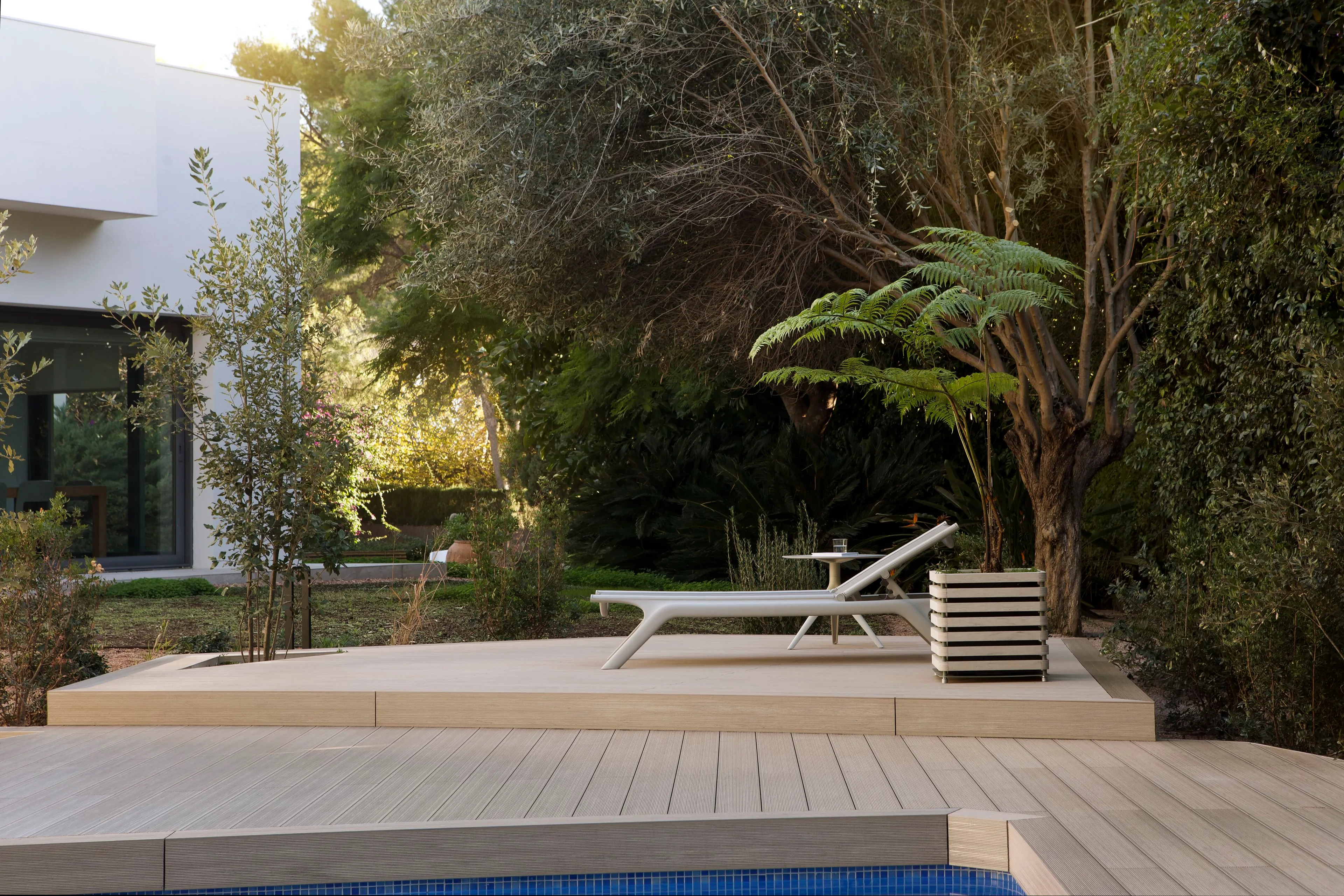
Rooftop decking in Canada almost never penetrates the roof membrane — you float the deck on adjustable pedestals or sleepers above it. Weight and structural load, drainage, and wind uplift decide the design more than the board does, so confirm load capacity with your structural engineer and local code first.
Short answer: Rooftop decking in Canada almost never penetrates the roof membrane — you float the deck on adjustable pedestals or sleepers above it. Weight and structural load, drainage, and wind uplift decide the design far more than the board does, so confirm load capacity with your structural engineer and local code before you choose anything.
We supply Tarimatec Ecofiber stone composite to builders across Canada — from downtown Toronto condo terraces to Vancouver podium decks — and work alongside the crews who install it, so we see where rooftop projects succeed and where they go sideways. The honest truth most rooftop guides bury is that the board is the easy part. A rooftop deck is a structural and water-management problem first and a finish problem second. Get the pedestal system, the load math, the drainage, and the wind detailing right, and almost any quality board will look good on top. Get them wrong and the nicest board on the market won't save you.
So this guide walks the rooftop the way we'd talk it through with your builder on site: building over a membrane without piercing it, why weight is the first question, how water has to leave, what wind does up high, how Canadian freeze-thaw and snow factor in, what it costs in CAD, and only then which board to put on top. Most of it applies whether you finish in Tarimatec, a wood-plastic composite, or porcelain — we'll be straight about where each fits.
If you're picturing a rooftop deck the way you'd build a backyard one — joists, posts, screws into the structure — set that picture down. On a roof or podium, the single most important rule is the one that protects the thing keeping water out of the building below: you almost never penetrate the waterproofing membrane. Instead, the deck floats above it.
Picture a downtown Toronto condo terrace over a torch-applied membrane. The roof slopes slightly for drainage — every roof does — so a deck laid straight onto it would tilt and pond. The fix is an adjustable pedestal system: small, height-adjustable supports that sit on the membrane and carry the deck above it. Dial each pedestal to a different height and you get a dead-level walking surface over a sloped roof, with an open air gap underneath that lets water run to the drains. Nothing screws through the membrane; the deck's own weight holds it in place. Tarimatec works on pedestals in both plank and tile formats — the tile format clicks in, floats above the membrane, and lifts out for access, which is exactly why stone composite suits the job.
The older, lower-cost approach is a sleeper system: rails (often on protective pads) that sit on the membrane with the boards fixed to them. Sleepers can work on a low-slope roof, but they don't correct slope the way pedestals do, they sit closer to the membrane with less drainage clearance, and they're fussier to level. For most Canadian rooftop and terrace projects we see, adjustable pedestals are the cleaner answer — they protect the membrane, drain freely, and come apart for maintenance. Either way, the membrane has to be sound and the system compatible with it, so loop in your roofing or waterproofing contractor before anyone orders decking.
Here's the question we ask before anyone talks about finishes: how much load can your roof actually carry? A backyard deck transfers its weight into the ground. A rooftop deck transfers everything — the boards, the pedestals, the furniture, the people, the snow — into the building structure underneath. That structure has a finite capacity, and it's not a number you guess at.
This is also where we'll be honest about our own product, because integrity matters more than a sale. Stone composite is denser and heavier than hollow wood-plastic composite — that mineral-rich matrix that gives Tarimatec its freeze-thaw stability also gives it weight. On the ground that's irrelevant. On a weight-constrained roof it's a real consideration, and we won't pretend otherwise. If your structural engineer comes back with a tight load budget, a lighter board on pedestals may be the right call, and that's a conversation we'd rather have honestly than oversell into.
Picture a Calgary high-rise balcony slab, already cantilevered out from the building and carrying its own limits, versus a purpose-built podium deck over a Vancouver parking structure, engineered from the start to carry a landscaped terrace. Those are wildly different load situations — the same deck build could be fine on one and over budget on the other. We won't quote a load number here: live and dead load capacity depend entirely on your structure, and the only right figures are the ones your structural engineer confirms against the National Building Code and your local requirements. What we'll say plainly is to get that assessment before you fall in love with a board, because the structure decides what's possible and everything else follows from it.
On a backyard deck, water that gets through the gaps just lands on the dirt and disappears. On a roof, every drop has to find its way to a drain — and your deck sits directly in that path. So a rooftop deck has one non-negotiable job beyond looking good: it can't trap water against the membrane.
This is the quiet advantage of a pedestal system. Because the deck floats on supports with an open gap beneath it, the entire surface becomes a drainage plane: rain and snowmelt fall through the board gaps, hit the membrane below, and run down its built-in slope to the roof drains, completely independent of how level your walking surface is. Picture a Vancouver podium deck under a January atmospheric river — days of rain. With pedestals, that water sheets straight through to the membrane and away. With boards laid tight on a flat surface, you'd be channelling it across the top and praying it finds an edge.
The board matters here too, and it's where stone composite earns its place on a roof. Tarimatec's dense, non-porous core doesn't drink standing water the way wood-fibre boards can, so shoulder-season snowmelt and rain run off and drain rather than soaking in and waiting to freeze. Two things we'd flag to any rooftop crew: keep the membrane's slope and drains clear and accessible (a floating deck must let you reach drains — another reason removable pedestal tiles win), and confirm the drainage approach with your roofing contractor so the deck and roof work as one system, not two.
You think about wind on a rooftop in a way you never would at grade, because up there it behaves differently — it accelerates over building edges and it lifts. A deck that floats on pedestals is, by design, not fastened down, which makes wind uplift a genuine engineering question rather than an afterthought, especially on exposed and tall buildings.
Picture a Halifax waterfront rooftop taking the full reach of an Atlantic gale off the harbour — wind and salt together, the most exposed corner Canada serves up — or the upper floors of a Toronto tower where the building funnels and speeds the wind at the parapet. In those conditions, the loose-laid deck that's perfect for drainage needs a plan so wind can't get under boards and lift them. Engineered pedestal systems address this through added board fixings, wind clips, ballast, or perimeter detailing — but which measure your project needs depends on building height, exposure, and local wind load, values the National Building Code and your structural engineer define for your site. We won't put a wind number on the page we can't stand behind for your building. The takeaway: on anything tall or exposed, treat uplift as a design input from day one, not a detail bolted on at the end. Tarimatec's Surco anti-slip finish, worth specifying on any rooftop for wet traction, is a separate question from uplift — plan for both.
Your rooftop deck has to survive a Canadian winter doing two things at once: holding up under snow, and riding the freeze-thaw cycle without the surface degrading. Both deserve a plan, and the US-written rooftop guides skip both.
Snow is a load, and on a roof it's a load the building already accounts for — which is exactly why your deck build can't ignore it. Picture a Montreal terrace under a heavy February dump, or a Toronto roof where days of accumulation sit until a thaw. That snow weight stacks on top of your deck's weight, and the total has to live within the structure's capacity. This is the same reason the weight conversation comes first: your engineer sizes the whole picture — deck, occupants, furniture, and design snow load — against what the roof can carry, using the snow load your local code assigns to your location. It's not a number we'd invent; it's one your engineer confirms.
Freeze-thaw is the other half, and it's where board choice quietly pays off. A rooftop surface in Canada can swing from deep cold to baking sun on the same south-facing afternoon, and meltwater that soaks into a porous board then refreezes is the mechanism behind cupping, checking, and spalling. Tarimatec's stone composite binds rice husk and recycled content in a mineral-rich matrix engineered to move less and resist moisture wicking — less water in, less movement, fewer surprises in year three. On a roof, where you really don't want to be pulling and replacing boards, that dimensional stability is worth more than it is at grade. One honest caveat true of every board: it can only do its half. Follow the manufacturer's spacing and expansion guidance for your install temperature so the deck can breathe through the seasons — we've seen good boards fail on tight installs more often than the reverse.
You're trying to budget, so let's be straight: a rooftop deck costs more than a backyard one, and the reason isn't the board — it's everything underneath and around it. A ground-level composite deck in Canada typically runs about $40 to $75 per square foot installed. A rooftop or podium deck climbs from there, and here's where the extra money goes.
First, the structural assessment — the engineer's review of what your roof can carry — isn't optional on a rooftop, and it's money spent before a single board arrives. Second, the membrane: if your roof's waterproofing is aging or not rated for a deck above it, that work happens first, and it isn't cheap. Third, the support system — adjustable pedestals add real cost over a backyard's simple footings, and they're what makes the whole thing drain and sit level. Then the decking: a premium board like Tarimatec sits around $14 to $20 per square foot for materials, with wood-plastic composite below it. Add access, logistics (getting material onto a roof is its own line item in a downtown core), and labour, and a rooftop deck lands well above grade-level numbers.
The honest way to read that premium: the structure and the membrane protect the building, so they're the costs you never cut. The board is where you choose finish and lifespan. For a Toronto condo terrace, the difference between a board you wash and one you re-seal every spring is the difference between an amenity and a chore. For your own dimensions in CAD, run the Zinodeck cost calculator, and for the full grade-level picture see our composite decking cost in Canada guide — then layer the rooftop extras on top.
If you read nothing else, read this. These are the five factors that decide a Canadian rooftop deck, what to plan for on each, the climate wrinkle, and — because most of these aren't DIY calls — who to confirm them with. We've kept it honest and free of invented load numbers, because the only load figures that matter are the ones your engineer signs off on.
| Factor | What to plan for | Canadian-climate note | Who to confirm with |
|---|---|---|---|
| Pedestal system | Float the deck on adjustable pedestals over the membrane; never penetrate it. Tile format lifts out for drain access. | Corrects roof slope to a level surface while leaving a drainage gap for rain and snowmelt. | Roofing / waterproofing contractor + decking supplier |
| Weight & load | Total the deck, pedestals, furniture, people and snow against the roof's capacity. Stone composite is heavier than hollow WPC — a real factor on tight roofs. | Design snow load adds to the total every winter and must fit within capacity. | Structural engineer + local building code (NBC) |
| Drainage | Keep water moving to the roof drains; floating decks let it sheet through to the membrane below. Keep drains accessible. | Atlantic rivers, spring melt and shoulder-season rain all have to leave fast. | Roofing contractor |
| Wind uplift | On tall or exposed buildings, plan fixings, clips, ballast or perimeter detailing so wind can't lift loose-laid boards. | Wind accelerates over parapets and off open water (think Halifax harbour). | Structural engineer + local wind-load code |
| Board choice | Pick a stable, non-porous, anti-slip board (specify the Surco finish). The board is the last decision, not the first. | Freeze-thaw and hard UV reward a mineral-rich board that resists moisture and fade. | Decking supplier (samples on the actual roof) |
With the structure, drainage, and wind sorted, you've finally earned the fun decision: what you actually walk on. And on a rooftop, where access is hard and replacing boards is a project you never want to repeat, the board's job is to be stable, non-porous, slip-safe, and low-maintenance for the long haul.
This is the one we distribute, so take the enthusiasm with the disclosure — but the reasons are documented, not decorative. Tarimatec Ecofiber stone composite is European-engineered, made in Spain by Plásticos Viters S.A., and selected for Canadian weather; Zinodeck is its exclusive Canadian distributor, supporting it from Vaughan, Ontario. It is not made in Canada, and we won't pretend otherwise. What it brings to a roof: a dense, non-porous, mineral-rich core (rice husk at 50 parts for every 100 parts of PVC — roughly a quarter of the blend by weight — and 33% recovered composite re-used in production, per the EPD) that resists the moisture wicking and freeze-thaw movement a rooftop punishes a board with; pedestal-compatible plank and tile formats that float over a membrane and lift out for drain access; a Surco anti-slip finish for wet traction; and 31 colours to match a building facade. It's backed by a Tecnalia-verified Environmental Product Declaration, ISO 14001 certification, and a 25-year warranty, and it's 100% recyclable at end of life — the documentation an architect specifying a condo amenity deck or a LEED project actually needs.
The one trade-off, stated honestly because we opened with it: that mineral density is also weight, and weight is the variable a roof cares about. If your engineer's load budget is tight, a lighter board on pedestals may suit the structure better, and we'd tell you so. Tarimatec's case on a rooftop is durability, verified sustainability, and freeze-thaw stability — not being the lightest board in the room. Where the load capacity allows it, that's a strong combination for a deck that has to look good and behave for decades over a membrane you never want to disturb. For the deeper material comparison, our best composite decking in Canada guide lays out how stone composite stacks against the wood-plastic field.
However you lean, don't choose a rooftop board off a screen — boards read completely differently in your own rooftop light, and weight, drainage, and wind all have to be settled with your engineer and roofing contractor regardless of which board wins. Put real samples on the actual roof, in the actual sun: order Tarimatec samples, explore the full composite decking range, and estimate your rooftop project in CAD with the Zinodeck calculator before you commit to a single board.
Or go straight to the range: Tarimatec composite decking in Canada · technical data for architects and specifiers · order decking samples.
{"@context":"https://schema.org","@type":"FAQPage","mainEntity":[{"@type":"Question","name":"Can you put composite decking on a rooftop?","acceptedAnswer":{"@type":"Answer","text":"Yes. Rooftop composite decking is well established, but you almost never fasten it through the roof. Instead the deck floats above the waterproofing membrane on adjustable pedestals (or sometimes sleepers), correcting the roof's slope to a level surface while leaving a drainage gap underneath. The board choice matters less than the structure: confirm your roof's load capacity, drainage, and wind detailing with a structural engineer and your roofing contractor before ordering decking."}},{"@type":"Question","name":"Do you have to use a pedestal system for a rooftop deck?","acceptedAnswer":{"@type":"Answer","text":"Not always, but for most Canadian rooftop and terrace projects an adjustable pedestal system is the cleaner answer. Pedestals correct the roof's drainage slope to a dead-level walking surface, leave an open air gap so water drains to the membrane and the roof drains, protect the membrane because nothing penetrates it, and come apart for maintenance and drain access. A sleeper system can work on a low-slope roof but offers less drainage clearance and doesn't correct slope. Confirm compatibility with your roofing or waterproofing contractor."}},{"@type":"Question","name":"How much weight can a rooftop deck hold?","acceptedAnswer":{"@type":"Answer","text":"That depends entirely on your specific building, and it is not a figure to guess at. A rooftop deck transfers all of its weight — boards, pedestals, furniture, people, and snow — into the structure below, which has a finite capacity. Stone composite is denser and heavier than hollow wood-plastic composite, so it is a real consideration on weight-constrained roofs. The only correct load numbers are the live and dead load capacities your structural engineer confirms against the National Building Code and your local requirements, including the design snow load for your location."}},{"@type":"Question","name":"How does a rooftop deck drain?","acceptedAnswer":{"@type":"Answer","text":"With a floating pedestal system, the whole deck becomes a drainage plane: rain and snowmelt fall through the gaps between boards, hit the waterproofing membrane below, and run down its built-in slope to the roof drains, independent of how level the walking surface is. A dense, non-porous board such as Tarimatec stone composite helps because it doesn't absorb standing water before it can drain. Keep the membrane's slope and drains clear and accessible, and confirm the drainage approach with your roofing contractor so the deck and roof work as one system."}},{"@type":"Question","name":"Is stone composite decking too heavy for a roof?","acceptedAnswer":{"@type":"Answer","text":"It can be a consideration, and we're honest about that. Stone composite's mineral-rich matrix gives it excellent freeze-thaw stability but also makes it denser and heavier than hollow wood-plastic composite. On the ground that's irrelevant; on a weight-constrained roof it matters. Whether it suits your roof depends on the load capacity your structural engineer confirms. If the load budget is tight, a lighter board on pedestals may be the better fit — but where capacity allows, stone composite's durability and freeze-thaw performance make it a strong rooftop choice."}},{"@type":"Question","name":"What is the best decking for a rooftop or condo terrace in Canada?","acceptedAnswer":{"@type":"Answer","text":"The best rooftop board is stable, non-porous, slip-resistant when wet, and low-maintenance, because access is hard and you don't want to replace boards. Tarimatec Ecofiber stone composite fits this well: a dense non-porous core that resists moisture and freeze-thaw movement, pedestal-compatible plank and tile formats that float over a membrane and lift out for drain access, an anti-slip Surco finish, 31 colours to match a building facade, plus a Tecnalia-verified EPD, ISO 14001 certification and a 25-year warranty. Confirm your roof's load capacity allows the board's weight with your structural engineer first."}}]}