

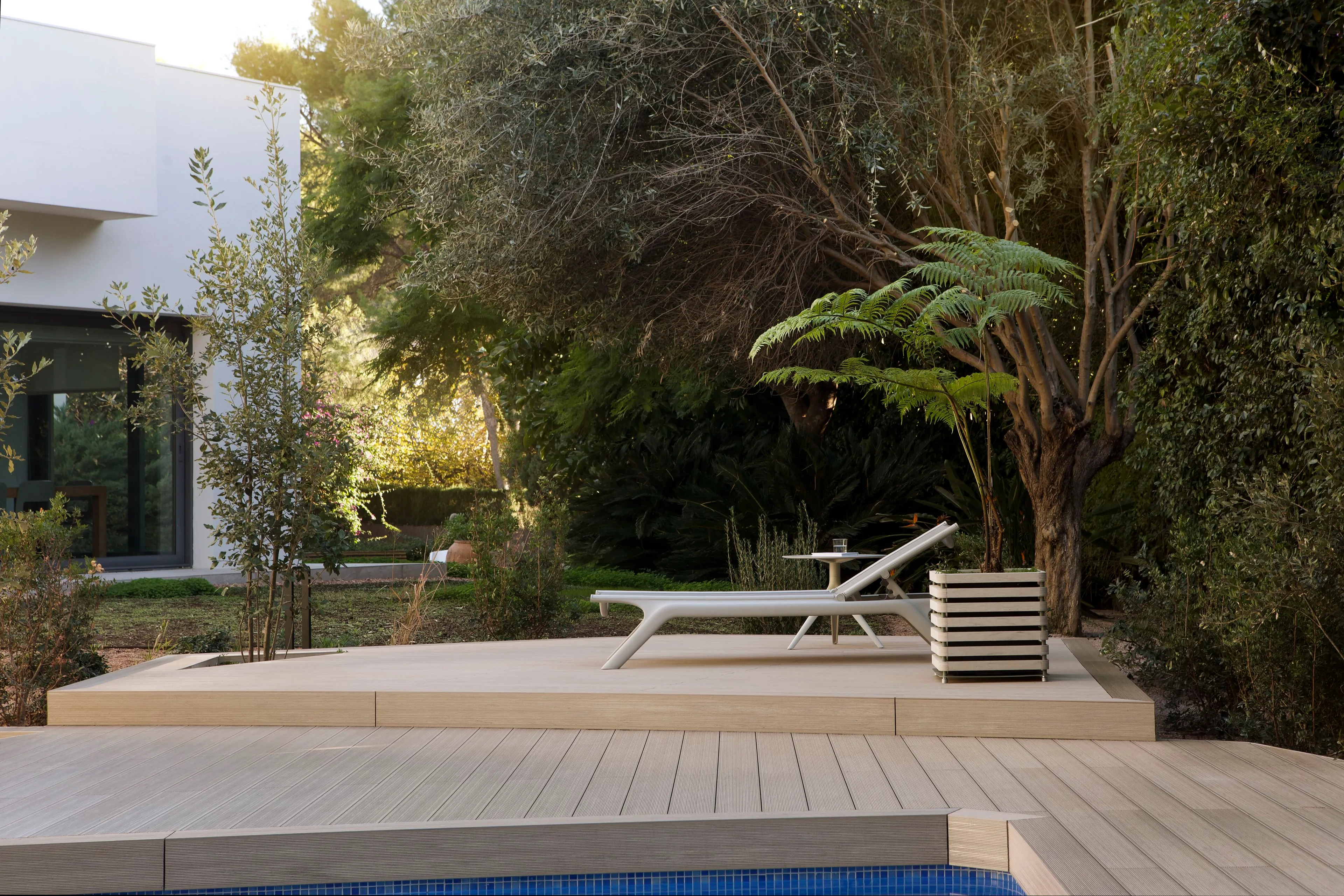
Specify a pool surround to Class 3 / R11 wet slip resistance under UNE-ENV 12633, the highest class in that system. Tarimatec is classified there, absorbs 0.59 % water at 24 hours under UNE-EN 317, and fixes with 316L stainless clips. The data is European, with no CCMC evaluation behind it.
Short answer: Specify a pool surround to Class 3 / R11 wet slip resistance under UNE-ENV 12633 — Class 3 is the highest class in that system. Tarimatec is classified there, absorbs 0.59 % water at 24 hours under UNE-EN 317, and fixes with 316L stainless clips. The data is European, and no CCMC evaluation stands behind it.
You are drawing a pool surround, and the question that comes back at you in review will not be which colour the client liked. It will be what the surface does wet, barefoot, under a lifeguard's sightline. Slip resistance is the first line of that specification, and the line most often written badly, because the two halves of this industry measure friction differently and quote the results as though they were interchangeable.
Picture a hotel pool terrace in Halifax in August. Salt off the harbour, chlorinated splash-out across the coping, sunscreen worked in by a few hundred wet feet a day, a crew hosing it down at six in the morning. That is the service condition. Here is what to write, what the Tarimatec composite decking range can document, and — just as important here — what it cannot.
Tarimatec's slip figure is a classification, not a coefficient: Class 3 / R11 in the wet condition, to UNE-ENV 12633. That standard is the Spanish and wider European method built around a swinging pendulum with a rubber slider dragged across a wetted surface; the energy the slider loses is banded into classes. Class 3 is the top band, and the class European codes attach to pool surrounds, changing areas and exterior floors walked on wet.
A Canadian spec writer is more likely trained on the North American approach: a dynamic coefficient of friction measured on a tribometer, reported as DCOF, with the familiar 0.42 wet threshold from the ANSI A326.3 family. It is tempting to line the two up. Do not. Different instruments, different contact materials, different sliding speeds, different pass criteria — and no defensible conversion between them. If your project manual or your authority having jurisdiction calls for a DCOF value, a Class 3 classification does not satisfy that clause on its face. Ask for the DCOF test in writing rather than accept a translated number from anybody's sales sheet.
What Class 3 does tell you is real: on the European wet-pendulum test this surface sits in the highest band. Ask for the report itself, not the line in the brochure. There is more on texture underfoot in our guide to whether composite decking is slippery when wet.
Pool chemistry is unkind to porous materials. Chlorinated water carries oxidising chemistry into every open pore, salt systems leave a residue that draws moisture back in, and sunscreen leaves an oily film that holds both. A board that drinks even a little of that gets a longer exposure than the splash suggests.
Tarimatec is a PVC-mineral composite — PVC, rice husk and limestone — tested to UNE-EN 317 for water absorption at 0.59 % at 24 hours in the hollow profile, 0.38 % in the solid profile and 1.66 % at 28 days. Small numbers, but numbers, not zero, and they are the ones to write into the manual. The practical consequence shows at the cut ends. On a wood-fibre composite a saw cut exposes wood flour that will wick; here there is no wood flour to wick, so a mitred edge at the coping behaves broadly like the face of the board. What you protect at a cut end is the fixing, not the fibre.
The board survives the pool. The steel is what you have to think about. The hidden clip system comes in AISI 304L and 316L stainless at 25 clips per square metre, and for a chlorinated or coastal deck you specify 316L and write the grade into the schedule. The difference is molybdenum: 316L resists chloride pitting in a way 304L does not, and pitting is the failure mode a pool deck produces — a slow freckling under the boards that nobody sees until a clip lets go.
It is the most common omission on pool specifications. The board gets three paragraphs, the fastener none, and site takes whatever arrives. On a Muskoka lakeside pool the consequence is slow and cosmetic. On a Halifax waterfront terrace, with salt spray on top of pool chemistry, it is neither. The clip grade belongs in the fixing schedule, in writing.
Slip class does its work in the two seconds before the water leaves, so everything that shortens that window helps. Tarimatec sits on aluminium joists in EN AW 6005 T6 at 350 mm spacing: a sub-frame that does not rot, does not move seasonally the way timber sleepers do, and can sit on adjustable pedestals to build fall without shimming a wooden frame into a slope.
Draw the fall away from the pool, keep the board gaps clear, and cross-ventilate the cavity so splash-out drains and dries rather than sitting on the membrane. Where the deck meets a coping detail, check that the water leaving the boards has somewhere to go that is not the joint you just drew. There is more in our Tarimatec installation guidance.
Nobody wears shoes on a pool deck, so surface temperature is a comfort specification. Tarimatec's white colour is reported at SRI greater than 80 in Tecnalia report 082062-002, measured to ASTM E1980. On a Toronto rooftop pool in July that is the difference between a deck people cross and a deck people hop across.
Now the caveat, because it matters: that figure is for one colour. It is not a range value across the palette, and it should not be presented as one. A dark board in the same range will run hotter, as every dark exterior surface does. If barefoot comfort is a design requirement, specify at the light end of the 31-colour finish range, and read our explainer on whether composite decking gets hot before you commit to a dark deck around water.
| Property | Value | Standard / source |
|---|---|---|
| Wet slip resistance | Class 3 / R11 (highest class) | UNE-ENV 12633 |
| Water absorption, 24 h | 0.59 % hollow; 0.38 % solid | UNE-EN 317 |
| Water absorption, 28 days | 1.66 % | UNE-EN 317 |
| Reaction to fire, floorings | Bfl-s1 | UNE-EN 13501-1 |
| External fire, roof exposure | Broof(t1) | ENV 1187 |
| Solar reflectance index, white | SRI greater than 80 (one colour only) | Tecnalia 082062-002, ASTM E1980 |
| Hidden clips | AISI 304L / 316L stainless, 25 per square metre | Manufacturer system data |
| Sub-frame | Aluminium EN AW 6005 T6, 350 mm joist centres | Manufacturer system data |
| Warranty | 25-year manufacturer warranty from Tarimatec, administered in Canada by Zinodeck; excludes damage from weight overload | Warranty document |
Every figure above was generated to European standards, in European laboratories. Tarimatec does not hold a CAN/ULC S102 surface-burning test, and holds no CCMC evaluation report today. For a private pool surround or a hospitality terrace outside the combustible-cladding provisions, that is usually not the gate. For a multi-family or institutional project where the reviewer wants a Canadian evaluation, it can be — establish that early, not at submission. The full picture is in our post on multi-family balconies and Canadian fire ratings, and the documentation set we can supply is listed on our page for architects and specifiers.
No. They are separate systems. UNE-ENV 12633 uses a swinging pendulum with a rubber slider and reports a class from 0 to 3; DCOF is a tribometer measurement reported as a coefficient. The instruments, contact conditions and pass criteria differ, so the two results should never be equated or converted. If your specification calls for DCOF, request that test.
The board is a PVC-mineral composite with no wood flour, and it absorbs 0.59 % water at 24 hours in the hollow profile and 0.38 % in the solid profile under UNE-EN 317. The part of the assembly that needs attention around chlorine and salt is the metal, which is why 316L stainless clips are specified for pool and coastal decks rather than 304L.
Tarimatec is installed on aluminium joists in EN AW 6005 T6 at 350 mm centres. Around a pool, set the frame on adjustable pedestals so you can build fall away from the water, keep the board gaps clear, and ventilate the cavity so splash-out drains and dries instead of sitting on the membrane.
The white colour is reported at a solar reflectance index greater than 80 in Tecnalia report 082062-002, measured to ASTM E1980. That figure applies to one colour only and should not be read across the palette. Darker boards will run hotter, as any dark exterior surface does, so specify at the light end of the range where barefoot comfort matters.
For private pool surrounds and most hospitality terraces outside the combustible-cladding provisions, yes, because the test data required is slip, water absorption and the system details. Where the authority having jurisdiction requires a Canadian evaluation for the occupancy, Tarimatec cannot be specified on European data alone today. Confirm that requirement before you write the board into the manual.
Start with the test reports rather than the colour chart. Our hospitality decking page sets out how these decks go together, you can request a project quote in CAD, and you can order decking samples — paid, shipping from Vaughan, Ontario in 5 to 10 business days — so your client can stand on a wet board before you commit.
{"@context": "https://schema.org", "@type": "FAQPage", "mainEntity": [{"@type": "Question", "name": "Is Class 3 under UNE-ENV 12633 the same as a DCOF of 0.42?", "acceptedAnswer": {"@type": "Answer", "text": "No. They are separate systems. UNE-ENV 12633 uses a swinging pendulum with a rubber slider and reports a class from 0 to 3; DCOF is a tribometer measurement reported as a coefficient. The instruments, contact conditions and pass criteria differ, so the two results should never be equated or converted. If your specification calls for DCOF, request that test."}}, {"@type": "Question", "name": "Does chlorinated or salt water damage Tarimatec decking?", "acceptedAnswer": {"@type": "Answer", "text": "The board is a PVC-mineral composite with no wood flour, and it absorbs 0.59 % water at 24 hours in the hollow profile and 0.38 % in the solid profile under UNE-EN 317. The part of the assembly that needs attention around chlorine and salt is the metal, which is why 316L stainless clips are specified for pool and coastal decks rather than 304L."}}, {"@type": "Question", "name": "What joist spacing does a pool deck need?", "acceptedAnswer": {"@type": "Answer", "text": "Tarimatec is installed on aluminium joists in EN AW 6005 T6 at 350 mm centres. Around a pool, set the frame on adjustable pedestals so you can build fall away from the water, keep the board gaps clear, and ventilate the cavity so splash-out drains and dries instead of sitting on the membrane."}}, {"@type": "Question", "name": "Will a Tarimatec pool deck be too hot to walk on barefoot?", "acceptedAnswer": {"@type": "Answer", "text": "The white colour is reported at a solar reflectance index greater than 80 in Tecnalia report 082062-002, measured to ASTM E1980. That figure applies to one colour only and should not be read across the palette. Darker boards will run hotter, as any dark exterior surface does, so specify at the light end of the range where barefoot comfort matters."}}, {"@type": "Question", "name": "Can Tarimatec be specified on a Canadian pool project without a CCMC evaluation?", "acceptedAnswer": {"@type": "Answer", "text": "For private pool surrounds and most hospitality terraces outside the combustible-cladding provisions, yes, because the test data required is slip, water absorption and the system details. Where the authority having jurisdiction requires a Canadian evaluation for the occupancy, Tarimatec cannot be specified on European data alone today. Confirm that requirement before you write the board into the manual."}}]}