

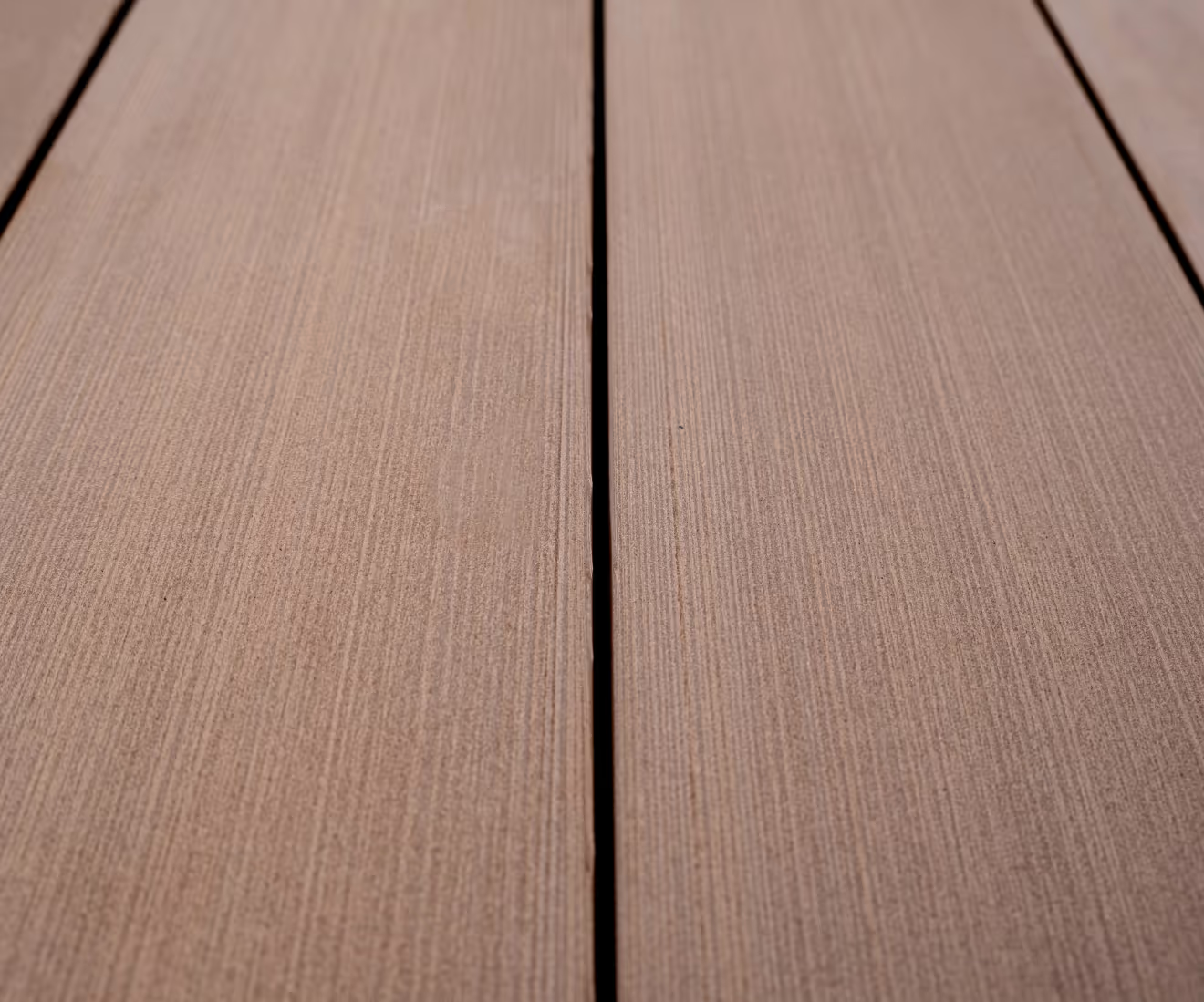
Composite decking costs more up front, gets hot in dark colours, is not structural, scratches permanently, moves with temperature so gaps are mandatory, and locks in your colour for good. None of that makes it a bad choice. It makes it a choice with real trade-offs you should see before you sign.
Short answer: Composite decking costs more up front, gets hot in dark colours, is not structural, scratches permanently, moves with temperature so gaps are mandatory, and locks in your colour for good. None of that makes it a bad choice. It makes it a choice with real trade-offs you should see before you sign.
Every product page you have read this week was written to sell you something, ours included. So this is the page we would rather you read first: the whole honest list, including the parts that are awkward for us. If you still want the boards afterwards, you will be a much happier customer.
Composite is a premium category and pretending otherwise is how people end up resentful in year one. Here is the public Canadian price ladder, from Home Depot Canada and named dealer listings, verified September 2026, in Canadian dollars per linear foot.
| Board | CAD per linear ft |
|---|---|
| Veranda Meadow | 3.04 |
| Trex Enhance Basics | 3.45 |
| MoistureShield Elevate | 3.69 |
| Trex Enhance Naturals | 4.67 |
| TimberTech Prime+ | 4.92 |
| MoistureShield Vision CoolDeck | 7.80 |
| Fiberon Concordia | 8.98 |
| Trex Transcend | 9.45 |
| TimberTech Landmark Advanced PVC | 10.62 |
| TimberTech Vintage Advanced PVC | 11.87 |
That is a four-fold spread inside one category, before a single joist is bought, and pressure-treated timber sits below all of it. Tarimatec is quoted per project rather than off a shelf, so you will not find us on that ladder, but nothing in this category is cheap on day one. You can model your own square footage with our CAD project calculator before you commit.
Stand on a south-facing Toronto rooftop at three in the afternoon in July and no marketing claim survives. Dark boards absorb solar energy and hold it, the surface climbs well past comfortable, and bare feet do the little hop to the nearest shade. This is physics, and every synthetic decking material on the market is subject to it.
Colour beats chemistry here. Tarimatec publishes a solar reflectance index above 80 on the white colour, from Tecnalia report 082062-002 measured to ASTM E1980, and we say white specifically because that is the one colour the figure applies to. If you are set on charcoal for a full-sun rooftop, choose it with your eyes open and plan shade. Our guide to how hot composite decking gets works through the whole picture.
The boards are a surface. They carry you, not the deck. Everything below, the beams, the posts, the footings and the joist spacing, is engineering that a good board cannot rescue. The Tarimatec system uses aluminium EN AW 6005 T6 joists at 350 mm centres, and stretching that spacing to save on joists is the most common way a premium deck ends up feeling cheap underfoot.
And composite scratches. Drag a cast-iron planter across it, or a barbecue with a broken castor, and you will leave a mark. Here is the part that matters more than the scratch: unlike a timber deck, you cannot sand a deep gouge out. On cedar, a Saturday with a sander and some oil buys you a new-looking deck. On any composite, the fix for a real gouge is replacing that board. If your deck is a family workshop as much as a lounge, weigh that honestly.
Every decking material expands and contracts with temperature, and Canada asks more of that than most places. A Calgary chinook can swing the surface twenty degrees in an afternoon, and a deck installed tight in October has nowhere to send that movement in July.
So gapping is mandatory, at the ends and between boards, and it is set by board length, site and the temperature on the day of install. Which means a composite deck shows a sloppy install more plainly than timber does. Uneven gaps, a wandering line, a board bearing on a wall: all of it reads instantly on a clean synthetic surface. Read how composite decking expansion gaps work before your crew starts, and treat any installer who waves the question away as a warning.
You cannot restain a composite deck. Whatever tone you choose is the tone you live with for the life of the boards, and while you can repaint a cedar deck in a weekend when you tire of it, this is a one-way door. Choose it in your own light, on your own site, at the time of day you actually use the deck.
At the value end of the market, boards also look manufactured up close. Repeating grain patterns, a plastic sheen at a low sun angle, a texture that reads convincingly at three metres and less so at half a metre. Better boards fix this with varied embossing and multi-tonal finishes, and it is why we push samples so hard: photographs flatter everything. There are 31 Tarimatec colours across three finishes, and you can browse the colour and finish range, but the only test that counts is a board in your hand.
Three of them, plainly.
Mould grows on the surface of every deck. Not in our board, which has no wood flour and returns a not attackable result in two independent fungus tests to European practice, but on it, in the film of pollen and leaf tannin that lands on any horizontal outdoor surface. Anyone promising you a mould-proof deck is selling you a cleaning schedule you were going to need anyway. Our piece on mould on composite decking explains what to do about it.
Tarimatec is import-to-order on a lead time of 8 to 12 weeks. It is manufactured in Valencia, Spain, by Plasticos Viters, and it comes when the container comes. If you decided in May that you want a deck for July, we are not your supplier this year, and a big-box brand on a shelf is.
And the paperwork is European. Tarimatec's test data is to European standards, and it does not hold a CAN/ULC S102 flame-spread test or a CCMC evaluation today, while Trex, Deckorators and Fiberon hold CCMC reports. For a backyard deck this changes nothing. For a project where a consultant requires a Canadian evaluation on file, it can be decisive, and you deserve to know that before you fall in love with a colour.
There are three cases where we will tell you to buy timber. A small, budget-led build where the first invoice is the whole decision. A utility structure, a shed landing or a set of back steps, where nobody is looking at it. And a deck you expect to replace inside ten years, perhaps because you are selling, or the layout is temporary, or the house has bigger plans coming. Composite earns its money over a long life on a deck you use daily. Under ten years, on a surface nobody admires, pressure-treated timber does the job for less.
The price you pay on day one. Published Canadian retail runs from about 3.04 dollars per linear foot for Veranda Meadow up to 11.87 dollars for TimberTech Vintage Advanced PVC, per Home Depot Canada and named dealer listings verified in September 2026, and pressure-treated timber sits below all of it. Everything composite gives back, it gives back over years.
No. A deep gouge in a composite board is permanent, and the repair is replacement of that board rather than a weekend with a sander. This is the one place timber genuinely wins, because a scratched cedar deck can be sanded and re-oiled back to new.
Yes, and dark colours get hottest. Colour matters more than material here. Tarimatec publishes a solar reflectance index above 80 on the white colour only, from Tecnalia report 082062-002 to ASTM E1980, and that figure applies to that one colour rather than to the range.
No. The boards are a walking surface, not a load-carrying element, and they need a properly designed and correctly spaced sub-frame beneath them. The Tarimatec system uses aluminium EN AW 6005 T6 joists at 350 mm centres, and widening that spacing to save money undermines the whole deck.
On a small budget-led build, on a shed landing or a set of utility steps, and on any deck you expect to replace within about ten years. Composite earns its money over a long life on a deck you look at every day, and it cannot beat pressure-treated timber on the first invoice.
If you have read all of that and still want the boards, that is the right way round. Look at the Tarimatec decking range, then order decking samples, which are paid and ship from Vaughan in five to ten business days, or request a project quote in CAD and ask us the awkward questions directly. The three objections worth chasing down next are heat underfoot, whether hidden fasteners are worth it, and what a decking warranty actually covers and whether it transfers.
{"@context": "https://schema.org", "@type": "FAQPage", "mainEntity": [{"@type": "Question", "name": "What is the biggest downside of composite decking?", "acceptedAnswer": {"@type": "Answer", "text": "The price you pay on day one. Published Canadian retail runs from about 3.04 dollars per linear foot for Veranda Meadow up to 11.87 dollars for TimberTech Vintage Advanced PVC, per Home Depot Canada and named dealer listings verified in September 2026, and pressure-treated timber sits below all of it. Everything composite gives back, it gives back over years."}}, {"@type": "Question", "name": "Can you sand or refinish composite decking?", "acceptedAnswer": {"@type": "Answer", "text": "No. A deep gouge in a composite board is permanent, and the repair is replacement of that board rather than a weekend with a sander. This is the one place timber genuinely wins, because a scratched cedar deck can be sanded and re-oiled back to new."}}, {"@type": "Question", "name": "Does composite decking get hot in the sun?", "acceptedAnswer": {"@type": "Answer", "text": "Yes, and dark colours get hottest. Colour matters more than material here. Tarimatec publishes a solar reflectance index above 80 on the white colour only, from Tecnalia report 082062-002 to ASTM E1980, and that figure applies to that one colour rather than to the range."}}, {"@type": "Question", "name": "Is composite decking structural?", "acceptedAnswer": {"@type": "Answer", "text": "No. The boards are a walking surface, not a load-carrying element, and they need a properly designed and correctly spaced sub-frame beneath them. The Tarimatec system uses aluminium EN AW 6005 T6 joists at 350 mm centres, and widening that spacing to save money undermines the whole deck."}}, {"@type": "Question", "name": "When is wood still the better choice?", "acceptedAnswer": {"@type": "Answer", "text": "On a small budget-led build, on a shed landing or a set of utility steps, and on any deck you expect to replace within about ten years. Composite earns its money over a long life on a deck you look at every day, and it cannot beat pressure-treated timber on the first invoice."}}]}