

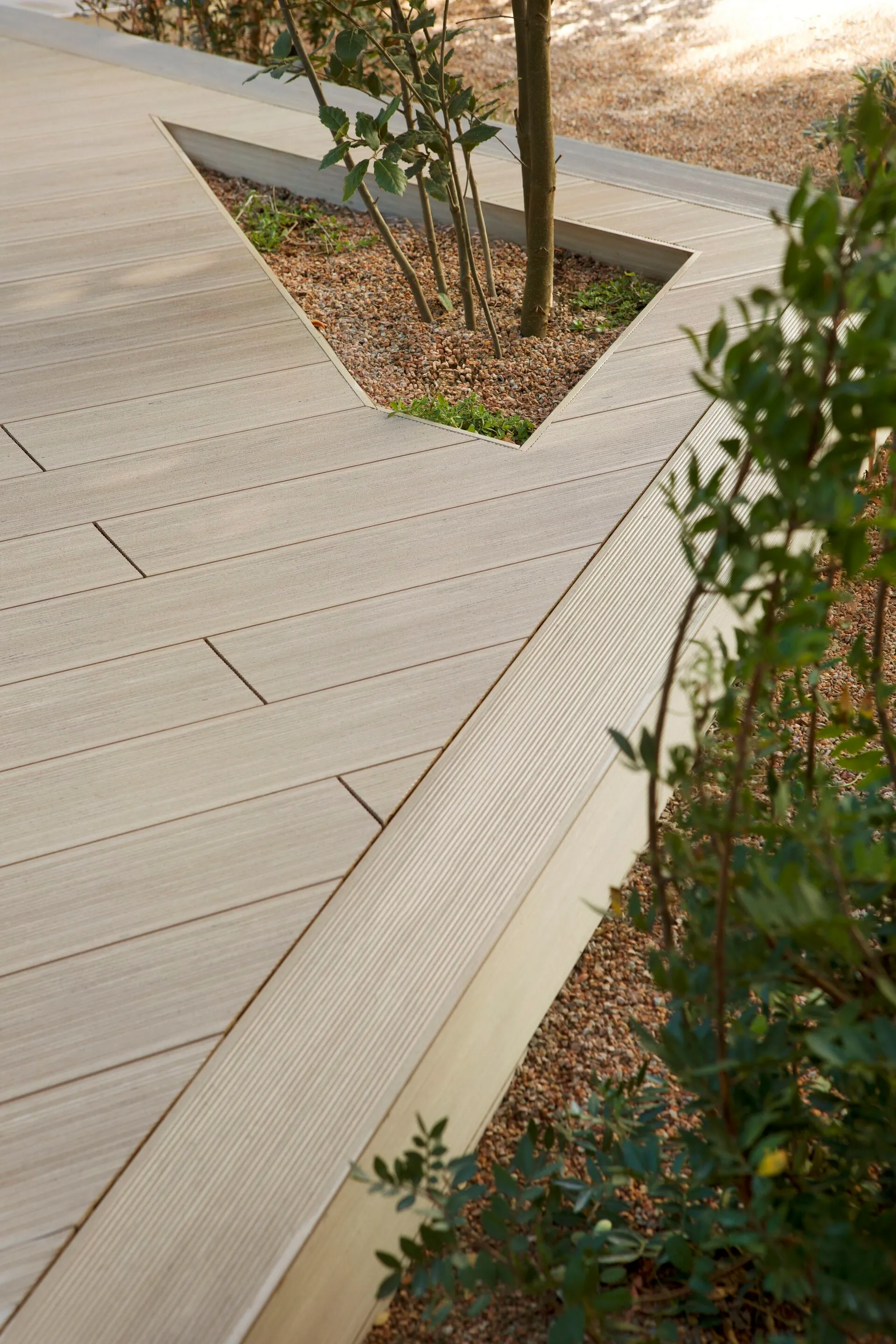
Mould does not eat a composite board. It grows on what lands on the board, which is pollen, leaf tannin and the thin organic film every outdoor surface collects, and that is equally true of wood, PVC, stone and composite. What differs is whether the board itself can be colonised.
Short answer: Mould does not eat a composite board. It grows on what lands on the board, which is pollen, leaf tannin and the thin organic film every outdoor surface collects, and that is equally true of wood, PVC, stone and composite. What differs between products is whether the board itself can be colonised.
You are probably not asking this in the abstract. You are asking because there is a grey-green bloom in the shady corner by the fence, or because the deck you tore out five years ago went black along its north edge and you have no intention of doing that again. That is the right question to bring to a decking supplier, and most of us answer it badly, usually by promising something no material can deliver.
So here is the honest version: what the mould is feeding on, whether the board is part of the meal, which number on a spec sheet tells you anything useful, and what to do on the Saturday morning you find a patch.
Picture a north-facing patio outside Nanaimo in November. Cedar hedge on one side, the house on the other, and a sun angle so low that the morning damp never fully burns off. That patio will grow mould on concrete, on natural stone, on painted wood, on a plastic chair left out since August. The spores are already in the air everywhere in Canada. They need two things to settle in: moisture that lingers, and something organic to eat.
On a deck, that something organic is almost never the deck. It is the film: pollen in May, tannin leaching out of wet leaves in October, road dust, sunscreen, barbecue grease, dog hair. The film builds quietly on any horizontal surface outdoors, and in a corner that stays damp it becomes a growing medium. Which is why the honest answer to "does composite decking get mould" is yes, on the surface, along with everything else outdoors, PVC and stone included.
Here is where materials genuinely part ways, and it is worth knowing before you shop.
Timber is food. That is not a criticism of cedar, it is chemistry, and it is why wood decks want a sealer every couple of years.
Many North American composite boards use wood flour in the core, wrapped in a polymer cap. The cap does a real job on the face, and modern capped products are far better than the uncapped generation that gave composite a bad name. The weak points are the places the cap does not reach: cut ends where a board was trimmed to length, screw penetrations driven through the face, and on some products the underside. Water reaches the wood flour there, and colonisation starts inside the board, where you cannot see it and cannot clean it.
Tarimatec has no wood flour in it. The board is PVC, rice husk and limestone, roughly 100:50:40 parts, which the manufacturer calls Ecofiber Stone Composite and which we describe as a PVC-mineral composite. Two independent fungus tests, one for basidiomycete rot and one for soft rot, return a result of not attackable. Be clear-eyed about what that is: manufacturer lab data, produced to European test practice, not a twenty-year field study on a Canadian lakefront. It tells you the core has nothing fungi want. It tells you nothing at all about the pollen sitting on top of it.
Ask any supplier for the water absorption figure and the standard it was measured to. It quietly predicts most of what happens to a deck in year five, because mould needs water that lingers, and a board that drinks holds moisture inside itself, in the cut end, and around every fastener.
Tarimatec absorbs 0.59 % at 24 hours in the hollow profile and 0.38 % in the solid profile, measured to UNE-EN 317, rising to 1.66 % at 28 days under the same standard. Read that as a board that stays essentially a board after a full day submerged. It is not a claim that water never touches it, and we will not pretend otherwise. It means the water sits on the surface and drains, which is where a soft brush can reach it.
Drainage is the other half of that sentence. The gaps between boards are not a styling choice, they are the path water takes off your deck, and a deck installed tight will hold damp in the seams no matter what the board is made of. Our guide to composite decking expansion gaps covers the spacing side of this in detail.
Think of a Muskoka cottage deck under a pair of old maples. Nobody is there in late October. The leaves come down, get rained on, mat together, and that mat sits on the boards until May. The family opens the place up in spring to black spotting in the exact shape of last autumn. The board did not fail. The housekeeping did, and nobody was there to do it.
| What you are seeing | What is actually causing it | What fixes it |
|---|---|---|
| Grey-green film in a corner that never gets sun | Surface stays damp long enough for spores to settle into the organic film | Soft brush, warm water, mild detergent, then open up the airflow: thin the hedge, move the planter |
| Black spotting under a maple every spring | Tannins and sugars from a wet mat of leaves feeding surface growth all winter | Clear leaf litter through October and before you close the place up |
| Dark lines along the board seams | Grit and organic debris packed into the gaps, holding water in place | Sweep the gaps clear each spring with a thin blade or a stiff brush |
| A musty smell under the frame | No ventilation under the deck and ground moisture with nowhere to go | Keep the underside ventilated and the grade draining, and do not skirt it solid |
| Perfect squares of bloom where the planters were | Objects sitting flat on the board trap water and debris beneath them | Put feet under planters and furniture and shift them a couple of times a season |
| Slick green film near the pool or hot tub | Constant splash-out plus shade, which is a permanently damp surface | Rinse it down regularly and keep the traffic zone clear |
That last row matters more than it looks, because a mouldy film is slippery on any surface. Tarimatec is rated Class 3 and R11 when wet under UNE-ENV 12633, the European wet-pendulum classification where Class 3 is the highest and is what pool surrounds are specified to, but no rating survives a layer of algae. Clean beats certified, every time.
Soft brush. Warm water. A mild detergent. Work along the length of the board, rinse it off, and let it dry. That handles almost everything, and it is the whole maintenance routine for most decks, twice a year.
A few things to avoid, learned the expensive way. Do not run a pressure washer above the limit the manufacturer states, and if you use one at all, fit a wide fan tip and keep the wand well back, moving constantly. A narrow tip held close scores the surface of every composite board on the market, and unlike a timber deck you cannot sand the damage out. No wire brushes, no metal scrapers. Keep de-icing salt off the fixings in winter and use a plastic shovel rather than a metal-edged one, which is practical guidance from us rather than a published rating. And in autumn, sweep. Unglamorous, and the single most effective anti-mould measure there is.
Two things, since you are comparing suppliers. The fungus results above are the manufacturer's own laboratory data to European practice, and we will send you the reports rather than paraphrase them. And Tarimatec does not hold a CAN/ULC S102 flame-spread test or a CCMC evaluation today, while Trex, Deckorators and Fiberon hold CCMC reports. That has nothing to do with mould, but if your project needs a Canadian evaluation on file, better you know now than at submission. The Tarimatec decking range is documented to European standards, and we would rather tell you which paperwork exists than let you assume.
The two independent fungus tests the manufacturer commissioned, one for basidiomycete rot and one for soft rot, both return a result of not attackable, and that is manufacturer lab data rather than a Canadian field study. Mould you see is growing in the film of pollen and leaf debris sitting on top of the board, and it comes off with a soft brush and warm water.
Carefully, and only within the pressure limit the manufacturer states. Use a wide fan tip, keep the wand well back, and work along the length of the board rather than across it. A narrow tip held close will score any composite surface permanently, and unlike wood you cannot sand that out afterwards.
Because that corner is not drying out. Mould needs moisture that lingers, so the fix is airflow rather than a stronger cleaner. Thin the hedge, lift planters and furniture onto feet, keep the board gaps clear so water drains through, and keep the underside of the frame ventilated.
It matters for what happens inside the board rather than on top of it. Tarimatec absorbs 0.59 % at 24 hours in the hollow profile and 0.38 % in the solid profile, measured to UNE-EN 317, so there is very little water held in the board itself and very little for anything to colonise.
Start with warm water, a mild detergent and a soft brush, which handles most surface growth. If you go further than that, dilute it, test a hidden spot first, keep it off nearby planting, and rinse thoroughly. Never take a wire brush or a metal blade to the surface.
If you want to know how a board behaves in your own shade rather than in a photograph, put one there. You can order decking samples, which are paid and ship from Vaughan in five to ten business days, browse the 31 Tarimatec colours and finishes, or request a project quote in CAD. Still building the picture? Our notes on composite decking through a Canadian winter and the plain list of the downsides of composite decking are the next two to read.
{"@context": "https://schema.org", "@type": "FAQPage", "mainEntity": [{"@type": "Question", "name": "Does mould damage a Tarimatec board?", "acceptedAnswer": {"@type": "Answer", "text": "The two independent fungus tests the manufacturer commissioned, one for basidiomycete rot and one for soft rot, both return a result of not attackable, and that is manufacturer lab data rather than a Canadian field study. Mould you see is growing in the film of pollen and leaf debris sitting on top of the board, and it comes off with a soft brush and warm water."}}, {"@type": "Question", "name": "Can I use a pressure washer on composite decking?", "acceptedAnswer": {"@type": "Answer", "text": "Carefully, and only within the pressure limit the manufacturer states. Use a wide fan tip, keep the wand well back, and work along the length of the board rather than across it. A narrow tip held close will score any composite surface permanently, and unlike wood you cannot sand that out afterwards."}}, {"@type": "Question", "name": "Why does mould keep coming back in the same corner?", "acceptedAnswer": {"@type": "Answer", "text": "Because that corner is not drying out. Mould needs moisture that lingers, so the fix is airflow rather than a stronger cleaner. Thin the hedge, lift planters and furniture onto feet, keep the board gaps clear so water drains through, and keep the underside of the frame ventilated."}}, {"@type": "Question", "name": "Does water absorption really matter for mould?", "acceptedAnswer": {"@type": "Answer", "text": "It matters for what happens inside the board rather than on top of it. Tarimatec absorbs 0.59 % at 24 hours in the hollow profile and 0.38 % in the solid profile, measured to UNE-EN 317, so there is very little water held in the board itself and very little for anything to colonise."}}, {"@type": "Question", "name": "Is bleach safe on a composite deck?", "acceptedAnswer": {"@type": "Answer", "text": "Start with warm water, a mild detergent and a soft brush, which handles most surface growth. If you go further than that, dilute it, test a hidden spot first, keep it off nearby planting, and rinse thoroughly. Never take a wire brush or a metal blade to the surface."}}]}