

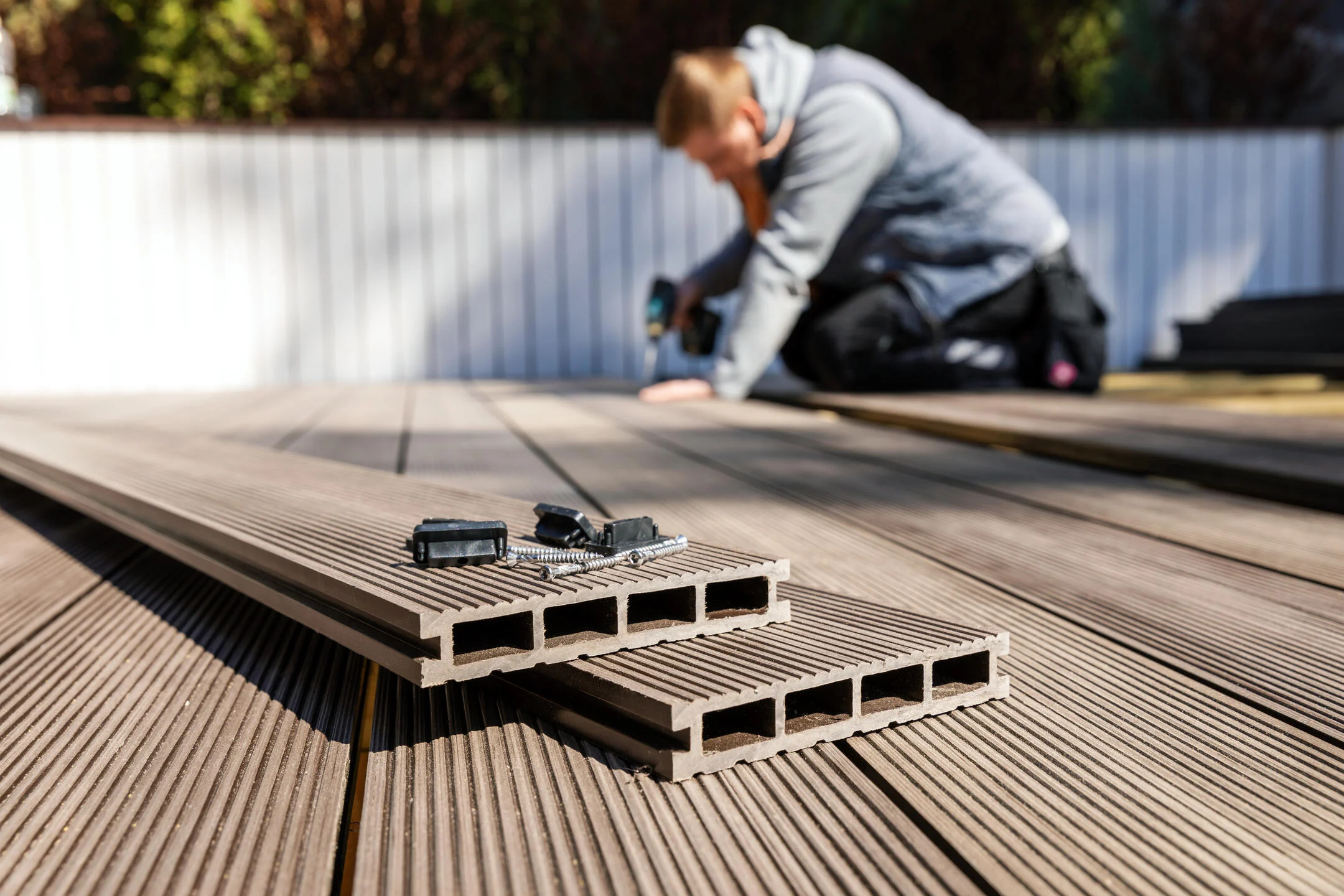
Hidden fasteners give you a deck surface with no screw heads and no penetrations through the face of the board for water to find. You pay for that in system cost and in a slower first install, and you accept that replacing one board mid-deck means working back from an edge.
Short answer: Hidden fasteners give you a deck surface with no screw heads and no penetrations through the face of the board for water to find. You pay for that in system cost and in a slower first install, and you accept that replacing one board mid-deck means working back from an edge.
Most people arrive at this question after standing on someone else's deck and noticing the screws. Two little dots at the end of every board, four hundred of them across the surface, some sunk slightly deeper than others, a couple with a hairline of dark staining creeping out. It looks fine from the kitchen window and it looks like carpentry up close.
So the fair way to answer whether hidden fasteners are a pain or worth it is to describe exactly what you get, exactly what you give up, and where the money goes. Here is that, without the brochure voice.
It is three parts that are designed as one assembly, which matters more than any single component.
The substructure is aluminium, specifically EN AW 6005 T6 alloy joists, set at 350 mm centres. Aluminium does not rot, does not need treating and does not care about the moisture that eventually finds every timber frame. The 350 mm spacing is not a suggestion to be stretched to save on joists, it is the span the board is designed to work over.
The boards are held down by clips in AISI 304L or 316L stainless steel, at 25 clips per square metre. Each clip sits in the groove on the side of the board, screws down into the joist, and locates the next board at a consistent gap. No screw ever goes through the walking surface.
That last sentence is the whole product. On a face-screwed deck you have deliberately made a few hundred holes through the top of a board specifically engineered to resist water, and every one of them is a small path in. Tarimatec absorbs 0.59 % at 24 hours in the hollow profile and 0.38 % in the solid profile, measured to UNE-EN 317, which is a good number to protect rather than perforate.
The first board and the last board still need thought. A clip needs a board on both sides of it, so the perimeter is handled with a starter clip, a trim or an edge detail, and it is the part of the job an inexperienced crew gets wrong. Get it wrong and the deck moves at the edges or shows a fixing exactly where you did not want one.
A mid-deck board replacement means working back from an edge. If a barbecue leg gouges board number fourteen of thirty, you release boards from the nearest edge in sequence until you reach it. That is real, it is slower than backing out two screws, and anyone who tells you otherwise has not done it. The practical answer is to plan for it: on a large deck, design a removable run over any services or any area likely to take a hit.
It costs more than screws. Clips, stainless, aluminium joists and the labour to set them out properly all sit above a timber frame with a box of deck screws on top. That difference is not enormous across a whole project, where substructure, access and site conditions do the heavy lifting on price, but it is real and you should see it on the quote.
And an installer who has never used the system is slower on the first deck. Not much slower on the second. If your contractor is new to it, say so early and let us walk them through the details before they cut anything, which is the entire reason our installation guidance exists.
| Fixing method | Look | Water path | Replacing one board | Cost |
|---|---|---|---|---|
| Face screws, plated or coated | Visible heads in rows, staining likely near salt | Direct penetration through the board face at every screw | Easiest: back out two screws | Lowest |
| Face screws with colour-matched plugs | Better, but plugs read as dots up close and can lift | Same penetration, plug is cosmetic only | Easy once the plugs are out | Low, plus fiddly labour |
| Proprietary clips from wood-fibre composite brands | Clean surface, no visible fixings | None through the face, but the board core is wood-fibre at cut ends | Work back from an edge | Mid |
| Tarimatec clips on aluminium joists | Clean surface, no visible fixings, consistent gapping | None through the face; the board core has no wood flour | Work back from an edge, or plan a removable run | Highest of the four |
Read the last column honestly. We are the most expensive row on that table and we are not going to pretend the difference is imaginary. What you are buying in the other three columns is a surface with nothing driven through it and a frame that will not be the reason the deck fails.
Stand on a Halifax waterfront deck in year three of plated screws and you will see the argument made for you. Salt air does not need a storm to work. It arrives on the wind, settles into every fixing, and starts pulling rust bleed down the face of the board in brown tears that no amount of scrubbing removes, because the stain is coming out of the fastener, not off the surface.
Both AISI 304L and 316L are stainless. The difference is molybdenum in the 316L, which makes it considerably more resistant to pitting corrosion from chlorides. Chlorides is a technical word for the three things that ruin coastal and rooftop fixings: salt spray, pool water, and de-icing salt tracked across a terrace all winter. Inland, away from a pool, 304L is a sensible specification. On the harbour, around a pool, or on a downtown rooftop where somebody will inevitably spread salt in February, specify 316L and treat it as non-negotiable.
One practical note for rooftops and pools, where this system earns its keep: the boards are rated Class 3 and R11 wet under UNE-ENV 12633, the European wet-pendulum classification in which Class 3 is the highest and is what pool surrounds are specified to. A clip system also keeps the fixings out of the standing water that collects on any flat terrace. Our notes on rooftop decking go further into the pedestal and drainage side.
Tarimatec's data is to European standards. There is no CAN/ULC S102 flame-spread test and no CCMC evaluation for it today, while Trex, Deckorators and Fiberon hold CCMC reports, which matters if your project team needs a Canadian evaluation on file. There is also no published cold-temperature rating for the boards, so anything we tell you about February is practical guidance rather than a rating: plastic shovel, no metal blades, no rock salt sitting on the clips, and sand or calcium magnesium acetate for traction.
On a deck you will look at every day, usually yes, because you get an unbroken surface and no screw penetrations through the face for water to find. On a small utility landing you will rarely stand on, probably not. The clip system, the aluminium joists and the extra labour on a first install all cost more than a box of screws, and it is fair to weigh that against the size and prominence of the deck.
The Tarimatec system uses 25 clips per square metre, with the aluminium EN AW 6005 T6 joists set at 350 mm centres. Those two numbers move together, so if your installer widens the joist spacing to save on substructure, the clip count and the support under the board both change, and the deck will not behave as it was designed to.
Yes, but you work back from the nearest edge, releasing boards in sequence until you reach the damaged one. It is slower than backing out two screws. On large decks we suggest planning a removable access run over any services or any area likely to take damage, which turns an afternoon of lifting into a ten-minute job.
Both are stainless. The 316L grade contains molybdenum, which makes it markedly more resistant to pitting from chlorides, meaning salt spray, pool chemistry and de-icing salt carried onto a rooftop. Inland and away from a pool, 304L is generally the sensible choice. Within sight of salt water, specify 316L and do not economise on it.
The clip sets a consistent spacing between boards, which removes the most common source of uneven gapping on a face-screwed deck. It does not remove your responsibility for end gaps, board length and the temperature the deck was installed at, all of which still have to be planned properly for the site.
If you are pricing a deck, the fixing system is the part most quotes bury, so ask for it line by line. You can see the Tarimatec decking range and the clip and joist accessories that go with it, order decking samples, which are paid and ship from Vaughan in five to ten business days, or request a project quote in CAD. Before your installer sets out the first joist, read our guide to installing composite decking in Canada and the one on composite decking expansion gaps, because those two decisions outlive every other choice on the job.
{"@context": "https://schema.org", "@type": "FAQPage", "mainEntity": [{"@type": "Question", "name": "Are hidden fasteners worth the extra cost?", "acceptedAnswer": {"@type": "Answer", "text": "On a deck you will look at every day, usually yes, because you get an unbroken surface and no screw penetrations through the face for water to find. On a small utility landing you will rarely stand on, probably not. The clip system, the aluminium joists and the extra labour on a first install all cost more than a box of screws, and it is fair to weigh that against the size and prominence of the deck."}}, {"@type": "Question", "name": "How many clips does a hidden-fastener deck need?", "acceptedAnswer": {"@type": "Answer", "text": "The Tarimatec system uses 25 clips per square metre, with the aluminium EN AW 6005 T6 joists set at 350 mm centres. Those two numbers move together, so if your installer widens the joist spacing to save on substructure, the clip count and the support under the board both change, and the deck will not behave as it was designed to."}}, {"@type": "Question", "name": "Can you replace one board in the middle of a hidden-fastener deck?", "acceptedAnswer": {"@type": "Answer", "text": "Yes, but you work back from the nearest edge, releasing boards in sequence until you reach the damaged one. It is slower than backing out two screws. On large decks we suggest planning a removable access run over any services or any area likely to take damage, which turns an afternoon of lifting into a ten-minute job."}}, {"@type": "Question", "name": "What is the difference between AISI 304L and 316L stainless clips?", "acceptedAnswer": {"@type": "Answer", "text": "Both are stainless. The 316L grade contains molybdenum, which makes it markedly more resistant to pitting from chlorides, meaning salt spray, pool chemistry and de-icing salt carried onto a rooftop. Inland and away from a pool, 304L is generally the sensible choice. Within sight of salt water, specify 316L and do not economise on it."}}, {"@type": "Question", "name": "Do hidden fasteners set the expansion gaps for me?", "acceptedAnswer": {"@type": "Answer", "text": "The clip sets a consistent spacing between boards, which removes the most common source of uneven gapping on a face-screwed deck. It does not remove your responsibility for end gaps, board length and the temperature the deck was installed at, all of which still have to be planned properly for the site."}}]}