

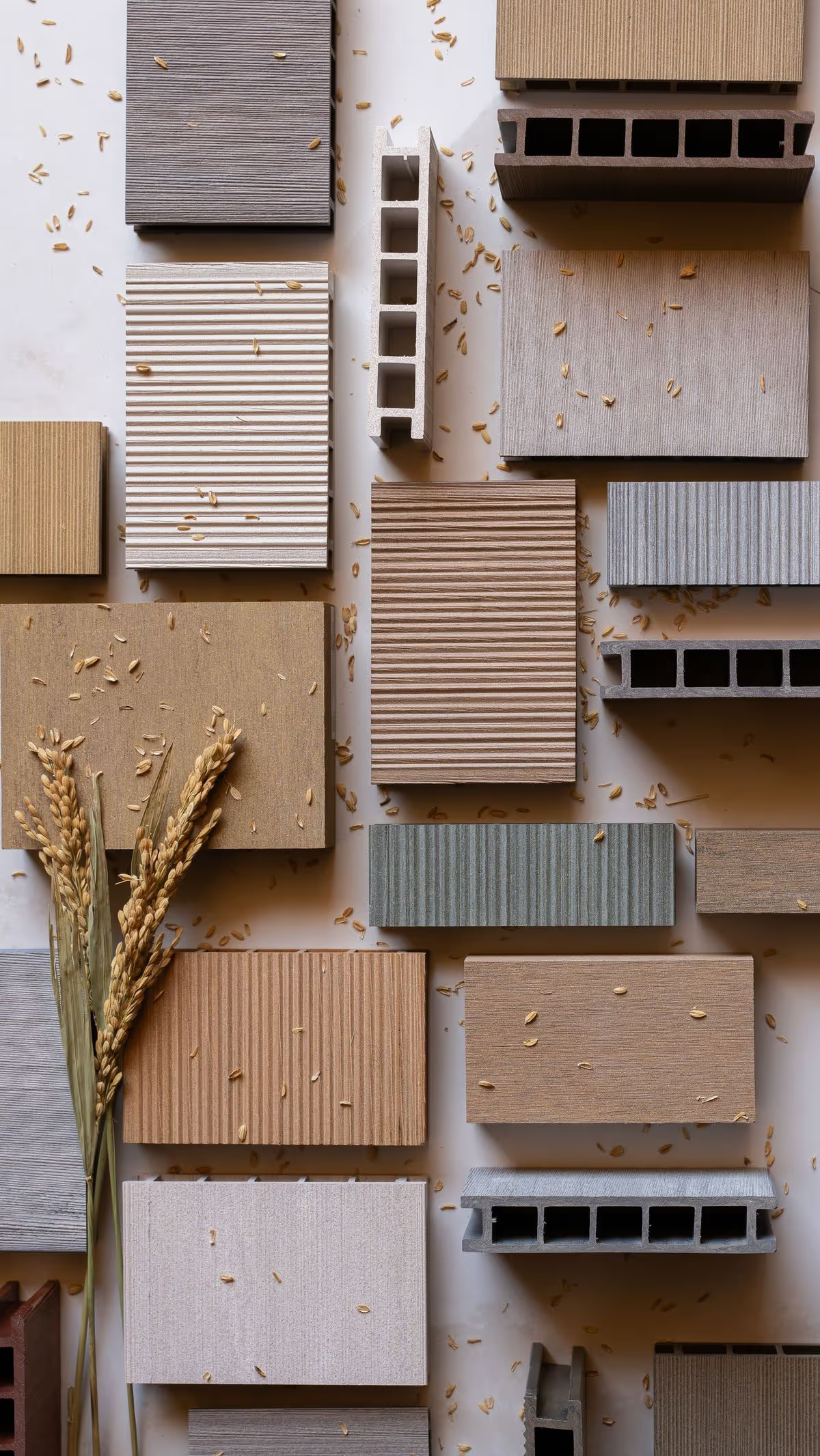
All pigmented outdoor materials change slightly in their first year of sun and then settle. Tarimatec publishes one measured figure, a colour change of Delta E 1.25 from salt-spray exposure testing, and we present it as laboratory data rather than a promise. We do not publish a fade-warranty number, and we will not invent one.
Short answer: All pigmented outdoor materials change slightly in their first year of sun and then settle. Tarimatec publishes one measured figure, a colour change of Delta E 1.25 from salt-spray exposure testing, and we present it as lab data rather than a promise. We do not publish a fade-warranty number, and we will not invent one.
You are asking this because you have seen it happen. A neighbour's deck that was a warm brown in its first summer and is now a flat grey-brown. A dark board with a pale rectangle where the planter sat for two years. Whatever the salesperson said at the time, the deck in front of you did not stay the colour it started.
So this post is going to be careful. We supply the Tarimatec decking range across Canada, and on colour retention we have exactly one published number and a lot of honest context. You will get both, and you will also get a plain comparison of what the big North American brands actually put in writing, including the places where they are ahead of us.
Ultraviolet light. That is the mechanism, and it is worth understanding because the folklore around it is wrong.
UV energy breaks chemical bonds in the pigments and in the polymer at the very top layer of the surface. The damage is measured in microns, not millimetres, which is why the underside of a board that has been in the sun for a decade still looks new when you flip it over. It is the same process that dulls a car roof faster than its doors, that turns patio cushions chalky, and that shifts the colour of a fence board on its south face while the north face holds.
Note what is not driving this. It is not cheapness. Every outdoor product that carries a pigment is in the same fight, and the difference between products is how much stabiliser and UV-resistant pigment technology went into the formulation, not whether a manufacturer cared. Rain does not fade a deck. Snow does not fade a deck. Sun fades decks, and the sunniest, most exposed part of your deck will always be a step ahead of the rest.
Picture a Regina backyard in July, sixteen hours of daylight and no shade taller than the fence. That deck is taking a heavier UV dose in one prairie summer than a shaded Vancouver Island patio takes in three. Two identical decks, two different outcomes, and the board did not change.
Tarimatec publishes a measured colour change of Delta E 1.25 from salt-spray exposure testing. That is a laboratory result from a specific standardised test, and we would rather explain it properly than let it float free in a headline.
Delta E, written as a triangle followed by an E, is the standard way of expressing how different two colours are as a single number. Smaller means closer. The rule of thumb most colour professionals use is that a Delta E of about one sits around the threshold of what a trained eye can detect when the two samples are side by side under controlled light, and that anything below about two is difficult to notice in ordinary conditions.
So a Delta E of 1.25 after salt-spray exposure is a good result, and it is real, measured data. Here is what it is not. It is not a warranty. It is not a rate of fade per year. It is not a UV weathering result, because a salt-spray chamber is testing something else. And it is not a description of what a deck looks like after eight Canadian summers, because nobody has run that test on this board and published it.
If salt is your environment specifically, that figure is directly relevant. A Halifax waterfront deck takes salt spray off the harbour every windy day of the year, and a measured Delta E of 1.25 through salt-spray exposure is exactly the kind of evidence worth having on that project. For sun in Saskatchewan, it is context, not proof.
Here is the comparison, and we have written it the way we would want it written about us. Warranty language changes by product line and by year, so confirm the current document for the exact board you are quoted.
| Brand | What is published on fade and stain | The honest read |
|---|---|---|
| Trex | Limited warranties of 25 to 50 years depending on the line, transferable once within the first five years | Long coverage, and a clear transfer rule. Check the fade-and-stain terms in the warranty document for the specific line you are buying |
| TimberTech | A published fade and stain warranty alongside a 50-year residential limited warranty that is pro-rated on a declining schedule, from 90 per cent recovery in years 11 to 14 down to 10 per cent in years 43 to 50 | The most explicit fade-and-stain paperwork of the group. Read the declining schedule carefully, because the headline number and the recoverable value are not the same thing |
| Fiberon | Tiered warranties of 25 to 50 years depending on product tier | Coverage scales with how much you spend. The entry tier and the top tier are different promises |
| Tarimatec, through Zinodeck | No published fade-warranty number. A 25-year manufacturer warranty from Tarimatec, administered in Canada by Zinodeck, excluding damage from weight overload. One measured colour result: Delta E 1.25 from salt-spray exposure testing | Measured data instead of a fade promise. On published fade-and-stain warranty language specifically, TimberTech and Trex give you more than we do, and we would rather you knew that from us |
It would be easy to write a sentence claiming the boards hold their colour for a set number of years. Plenty of decking marketing does. We are not going to, for a boring reason: we would have no way to support it, and you would have no way to check it.
A fade warranty is a commercial promise with a claims process behind it, not a property of a material. Tarimatec's Canadian coverage is the 25-year manufacturer warranty administered by Zinodeck, and it excludes damage from weight overload. If a written fade-and-stain warranty is what will let you sleep at night, buy the brand that publishes one. That is a completely reasonable way to choose, and we would rather lose the sale than win it on a number we made up.
There is one test that beats every brochure in this category, and it takes a summer and almost no effort.
What you see is your answer, for your exposure, in your colour. Note also which one you prefer, because a settled, slightly softened tone is not automatically worse than a factory-fresh one, and plenty of people like the settled version better once the deck is furnished. If you are still choosing, browse the 31 Tarimatec colours and finishes and pick two candidates, not one. Mid-tones and textured finishes tend to carry small changes more gracefully than a flat, very dark surface, and darker boards also run hotter, which we cover in our post on whether composite decking gets hot.
Ultraviolet light does. UV breaks down the pigments and the polymer at the very top of the surface, which is why colour change happens on the sun-facing side of a deck and not underneath it. It is a physics problem that every pigmented outdoor material shares, from decking to car paint to patio cushions, and it is not evidence that a board was made cheaply.
Delta E, written as a triangle followed by an E, is a single number describing the total perceived difference between two colours. Smaller is closer. As a widely used rule of thumb, a difference of about one is around the smallest change a trained observer can pick out side by side in controlled light, and differences below roughly two are hard to see in normal conditions.
Tarimatec publishes a colour change of Delta E 1.25 from salt-spray exposure testing. That is a measured laboratory result from a specific test, and we present it as exactly that. It is not a warranty figure, it is not a per-year fade rate, and it does not describe years of Canadian sun.
Because we do not have one, and inventing a number would be worse than admitting the gap. Tarimatec's coverage is a 25-year manufacturer warranty from Tarimatec, administered in Canada by Zinodeck, which excludes damage from weight overload. If a published fade-and-stain warranty is decisive for you, TimberTech and Trex publish more paper on that point than we do.
Most pigmented outdoor materials shift slightly during the first season of full exposure and then settle, so the change from year one to year two is usually far smaller than the change from new to year one. Plan for a slight settling rather than a dramatic loss, and judge the deck at the end of the first summer rather than in week three.
Order two samples of the same colour. Leave one outside on the exact spot where the deck will go, facing the sun, and keep the other indoors in a drawer. Compare them side by side after a full summer. That single test will tell you more than any number on any brochure, ours included.
The next step here is the sample test, not more reading. Order decking samples, which are paid and ship from Vaughan, Ontario in 5 to 10 business days, leave one out for a summer, and judge the colour with your own eyes. When you are ready, request a project quote in CAD. Boards are import-to-order on an 8 to 12 week lead time, so start the colour conversation a season before you want to build. If you are also weighing winter behaviour, our guide to composite decking in a Canadian winter is the honest companion to this one.
{"@context": "https://schema.org", "@type": "FAQPage", "mainEntity": [{"@type": "Question", "name": "What actually causes composite decking to fade?", "acceptedAnswer": {"@type": "Answer", "text": "Ultraviolet light does. UV breaks down the pigments and the polymer at the very top of the surface, which is why colour change happens on the sun-facing side of a deck and not underneath it. It is a physics problem that every pigmented outdoor material shares, from decking to car paint to patio cushions, and it is not evidence that a board was made cheaply."}}, {"@type": "Question", "name": "What does a Delta E number mean in plain English?", "acceptedAnswer": {"@type": "Answer", "text": "Delta E, written as a triangle followed by an E, is a single number describing the total perceived difference between two colours. Smaller is closer. As a widely used rule of thumb, a difference of about one is around the smallest change a trained observer can pick out side by side in controlled light, and differences below roughly two are hard to see in normal conditions."}}, {"@type": "Question", "name": "What is Tarimatec's published colour-change figure?", "acceptedAnswer": {"@type": "Answer", "text": "Tarimatec publishes a colour change of Delta E 1.25 from salt-spray exposure testing. That is a measured laboratory result from a specific test, and we present it as exactly that. It is not a warranty figure, it is not a per-year fade rate, and it does not describe years of Canadian sun."}}, {"@type": "Question", "name": "Why does Zinodeck not publish a fade warranty?", "acceptedAnswer": {"@type": "Answer", "text": "Because we do not have one, and inventing a number would be worse than admitting the gap. Tarimatec's coverage is a 25-year manufacturer warranty from Tarimatec, administered in Canada by Zinodeck, which excludes damage from weight overload. If a published fade-and-stain warranty is decisive for you, TimberTech and Trex publish more paper on that point than we do."}}, {"@type": "Question", "name": "Will my deck keep fading every year?", "acceptedAnswer": {"@type": "Answer", "text": "Most pigmented outdoor materials shift slightly during the first season of full exposure and then settle, so the change from year one to year two is usually far smaller than the change from new to year one. Plan for a slight settling rather than a dramatic loss, and judge the deck at the end of the first summer rather than in week three."}}, {"@type": "Question", "name": "How should I test a sample for colour retention?", "acceptedAnswer": {"@type": "Answer", "text": "Order two samples of the same colour. Leave one outside on the exact spot where the deck will go, facing the sun, and keep the other indoors in a drawer. Compare them side by side after a full summer. That single test will tell you more than any number on any brochure, ours included."}}]}